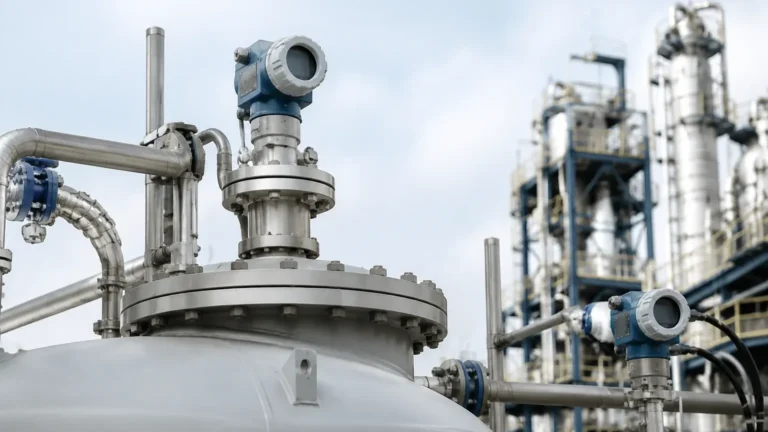
Kobold Radar Level Transmitter
Engineering Guide to Kobold Radar Level Transmitters: Principles, Selection, and Application
In the field of industrial process automation, precise level measurement is a fundamental requirement for inventory management, safety, and process efficiency. Among the various technologies available, radar-based systems have emerged as a gold standard due to their non-contact nature and relative immunity to changes in process temperature, pressure, and vapor composition. The Kobold radar level transmitter represents a significant segment of this market, offering specialized solutions for both liquid and solid media. This guide provides a detailed engineering analysis of radar measurement principles, selection criteria for Kobold instrumentation, and critical installation considerations for industrial environments.
Understanding Radar Level Measurement Principles
Before selecting a specific Kobold radar level transmitter, it is essential to understand the physics of electromagnetic wave propagation used in level sensing. Radar instruments operate on the "Time of Flight" (ToF) principle. The device emits high-frequency electromagnetic pulses (or a continuous wave) toward the product surface. These waves travel at the speed of light, reflect off the surface of the medium, and return to the sensor antenna.
Pulse Radar vs. FMCW
Most industrial radar sensors, including many in the Kobold portfolio, utilize one of two primary modulation techniques:
1. Pulse Radar: The transmitter emits a short microwave pulse and measures the time interval until the echo is received. This method is energy-efficient and suitable for many standard liquid applications.
2. Frequency Modulated Continuous Wave (FMCW): The transmitter emits a continuous signal with a constantly changing frequency. The distance is calculated based on the frequency difference between the transmitted and received signals at any given moment. FMCW is generally preferred for high-accuracy requirements and applications involving solids or turbulent surfaces because it provides a better signal-to-noise ratio.
The Role of Dielectric Constant (εr)
The reliability of a radar measurement is heavily dependent on the dielectric constant of the medium. The dielectric constant determines how much of the electromagnetic energy is reflected back to the sensor versus how much is absorbed or transmitted through the material. Media with high dielectric constants (e.g., water, εr ≈ 80) provide strong reflections, while hydrocarbons or plastic pellets (εr < 3) provide much weaker signals. When specifying Radar Level Meters, engineers must ensure the chosen device has the sensitivity required for the medium's specific εr value.
The Kobold Radar Level Transmitter Range
Kobold offers several series of radar transmitters designed to meet different industrial challenges. These generally fall into two categories: Guided Wave Radar (GWR) and Free-Space (Non-contact) Radar.
Guided Wave Radar (GWR) – NGR Series
The NGR series utilizes Time Domain Reflectometry (TDR). In this setup, the microwave pulse is guided along a probe (rod, cable, or coaxial tube) directly into the medium. This technology is highly effective for liquids with low dielectric constants or applications where foam and internal tank obstructions would interfere with a free-space signal.
Free-Space Radar – NRF Series
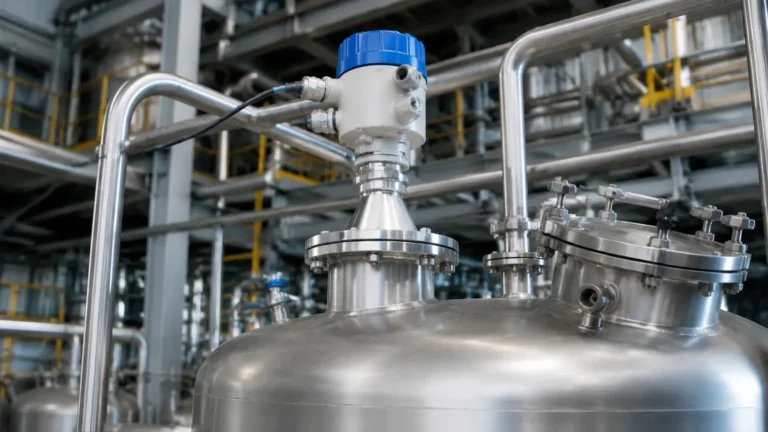
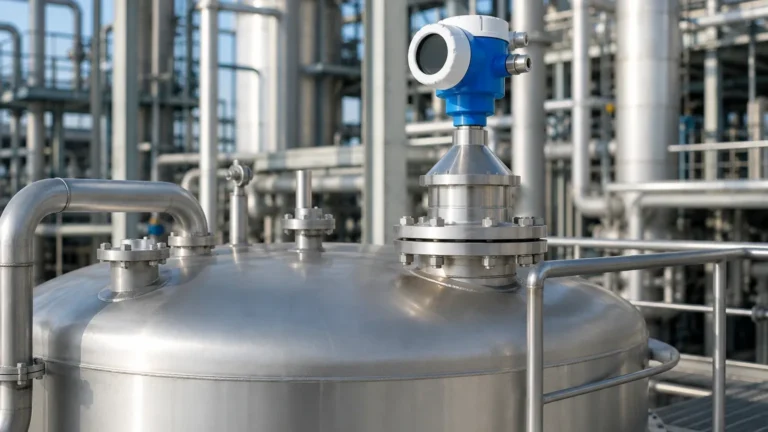
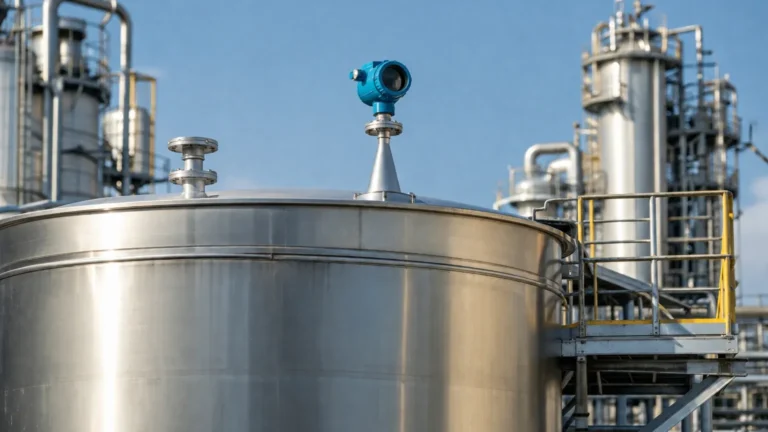
The NRF series represents the non-contact approach. These units are mounted at the top of the vessel and emit waves through the air. They are ideal for corrosive media where the sensor should not touch the product, or for high-temperature applications where a probe would be a liability.
Technical Selection Criteria
Selecting the correct Kobold radar level transmitter requires a systematic evaluation of the process environment. The following table outlines the primary considerations for engineering selection:
| Feature | Guided Wave Radar (e.g., NGR) | Free-Space Radar (e.g., NRF) |
| :— | :— | :— |
| Measurement Range | Up to 4 meters (Rod), 20 meters (Cable) | Up to 30+ meters (depending on model) |
| Media Suitability | Liquids, bypass chambers, interface | Liquids, heavy solids, corrosive acids |
| Effect of Foam | Minimal; pulse stays on the probe | Can attenuate or scatter the signal |
| Internal Obstructions | Not affected if probe is clear | Requires clear "Line of Sight" |
| Dielectric Minimum | Very low (εr ≥ 1.4) | Moderate (εr ≥ 1.9 to 2.1) |
| Process Connection | G ¾, 1" NPT, Flanges | Threaded or Flanged |
Frequency Selection
Frequency is a critical factor in non-contact radar. Kobold transmitters often operate in different bands:
* C-Band (~6 GHz): Better for applications with heavy steam or dust, as the longer wavelength can penetrate these particles.
* K-Band (~24-26 GHz): A standard for most liquid applications, offering a balance between beam focus and signal strength.
* W-Band (~80 GHz): Provides an extremely narrow beam angle, which is ideal for small vessels with internal obstructions or for measuring through narrow nozzles.
Installation Guidelines and Constraints
Correct installation is the most significant factor in the long-term reliability of a radar level transmitter. Even the most advanced Kobold radar level transmitter will fail if basic microwave physics are ignored during mounting.
Nozzle Geometry
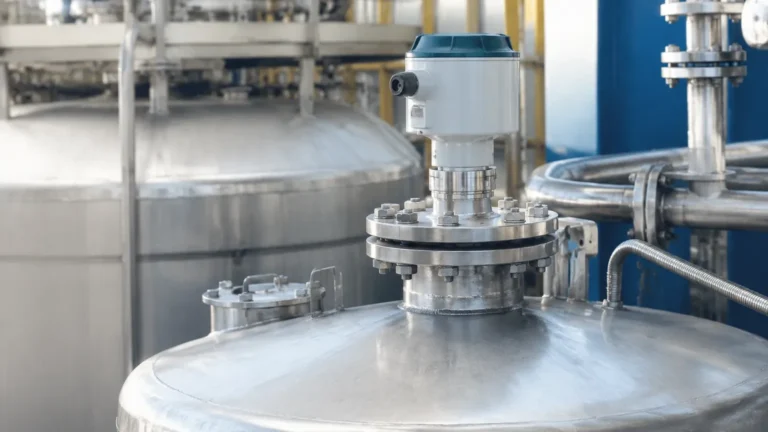
The mounting nozzle should be as short and wide as possible. If the nozzle is too long or narrow, the radar signal will reflect off the nozzle walls (ringing), creating a "dead zone" at the top of the tank. For non-contact radar, the antenna should ideally extend slightly past the bottom of the nozzle to prevent interference.
Beam Path and Obstructions
Radar waves spread out in a cone. Any internal structure—such as ladders, heating coils, or agitators—within this cone will create parasitic echoes.
* Distance from Wall: Always mount the sensor at least 200mm to 500mm away from the tank wall to avoid side-wall reflections.
* Agitators: If an agitator is present, the software in the Kobold transmitter can often be configured with a "False Echo Suppression" map to ignore the stationary parts of the tank, but the beam should still avoid the main path of the moving blades if possible.
Orientation
For liquid applications, the transmitter must be mounted perfectly vertical (perpendicular to the liquid surface). For bulk solids, an aiming flange may be required to tilt the sensor, as the material often forms a cone with a specific angle of repose, which can deflect the radar signal away from the receiver.

Limitations and Application Risks
While radar is versatile, it is not a universal solution. Engineers should be aware of the following risks:
1. Heavy Foam: Dense, thick foam (like shaving cream) can completely absorb a radar signal, leading to a "Loss of Echo" (LOE) error. In these cases, Guided Wave Radar or ultrasonic sensors may be more appropriate depending on the foam density.
2. Vacuum Conditions: While radar works in a vacuum, the seals and process connections must be specifically rated for vacuum service to prevent air ingress or sensor damage.
3. Extremely Low Dielectrics: For materials like liquid nitrogen or certain dry powders, the reflection may be too weak for standard free-space radar. A coaxial GWR probe is usually the technical recommendation here.
4. Condensation: Heavy condensation on the antenna lens can attenuate the signal. Some Kobold models feature PTFE or PP covers to minimize droplet formation, but in extreme cases, an air purge system may be necessary.
Maintenance and Troubleshooting
Radar transmitters are generally low-maintenance because they have no moving parts. However, in industrial B2B environments, the following maintenance steps are recommended:
* Visual Inspection: Check for buildup on the antenna or probe. While radar can "see through" thin layers of non-conductive buildup, heavy metallic or conductive coating will cause measurement errors.
* Signal Quality Monitoring: Most modern Kobold units provide a signal strength or "Echo Curve" diagnostic. Monitoring the signal-to-noise ratio over time can predict when cleaning or recalibration is required.
* Firmware Updates: Ensure the signal processing algorithms are up to date, especially if the process medium or tank internals have changed.
Frequently Asked Questions (FAQ)
Q: Can a Kobold radar level transmitter measure interface between two liquids?
A: Yes, Guided Wave Radar (GWR) models are specifically capable of measuring the interface between a lower-dielectric upper fluid (like oil) and a higher-dielectric lower fluid (like water), provided the upper layer is non-conductive.
Q: How does temperature affect the accuracy of the radar?
A: Unlike ultrasonic sensors, which depend on the speed of sound (which changes with air density and temperature), radar waves are electromagnetic. Their speed is constant regardless of air temperature, making radar much more accurate in fluctuating thermal environments.
Q: What is the "Blocking Distance"?
A: Also known as the Dead Band, this is the area immediately below the sensor where measurement is not possible. For Kobold transmitters, this typically ranges from 50mm to 300mm depending on the frequency and antenna type.
Q: Is it possible to use radar in pressurized vessels?
A: Yes, radar is well-suited for pressurized tanks. However, the process connection and the seal (often a glass or ceramic feed-through) must be rated for the specific pressure and temperature of the vessel.
Conclusion
The Kobold radar level transmitter series provides a robust solution for complex industrial level sensing. By understanding the dielectric properties of the medium and adhering to strict installation geometry, engineers can implement a measurement system that offers high precision and minimal maintenance. Whether choosing the NGR for narrow-space liquid interface or the NRF for non-contact solids measurement, matching the technology to the specific process constraints is the key to operational success. For further technical specifications and model comparisons, engineers should consult detailed documentation on modern Radar Level Meters to ensure the selected hardware meets the required safety and performance standards.