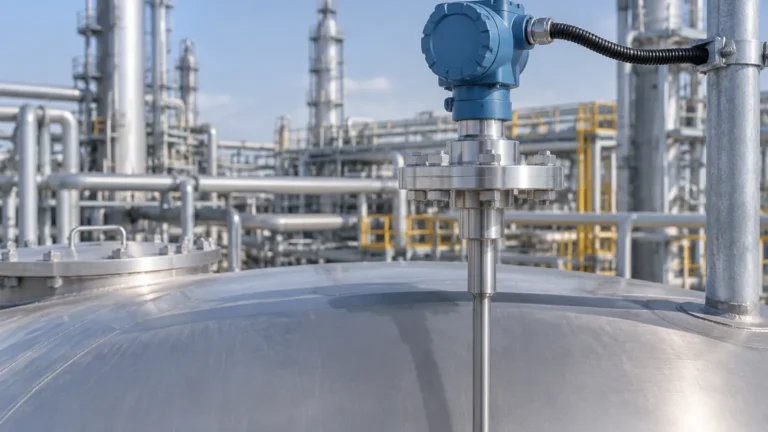
Sitrans Lr120 Radar Level Transmitter
Sitrans LR120 Radar Level Transmitter: A Technical Engineering Guide
In the field of industrial automation, the demand for precise and maintenance-free level measurement has led to a significant shift from traditional contact-based methods to non-contact radar technology. Among the specialized instruments in this category, the sitrans lr120 radar level transmitter represents a modern approach to liquid and solid level monitoring, specifically designed for applications where space is limited and reliability is paramount. This guide provides a technical analysis of its operating principles, selection criteria, and installation requirements within the broader context of Radar Level Meters.
Understanding Radar Measurement Principles
Before selecting a specific instrument like the sitrans lr120 radar level transmitter, it is essential to understand the underlying technology that governs its performance. Radar level measurement generally falls into two categories: Pulse Radar and Frequency Modulated Continuous Wave (FMCW) radar.
Frequency Modulated Continuous Wave (FMCW)
The SITRANS LR120 utilizes FMCW technology operating at a high frequency of 80 GHz. Unlike pulse radar, which measures the time-of-flight of a single microwave burst, FMCW transmitters emit a continuous signal with a constantly changing frequency (a frequency ramp).
1. Signal Emission: The transmitter sends out a continuous microwave signal that increases in frequency over a specific period.
2. Reflection: The signal hits the surface of the medium and reflects back to the sensor.
3. Frequency Shift: Because the transmitter is still sweeping through its frequency ramp while the signal is traveling, the reflected signal will have a different frequency than the signal being emitted at the exact moment of reception.
4. Distance Calculation: The difference between these two frequencies (the beat frequency) is directly proportional to the distance to the material surface.
The Advantage of 80 GHz Technology
The choice of 80 GHz (W-band) frequency is a critical technical specification for the sitrans lr120 radar level transmitter. Higher frequencies result in shorter wavelengths, which allow for a much narrower beam angle from a smaller antenna. While older 6 GHz or 24 GHz Radar Level Meters might require large horn antennas to achieve a 10-degree beam, an 80 GHz sensor can achieve a 4-degree beam with a lens antenna only a few centimeters in diameter. This narrow beam is vital for avoiding internal tank obstructions like agitators, ladders, or heating coils.
Technical Profile of the SITRANS LR120
The SITRANS LR120 is an integrated, compact radar transmitter designed primarily for the water and wastewater industry, as well as simple chemical applications. Its design prioritizes ease of deployment and durability in harsh environments.
Key Specifications
* Measurement Range: Up to 15 meters (49.2 ft).
* Accuracy: ±2 mm (0.08 inches).
* Beam Angle: 4 degrees, allowing for installation in narrow vessels or close to tank walls.
* Process Temperature: -40 to +80 °C (-40 to +176 °F).
* Process Pressure: -1 to 3 bar (up to 43.5 psi).
* Communication: 4-20 mA with HART or Modbus RTU.
* Enclosure Rating: IP66/IP68, suitable for submersion and outdoor exposure.
The device is typically constructed from PVDF (Polyvinylidene fluoride), a highly non-reactive thermoplastic that provides excellent resistance to acids, solvents, and hydrocarbons. This makes the sitrans lr120 radar level transmitter suitable for chemical storage tanks where corrosive vapors might degrade other materials.
Selection Criteria and Comparative Analysis
When evaluating Radar Level Meters for a project, engineers must match the instrument's capabilities to the physical and chemical properties of the process. The following table outlines the selection parameters for the LR120 compared to general industrial requirements.
| Parameter | SITRANS LR120 Capability | Industrial Requirement Consideration |
| :— | :— | :— |
| Dielectric Constant ($ε_r$) | Suitable for $ε_r > 2$ | Low $ε_r$ materials (like oils) reflect less signal. |
| Surface Turbulence | High frequency handles ripples well | Heavy foam may require lower frequency or guided wave. |
| Vessel Geometry | Narrow 4° beam for tight spaces | Wide beams may cause false echoes from walls. |
| Mounting Connection | 1.5" NPT/BSP Thread | Ensure compatibility with existing tank nozzles. |
| Power Supply | 2-wire loop powered (HART) | Check PLC/DCS input card compatibility. |
When to Choose the LR120
This specific transmitter is ideal for "standard" industrial applications. If the application involves extremely high pressures (e.g., >40 bar) or temperatures exceeding 200°C, a more robust, flange-mounted radar system would be necessary. However, for open-channel flow, lift stations, and plastic storage tanks, the LR120 offers a cost-effective balance of precision and durability.
Installation Guidelines and Constraints
Correct installation is the most significant factor in the long-term accuracy of any radar level meter. Even the most advanced 80 GHz system can fail if basic physics is ignored.
Positioning and Clearance
1. Avoid the Center: Do not mount the transmitter in the exact center of a dome-roofed tank. This can cause multiple reflections that amplify noise and interfere with the primary signal.
2. Nozzle Height: The antenna should ideally extend slightly beyond the mounting nozzle to prevent "ringing" or internal reflections within the nozzle itself. If the nozzle is long, ensure the 4-degree beam does not hit the nozzle walls.
3. The Dead Zone: Every radar has a "blocking distance" or dead zone near the sensor face (typically around 250 mm or 10 inches for the LR120). Level measurements cannot be accurately taken within this range.
4. Obstruction Clearance: Maintain a clear path to the liquid surface. While the 4-degree beam is narrow, any metal object within that cone will reflect a signal that the transmitter must filter out using "Auto False Echo Suppression."
Environmental Considerations
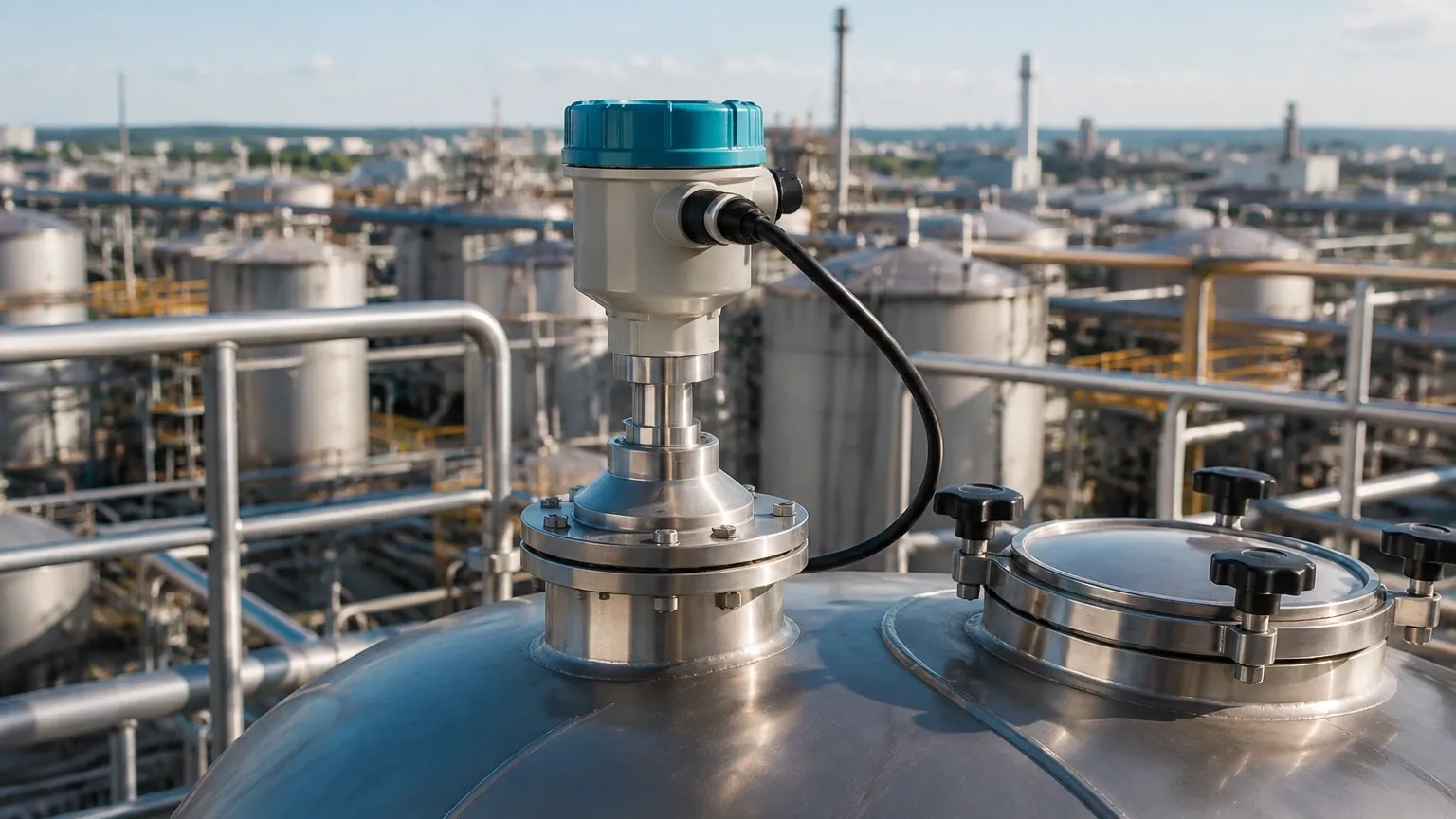
While the sitrans lr120 radar level transmitter is rated for IP68, condensation on the lens can occasionally attenuate the signal. The 80 GHz frequency is generally better at "seeing through" light condensation than lower frequencies, but in heavy steaming applications, a specialized lens or a purging system might be required. For the LR120, the flat-faced PVDF lens is designed to shed droplets, but it should be inspected periodically in high-fat or high-oil environments where buildup might occur.
Application Risks and Limitations
Engineers must be aware of the limitations of non-contact radar to avoid common pitfalls in the field.
* Heavy Foam: Radar signals are often absorbed or scattered by thick, dense foam (like that found in some wastewater treatment aeration tanks). If the foam is light and airy, the radar may see through it to the liquid. If the foam is dense and conductive, the radar might trigger off the top of the foam. In cases of persistent heavy foam, a guided wave radar or a hydrostatic pressure transmitter may be more reliable.
* Vacuum Applications: While radar works in a vacuum (unlike ultrasonic sensors which require a medium for sound travel), the seals and housing of the LR120 are rated for specific pressure ranges. Ensure the vessel does not exceed the -1 to 3 bar limit.
* Dust and Solids: The LR120 can be used for solids, but its range is significantly reduced compared to liquids. For tall grain silos or cement bunkers, a high-power solids-specific radar is usually preferred over a compact liquid-centric model.
Maintenance and Commissioning
One of the primary benefits of the sitrans lr120 radar level transmitter is its support for Bluetooth commissioning. Using an app (such as SITRANS mobile IQ), technicians can configure the device from a distance of up to 10 meters (33 ft). This is a significant safety advantage, as it removes the need for personnel to climb onto tank tops or enter hazardous areas just to check a reading or adjust a parameter.
Maintenance Checklist
* Visual Inspection: Check the PVDF lens for material buildup or scaling.
* Signal Strength: Monitor the "Confidence" or "Echo Strength" value via HART. A gradual drop in signal strength often indicates lens coating or a changing dielectric constant in the process.
* Firmware Updates: Ensure the signal processing algorithms are up to date to take advantage of improved false-echo suppression.
Frequently Asked Questions (FAQ)
Q: Can the SITRANS LR120 be used on plastic tanks?
A: Yes. Radar signals can penetrate plastic and fiberglass. It is possible to mount the transmitter above a plastic tank and measure the level through the tank roof, provided the plastic is not carbon-filled or metallic-lined. However, this will result in some signal loss.
Q: How does the LR120 handle agitators?
A: The 4-degree beam angle helps avoid hitting agitator blades. Additionally, the transmitter's software includes "False Echo Suppression," which allows the user to map out static reflections from internal tank structures, telling the sensor to ignore them.
Q: What is the minimum dielectric constant required?
A: The LR120 typically requires a dielectric constant ($ε_r$) of 2.0 or higher for reliable measurement at its full 15-meter range. For materials with lower $ε_r$, the effective range may be reduced, and careful commissioning is required.
Q: Is it compatible with older PLC systems?
A: Yes, the 4-20 mA analog output is a universal industrial standard. For more data-intensive applications, the HART protocol allows for remote diagnostics and multi-variable reporting over the same two wires.
Conclusion
The sitrans lr120 radar level transmitter is a specialized tool within the category of Radar Level Meters that addresses the need for compact, high-frequency measurement in the water and chemical sectors. By leveraging 80 GHz FMCW technology, it provides engineers with a narrow-beam solution that simplifies installation and reduces the risk of interference. When selected based on a thorough understanding of the process dielectric, temperature, and vessel geometry, it serves as a highly reliable component in modern industrial automation architectures.