Ultrasonic Level Sensor for Septic Tank
Ultrasonic Level Sensor for Septic Tank: A Comprehensive Engineering Guide
In industrial wastewater management and municipal sanitation, the reliable monitoring of septic systems is critical for preventing environmental contamination, optimizing maintenance schedules, and ensuring regulatory compliance. Traditional methods of level measurement, such as manual dipping or mechanical float switches, often prove inadequate in the corrosive and high-solids environment of a septic tank. Consequently, the adoption of Ultrasonic Level Meters has become the standard for modern process automation.
An ultrasonic level sensor for septic tank applications provides a non-contact solution that mitigates the risks associated with sensor fouling and chemical degradation. This guide explores the technical principles, selection criteria, and installation best practices for deploying ultrasonic technology in septic and wastewater environments.
Understanding the Measurement Principle
Before selecting an ultrasonic level sensor for septic tank monitoring, it is essential to understand the underlying physics of the technology. Ultrasonic sensors operate on the "Time of Flight" (ToF) principle.
The Time of Flight Mechanism
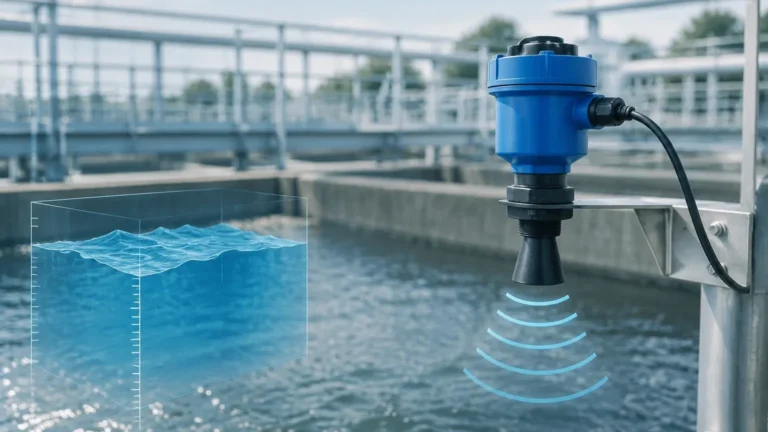
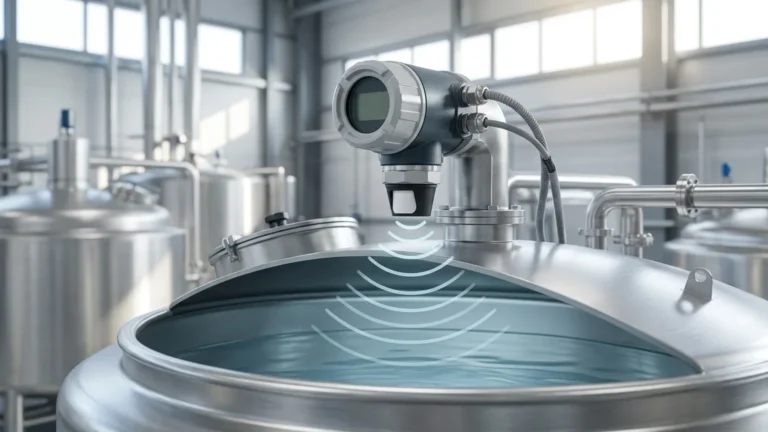
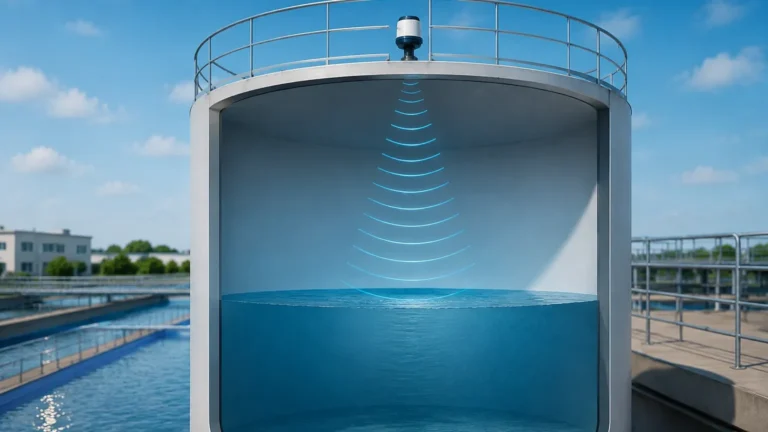
The sensor's transducer emits a series of high-frequency sound pulses (typically between 20 kHz and 200 kHz). These sound waves travel through the air space in the tank, strike the surface of the liquid or sludge, and reflect back to the transducer. The device's internal microprocessor measures the time interval between the emission of the pulse and the reception of the echo.
The distance ($D$) from the sensor to the liquid surface is calculated using the formula:
$$D = \frac{c \times t}{2}$$
Where:
* $c$ is the speed of sound in the air inside the tank.
* $t$ is the total elapsed time for the pulse to travel to the surface and back.
Since the height of the tank ($H$) is a known constant, the actual level ($L$) of the septic waste is determined by subtracting the measured distance from the total tank height ($L = H – D$).
Temperature Compensation
The speed of sound is not constant; it varies with the temperature of the medium through which it travels. In a septic tank, temperatures can fluctuate due to microbial activity or seasonal changes. Professional-grade Ultrasonic Level Meters from manufacturers like Welk include integrated temperature sensors to automatically adjust the calculation, ensuring accuracy remains within 0.25% to 0.5% of the measured range.
Why Use an Ultrasonic Level Sensor for Septic Tank Applications?
Septic tanks present a unique set of challenges, including the presence of hydrogen sulfide (H2S), methane, high humidity, and a layer of floating solids known as scum. Ultrasonic technology offers several advantages over contact-based methods:
1. Non-Contact Measurement: Because the sensor never touches the waste, there is no risk of grease buildup, corrosion of the sensing element, or mechanical failure due to solids. This significantly reduces the need for cleaning and maintenance.
2. Corrosion Resistance: High-quality sensors are typically housed in PVDF (Polyvinylidene fluoride) or PP (Polypropylene), materials that are highly resistant to the acidic and corrosive gases found in wastewater systems.
3. Solid and Liquid Versatility: While septic tanks contain a mix of liquids and semi-solids, the ultrasonic pulse reflects off the topmost surface (the scum layer), providing an accurate reading of the total volume and indicating when a pump-out is required.
4. Integration Ready: Most modern units provide standard industrial outputs, such as 4-20mA analog signals or RS485 Modbus digital communication, allowing for seamless integration into PLC (Programmable Logic Controller) or SCADA systems.
Key Selection Criteria for Septic Tank Sensors
Selecting the right ultrasonic level sensor for septic tank environments requires evaluating several technical specifications to ensure long-term reliability.
1. Measurement Range and Dead Zone
Every ultrasonic sensor has a "dead zone" (also known as the blocking distance) directly beneath the transducer where measurement is impossible. For septic tanks, which are often relatively shallow (1.5 to 3 meters or 5 to 10 feet), choosing a sensor with a small dead zone (e.g., 0.2m to 0.3m) is vital to prevent lost readings when the tank is near full.
2. Beam Angle
The beam angle determines the spread of the ultrasonic pulse. In narrow septic tanks or those with internal baffles and pipes, a narrow beam angle (e.g., 5° to 10°) is preferred. A wide beam might hit the tank walls or internal obstructions, causing false echoes.
3. Ingress Protection (IP Rating)
Given the high humidity and potential for occasional flooding, a minimum rating of IP66 is required, though IP68 is recommended for sensors mounted inside the tank or in areas prone to submersion.
4. Chemical Compatibility
Ensure the wetted parts of the sensor (the transducer face) are compatible with wastewater. Welk recommends PVDF for industrial septic systems where chemical cleaning agents or industrial byproducts may be present.
Technical Comparison: Ultrasonic vs. Alternative Technologies
| Feature | Ultrasonic Level Meter | Hydrostatic Pressure Sensor | Float Switch |
| :— | :— | :— | :— |
| Measurement Type | Non-contact | Contact (Submerged) | Contact (Mechanical) |
| Accuracy | High (±0.25% – 0.5%) | Medium to High | Low (Point level only) |
| Maintenance | Very Low | Moderate (Cleaning required) | High (Prone to fouling) |
| Corrosion Risk | Minimal | High (if not specialized) | High |
| Typical Cost | Moderate | Moderate | Low |
| Best Use Case | Continuous monitoring | Deep wells/Clear water | High/Low alarms |
Installation Considerations for Septic Tanks
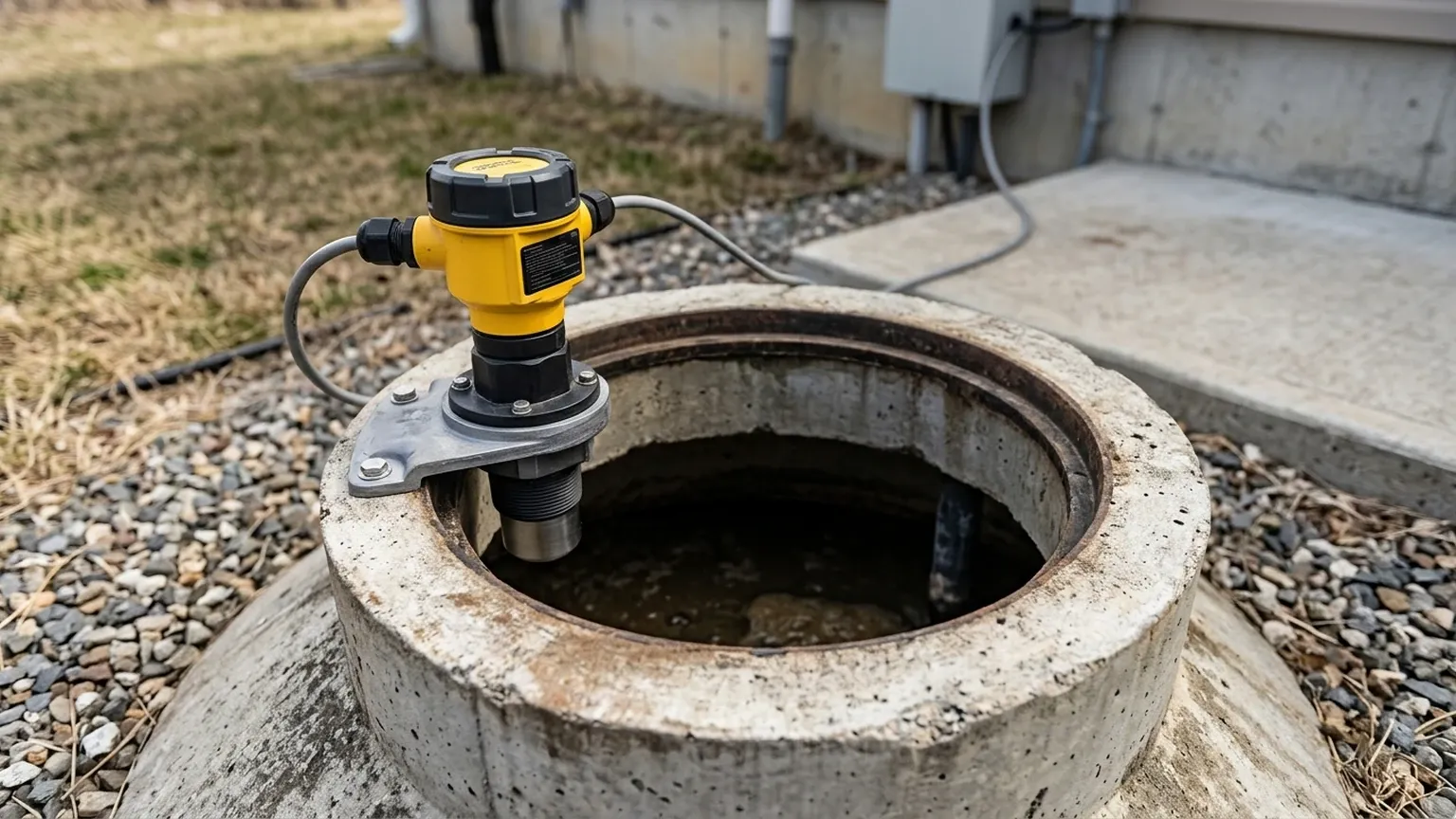
Proper installation is the most critical factor in the performance of an ultrasonic level sensor for septic tank monitoring. Poor placement can lead to erratic readings or complete signal loss.
Positioning and Clearance
* Avoid the Inlet: Never install the sensor directly above the inlet pipe. The turbulence and falling liquid will disrupt the ultrasonic pulse and create "noise" in the data.
* Perpendicular Alignment: The transducer face must be perfectly horizontal and parallel to the liquid surface. Even a slight tilt can cause the reflected signal to bounce away from the receiver.
* Wall Clearance: Maintain a distance from the tank wall at least equal to 1/10th of the tank height to prevent side-wall interference.
Managing Obstructions
Internal structures like ladders, pipes, or reinforcement struts can create false echoes. Advanced Ultrasonic Level Meters feature "False Echo Suppression" software. During commissioning, the engineer can program the sensor to ignore echoes from fixed internal objects, focusing only on the moving liquid surface.
Venting
Septic tanks must be properly vented. Excessive pressure or vacuum can affect the density of the air, slightly altering the speed of sound. More importantly, venting prevents the buildup of explosive gases, which is a safety requirement for any electronic installation in wastewater.
Limitations and Environmental Factors
While highly effective, ultrasonic sensors have specific limitations that engineers must account for:
* Heavy Foam: Thick, dense foam can absorb the ultrasonic pulse rather than reflecting it. If the septic tank is prone to heavy foaming (common in some industrial laundry or food processing applications), a radar level meter may be a more robust alternative.
* Steam and Vapor: Intense steam or heavy chemical vapors can change the speed of sound or cause signal attenuation. In standard residential or commercial septic tanks, this is rarely an issue, but it should be considered in high-temperature industrial processes.
* Vacuum/Pressure: Ultrasonic sensors rely on an air medium. They cannot function in a vacuum and require recalibration if the tank operates under significant pressure.
Maintenance and Troubleshooting
One of the primary benefits of using an ultrasonic level sensor for septic tank management is the minimal maintenance required. However, periodic checks are recommended:
1. Transducer Inspection: Check the face of the transducer for condensation or spider webs. While most sensors can transmit through light moisture, a heavy buildup of debris can weaken the signal.
2. Cable Integrity: Inspect the signal cable for signs of degradation caused by H2S gas exposure. Using conduit is highly recommended for wastewater installations.
3. Accuracy Verification: Periodically compare the sensor's output against a manual measurement to ensure the temperature compensation and calibration remain accurate.
Common Troubleshooting Steps
* Lost Signal (E01/Error): Often caused by the liquid level entering the dead zone. Check if the tank is overfilled.
* Erratic Readings: Usually the result of the sensor hitting an obstruction or the inlet stream. Re-evaluate the mounting position.
* Fixed Reading: If the level does not change despite inflow/outflow, the sensor may be locked onto a false echo from a pipe or baffle.
Conclusion
Implementing an ultrasonic level sensor for septic tank monitoring is a cost-effective and reliable way to modernize wastewater management. By providing continuous, non-contact data, these instruments allow facility managers to prevent overflows, reduce unnecessary pumping costs, and maintain environmental safety. When selecting a system, prioritize sensors with robust chemical resistance, narrow beam angles, and advanced signal processing to ensure success in the demanding septic environment.
For technical specifications and model selections tailored to industrial wastewater applications, engineers should consult professional resources for Ultrasonic Level Meters to match the instrument to the specific geometry and chemical profile of their project.
Frequently Asked Questions (FAQ)
Q: Can an ultrasonic sensor measure the thickness of the sludge layer at the bottom?
A: No. Ultrasonic level meters measure the top surface of the liquid or scum layer. To measure the sludge blanket thickness at the bottom of a tank, specialized sludge blanket level meters (often using different ultrasonic frequencies or optical sensors) are required.
Q: Is it safe to install these sensors in tanks containing methane?
A: Yes, but you must select an intrinsically safe (Ex-rated) version of the sensor. In many jurisdictions, septic tanks are classified as hazardous areas, requiring equipment that meets ATEX or IECEx standards to prevent ignition.
Q: How does heavy rain affect the sensor in an outdoor septic tank?
A: If the sensor is properly mounted inside a riser or under a cover, rain will not affect the measurement. However, rapid temperature changes during a storm might cause a temporary minor fluctuation in accuracy until the integrated temperature sensor compensates for the change.