Ultrasonic Liquid Level Meter Bedienungsanleitung Deutsch
Understanding Ultrasonic Liquid Level Meters: A Comprehensive Engineering Guide
In the landscape of industrial automation, precise level measurement is fundamental to operational efficiency, safety, and inventory management. Among the various technologies available, ultrasonic level measurement has emerged as a preferred non-contact solution for a wide array of liquid applications. For engineers and plant managers operating in international environments, particularly those requiring documentation in German—referred to as an ultrasonic liquid level meter bedienungsanleitung deutsch—understanding the technical nuances of these devices is essential for successful implementation.
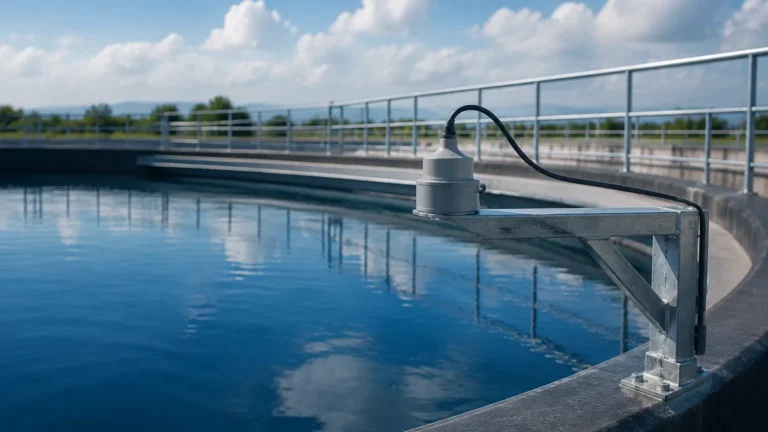
Welk, a professional manufacturer of industrial level measurement instruments, provides advanced Ultrasonic Level Meters designed to meet the rigorous demands of water treatment, chemical processing, and oil and gas industries. This guide explores the principles, selection criteria, and installation requirements for these instruments.
Measurement Principles of Ultrasonic Level Meters
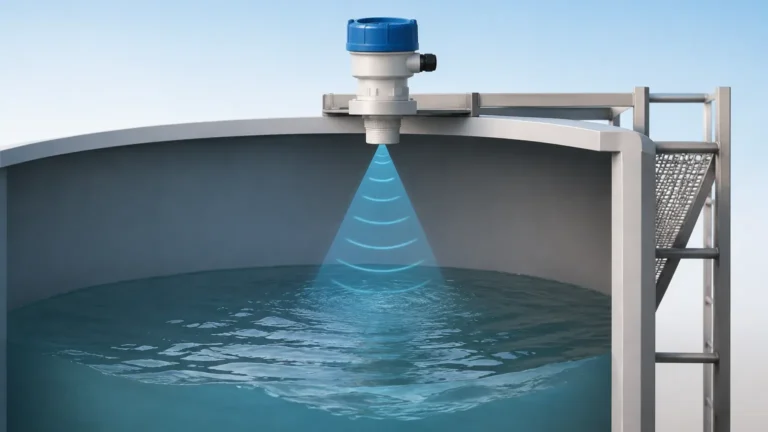
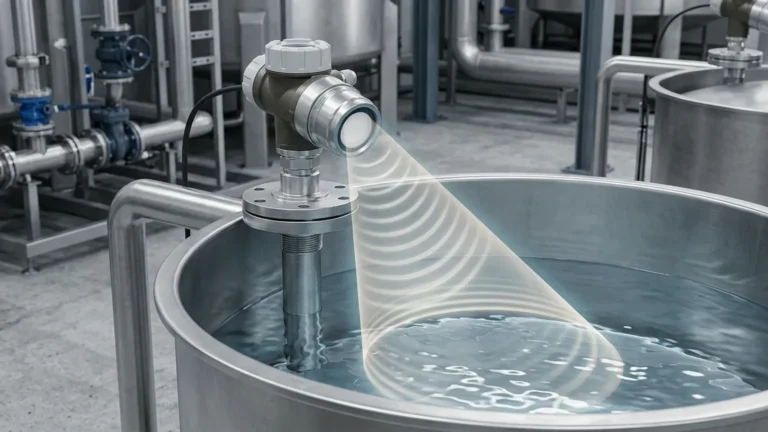
Ultrasonic level measurement is based on the "Time-of-Flight" (ToF) principle. The instrument’s transducer emits a high-frequency ultrasonic pulse toward the surface of the liquid. This pulse travels through the air, hits the liquid surface, and is reflected back to the transducer as an echo.
The device measures the time interval ($t$) between the emission of the pulse and the reception of the echo. Since the speed of sound in air ($v$) is a known constant (approximately 340 m/s at 20°C), the distance ($d$) from the sensor to the liquid surface can be calculated using the following formula:
$$d = \frac{v \times t}{2}$$
The level of the liquid ($L$) is then determined by subtracting this distance from the total height of the tank ($H$):
$$L = H – d$$
Temperature Compensation
Because the speed of sound varies with air temperature (changing by approximately 0.6 m/s per degree Celsius), professional ultrasonic level meters include an integrated temperature sensor. This allows the internal microprocessor to compensate for temperature fluctuations, ensuring accuracy remains consistent even as environmental conditions change.
The Importance of the Bedienungsanleitung (Instruction Manual)
For technical equipment used in German-speaking regions or by international firms with strict compliance standards, the ultrasonic liquid level meter bedienungsanleitung deutsch is more than just a translation; it is a critical safety and configuration document. A comprehensive manual ensures that the local technical staff can:
1. Correctly Wire the Device: Understanding the terminal assignments for 4-20mA loops, RS485 Modbus, or HART communication.
2. Navigate the Menu: Accessing the internal software to set parameters such as the "Empty Tank" distance and "Full Scale" range.
3. Implement Safety Protocols: Following specific guidelines for ATEX (explosion-proof) environments, which are common in European industrial sectors.
4. Interpret Error Codes: Quickly identifying issues like "Echo Loss" or "Temperature Sensor Failure" using standardized German terminology.
Selection Criteria for Industrial Applications
Choosing the right ultrasonic level meter requires an evaluation of the process environment. Not all liquids or tanks are suitable for ultrasonic technology. The following table provides a general reference for selecting Welk ultrasonic solutions based on typical application requirements.
Selection Reference Table
| Feature | Standard Liquid Meter | Chemical Resistant Meter | Long-Range / Solids Meter |
| :— | :— | :— | :— |
| Measuring Range | 0.3m to 10m | 0.3m to 12m | 0.5m to 30m |
| Transducer Material | ABS / PVC | PVDF / PTFE | Reinforced Polymer |
| Process Temperature | -20°C to +60°C | -40°C to +80°C | -20°C to +70°C |
| Output Signal | 4-20mA, 2-wire | 4-20mA + HART | 4-20mA, RS485 Modbus |
| Common Use Case | Water tanks, sumps | Acids, bases, solvents | Large silos, deep wells |
| Protection Class | IP65 / IP66 | IP67 / IP68 | IP66 |
Installation Considerations and Best Practices
Proper installation is the single most important factor in ensuring the reliability of an ultrasonic level meter. Failure to follow the guidelines outlined in the technical manual can lead to false readings or signal loss.
1. The Blind Zone (Dead Zone)
Every ultrasonic sensor has a "Blind Zone" directly beneath the transducer face where measurements cannot be taken. This is typically between 0.2m and 0.5m depending on the frequency of the sensor. The maximum liquid level must never reach into this zone, or the device will report an error or an incorrect maximum level.
2. Mounting Position
* Avoid the Center: In cylindrical tanks with domed tops, do not mount the sensor in the exact center, as this can create a parabolic effect that focuses unwanted multiple echoes back to the sensor.
* Distance from Wall: The sensor should be installed at a distance from the tank wall of at least 1/6th of the tank diameter to prevent the ultrasonic beam from hitting the wall and causing interference.
* Inlet Interference: Never install the sensor directly above the liquid inlet. The turbulence and falling liquid will scatter the ultrasonic pulse and prevent a clean echo return.
3. Beam Angle and Obstructions
The ultrasonic pulse travels in a cone shape (the beam angle is usually between 5° and 12°). The path of this cone must be clear of obstructions such as ladders, heating coils, or agitators. If an obstruction is unavoidable, many modern Ultrasonic Level Meters offer "False Echo Suppression" software features to ignore these static reflections.

Limitations of Ultrasonic Technology
While highly versatile, ultrasonic measurement has physical limitations that engineers must consider during the design phase:
* Vacuum Conditions: Ultrasonic waves require a medium (air or gas) to travel. They cannot function in a vacuum.
* High Pressure: High pressure increases the density of the gas, which can attenuate the signal or shift the speed of sound beyond the compensation limits of standard devices.
* Heavy Foam: Thick, dense foam on the liquid surface acts as an acoustic insulator, absorbing the pulse rather than reflecting it. In these cases, a radar level meter or a hydrostatic transmitter may be more appropriate.
* Extreme Dust or Steam: While minor dust is manageable, extremely heavy dust or dense steam can scatter the ultrasonic signal, reducing the effective measuring range.
Maintenance and Troubleshooting
Industrial ultrasonic meters are generally low-maintenance because they have no moving parts. However, periodic checks are recommended as part of a facility's preventive maintenance schedule.
1. Transducer Cleaning: In applications with high humidity or volatile liquids, condensation or buildup may occur on the transducer face. Gently wipe the face with a soft cloth and mild detergent. Do not use abrasive materials or strong solvents that could damage the matching layer of the transducer.
2. Signal Strength Verification: Most digital ultrasonic meters provide a signal-to-noise ratio or echo strength indicator. A significant drop in signal strength over time may indicate a failing transducer or a change in process conditions (e.g., increased surface turbulence).
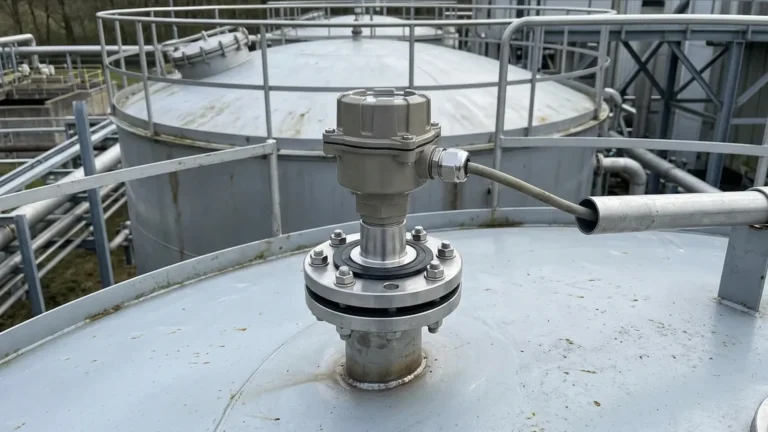
3. Cable Integrity: Ensure that cable glands are tight and that there is no moisture ingress into the terminal housing, which is a common cause of intermittent signal failure.
Frequently Asked Questions (FAQ)
Q: Can ultrasonic level meters be used for solids?
A: Yes, but with caveats. Solids like grain or plastic pellets have an angle of repose that reflects the signal away from the sensor. For solids, a device with a higher power output and a narrower beam angle is usually required, and the effective range is typically reduced by 50% compared to liquids.
Q: How do I handle a tank with a heavy agitator?
A: If the agitator is large, it will create significant surface turbulence and potential false echoes. You should use the software's damping function to average the readings and employ false echo mapping to "teach" the device to ignore the agitator blades.
Q: Is a German manual (Bedienungsanleitung) required for CE marking?
A: Yes, under the EU Machinery Directive and related regulations, technical products sold in Germany must be accompanied by instructions in the local language to ensure safe operation and maintenance.
Conclusion
Ultrasonic liquid level meters offer a cost-effective, reliable, and non-contact solution for modern industrial level monitoring. By understanding the underlying physics of Time-of-Flight measurement and adhering to strict installation protocols—often detailed in the ultrasonic liquid level meter bedienungsanleitung deutsch—operators can achieve high precision in even the most demanding environments.
For organizations seeking robust measurement solutions, Welk offers a range of customizable Ultrasonic Level Meters that combine advanced signal processing with industrial-grade durability. Whether managing water treatment facilities or complex chemical storage, selecting the right sensor and following authoritative engineering guidelines ensures long-term operational success.
Download Ultrasonic Liquid Level Meter Bedienungsanleitung Deutsch as a PDF