Ultrasonic Level Sensor Alibaba
Ultrasonic Level Sensor Alibaba: A Technical Guide for Industrial Procurement
In the modern industrial landscape, sourcing reliable instrumentation often begins with digital marketplaces. When searching for an ultrasonic level sensor alibaba offers a vast array of options ranging from low-cost components to high-end industrial transmitters. However, for engineers and procurement professionals in water treatment, chemical processing, and oil and gas, the challenge lies in distinguishing between a consumer-grade device and a robust industrial tool capable of surviving harsh process environments.
Selecting the right Ultrasonic Level Meters requires a deep understanding of measurement physics, application constraints, and supplier verification. This guide provides a technical foundation for evaluating these sensors, ensuring that your procurement decisions are based on factual engineering requirements rather than just price points.
Understanding the Measurement Principle
Before evaluating any ultrasonic level sensor alibaba listings, it is essential to understand how these devices function. Ultrasonic level measurement is a non-contact technology based on the "Time of Flight" (ToF) principle.
The Transducer and Pulse Emission
The core of the instrument is the transducer, which typically contains one or more piezoelectric crystals. When energized, these crystals vibrate at a specific frequency, emitting a burst of ultrasonic sound waves. These waves travel through the air (or gas) in the tank until they hit the surface of the medium being measured.
Reflection and Detection
Upon hitting the surface, a portion of the sound energy is reflected back toward the sensor as an echo. The transducer then switches to "receiving mode" to detect this return signal. The electronics within the meter calculate the time elapsed between the emission of the pulse and the reception of the echo.
Distance Calculation
The distance (D) from the sensor to the material surface is calculated using the formula:
D = (c × t) / 2
Where:
* c is the speed of sound in the medium (typically air, approx. 344 m/s at 20°C).
* t is the total time for the round trip.
Since the speed of sound is affected by air temperature, professional-grade Ultrasonic Level Meters include an integrated temperature sensor to compensate for these changes in real-time, ensuring accuracy across varying environmental conditions.
Navigating the Ultrasonic Level Sensor Alibaba Marketplace
When searching for an ultrasonic level sensor alibaba users will encounter thousands of suppliers. To ensure the reliability of your industrial automation system, you must categorize the offerings based on their technical specifications and the manufacturer's credentials.
1. Identifying Manufacturer vs. Trader
In the B2B sector, it is often preferable to work directly with manufacturers like Welk. Manufacturers provide deeper technical support, customization (OEM/ODM), and consistent quality control. When browsing Alibaba, look for "Verified Suppliers" and check for ISO 9001 certifications. A manufacturer will typically have a focused product line centered on level, flow, or pressure instrumentation, rather than a broad catalog of unrelated electronics.
2. Evaluating Technical Documentation
An industrial-grade listing should provide comprehensive datasheets. If a listing for an ultrasonic level sensor alibaba lacks details on beam angle, blind zones, or IP ratings, it may not be suitable for professional process control. Always request a full manual or technical specification sheet before proceeding with a bulk order.
Key Selection Criteria for Industrial Applications
To choose the correct meter, you must match the sensor's capabilities to your specific tank or vessel. Use the following criteria as a checklist:
Measurement Range and Frequency
Ultrasonic sensors operate at different frequencies, usually between 20 kHz and 70 kHz.
* High Frequency (e.g., 60-70 kHz): Used for shorter ranges (0.25m to 5m). These sensors are smaller and offer higher resolution.
* Low Frequency (e.g., 20-30 kHz): Used for long-range measurements (up to 30m or more). Lower frequencies penetrate dust and steam better but require larger transducers.
The Blind Zone (Dead Band)
The "Blind Zone" is a critical area directly below the transducer where the sensor cannot measure. This occurs because the transducer cannot receive an echo while it is still vibrating from the emission pulse. In a typical ultrasonic level sensor alibaba listing, this might range from 0.2m (8 inches) to 0.6m (24 inches). You must ensure the maximum liquid level never enters this zone, or the reading will be lost or erroneous.
Beam Angle
The ultrasonic pulse spreads out in a cone shape. The beam angle (often between 5° and 12°) determines how much space the sensor needs to avoid hitting tank walls, ladders, or agitators. A narrower beam angle is generally preferred for tall, narrow silos or tanks with internal obstructions.
Practical Selection Table
| Application Type | Recommended Range | Frequency | Typical Accuracy | Key Feature to Look For |
| :— | :— | :— | :— | :— |
| Small Water Tank | 0.3m – 5m | 60 kHz | ±0.25% | Compact size, IP68 rating |
| Chemical Storage | 0.5m – 10m | 40 kHz | ±0.25% | PTFE/PVDF wetted parts |
| Deep Sump/Well | 1m – 20m | 30 kHz | ±0.5% | High power, signal tracking |
| Solid Grain Silo | 1m – 15m | 20 kHz | ±1.0% | Dust-resistant, aiming flange |
Installation Considerations
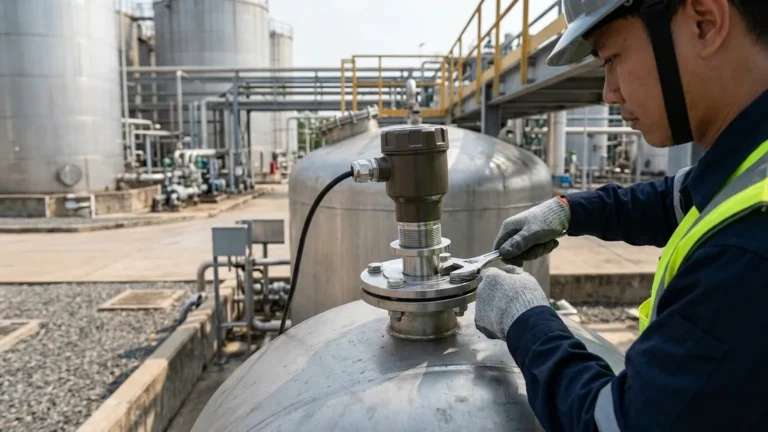
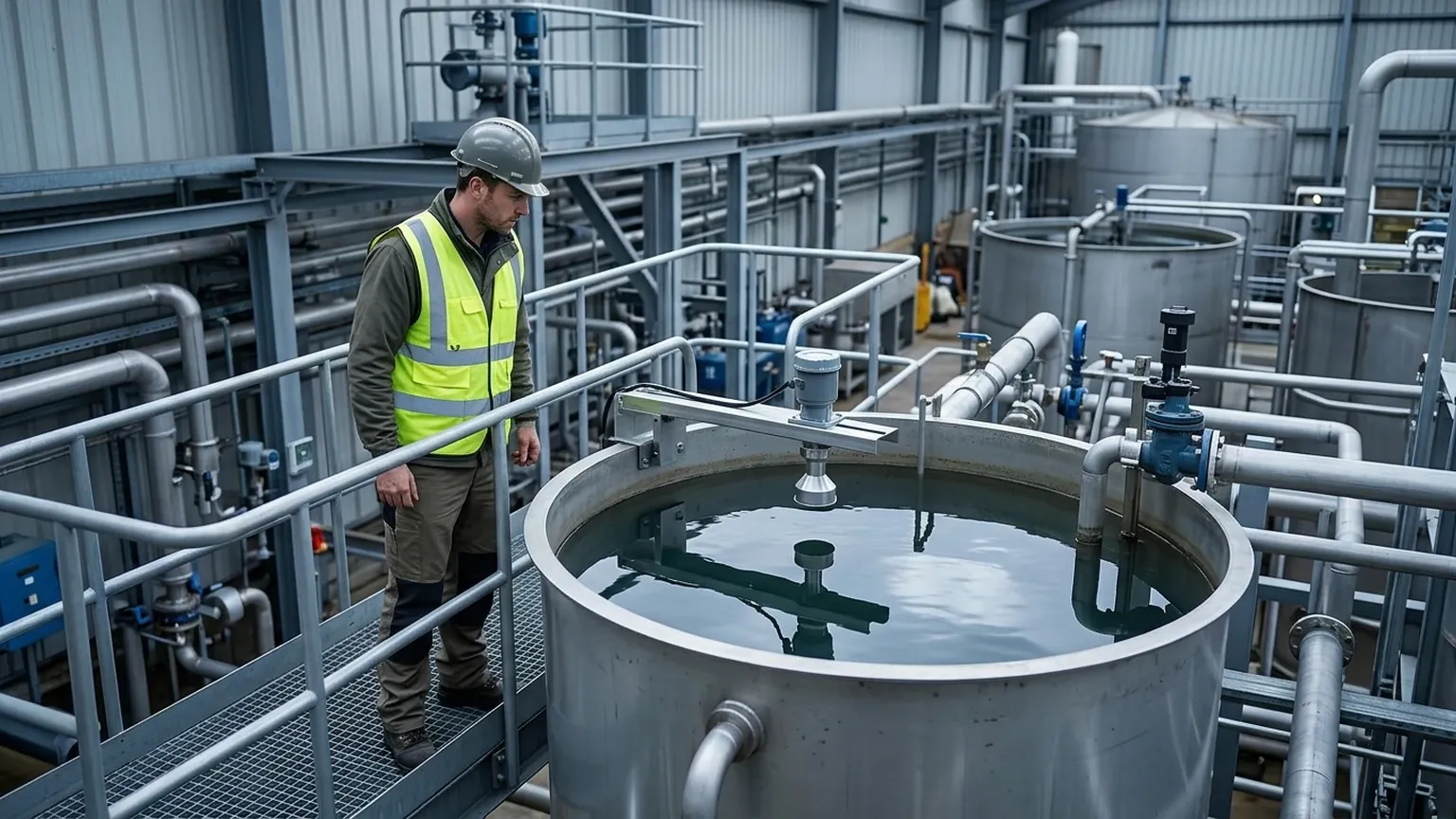
Even the highest quality Ultrasonic Level Meters will fail if installed incorrectly. Follow these engineering guidelines for a successful deployment:
1. Vertical Alignment: The sensor must be mounted perfectly perpendicular to the liquid surface. A tilt of even a few degrees can cause the reflected signal to miss the transducer entirely.
2. Avoid the Inflow: Never mount the sensor directly above the fill pipe. The falling liquid or solids will create noise and false echoes.
3. Distance from Walls: To prevent "wall echoes," mount the sensor at a distance from the tank wall that is at least 1/6th of the total tank height, depending on the beam angle.
4. Standpipe Usage: If the liquid surface is turbulent or covered in foam, installing the sensor inside a stilling well or standpipe can help stabilize the reading. Ensure the pipe is vented and has a smooth internal surface.
Limitations of Ultrasonic Technology
While versatile, ultrasonic sensors are not universal solutions. When sourcing an ultrasonic level sensor alibaba, be aware of these physical limitations:
* Vacuum Conditions: Sound requires a medium to travel. Ultrasonic sensors will not work in a vacuum.
* High Pressure: As pressure increases, the speed of sound changes, and the transducer's diaphragm may be stressed. Most standard units are limited to 3 bar (43.5 psi).
* Heavy Foam: Thick, dense foam absorbs the ultrasonic pulse rather than reflecting it. In these cases, a radar level meter or a hydrostatic transmitter is often a better choice.
* Extreme Temperatures: High temperatures can create temperature gradients in the air space, leading to measurement errors. Most ultrasonic sensors are rated up to 70°C or 80°C.
Why Choose Professional Manufacturers Over Generic Listings?
While the price of a generic ultrasonic level sensor alibaba might be tempting, industrial projects benefit from the reliability of established brands like Welk. Professional manufacturers provide:
* Advanced Signal Processing: Modern meters use "False Echo Suppression" algorithms to ignore internal tank obstructions like agitator blades.
* Material Compatibility: Options for PVDF or PTFE housing for corrosive acids and alkalis.
* Certifications: CE, RoHS, and explosion-proof (Ex-proof) ratings required for hazardous areas in oil and gas.
* Technical Support: Direct access to engineers who can help calculate beam spreads and advise on mounting configurations.
Frequently Asked Questions (FAQ)
Q: Can I use an ultrasonic level sensor for solids?
A: Yes, but with caution. Solids like grain or plastic pellets often have an angle of repose, which reflects the sound away from the sensor. You typically need a sensor with a higher power output and a lower frequency, and you must de-rate the effective range by approximately 50%.
Q: How do I handle condensation on the sensor face?
A: Condensation can attenuate the signal. Many professional Ultrasonic Level Meters feature a specialized transducer face material that sheds water droplets, or they use high-amplitude pulses to "shake off" moisture.
Q: What is the difference between 2-wire and 4-wire sensors?
A: 2-wire sensors are loop-powered (the 4-20mA signal and power share the same wires), which simplifies wiring. 4-wire sensors have separate power and signal wires, allowing for higher power consumption, which is often necessary for long-range or difficult applications.
Q: Is an ultrasonic sensor better than a radar sensor?
A: Ultrasonic is generally more cost-effective for water and simple liquid applications. However, radar is superior for high-temperature, high-pressure, or vacuum applications, and it is unaffected by vapors or dust.
For those evaluating their options on platforms like Alibaba, remember that the lowest price often excludes the cost of technical failure. For reliable, accurate, and cost-effective level measurement solutions, it is recommended to Review product options and application support from a specialized manufacturer to ensure your project's success.