Water Level Monitors
Water Level Monitors
In industrial process control and environmental management, the selection of appropriate water level monitors is a critical engineering decision. These instruments are not merely sensors but are integrated components of safety, efficiency, and regulatory compliance systems. Whether managing a municipal wastewater treatment facility, a chemical processing plant, or a high-pressure boiler system, the accuracy and reliability of level data directly impact operational uptime and resource management.
Professional manufacturers like Welk provide a diverse range of instrumentation designed to meet these rigorous demands. From non-contact radar systems to robust hydrostatic transmitters, the modern landscape of level measurement offers solutions tailored to specific media properties and environmental conditions. For a comprehensive overview of available technologies and specific product data, engineers often refer to the Main Page of specialized instrumentation providers to compare technical specifications and integration capabilities.
Principles of Level Measurement Technology
Before selecting water level monitors, it is essential to understand the physical principles governing their operation. Industrial level measurement is generally categorized into contact and non-contact methods, each with distinct advantages and limitations.
Ultrasonic Level Measurement
Ultrasonic sensors operate on the Time-of-Flight (ToF) principle. The sensor emits a high-frequency acoustic pulse (typically between 40 kHz and 75 kHz) that travels through the air, reflects off the water surface, and returns to the transducer. The distance is calculated based on the speed of sound in air.
* Advantages: Non-contact, cost-effective, and easy to install.
* Limitations: Sensitive to air temperature fluctuations, heavy foam, and high-pressure environments where the density of the transmission medium changes.
Radar Level Measurement (FMCW and Pulse)
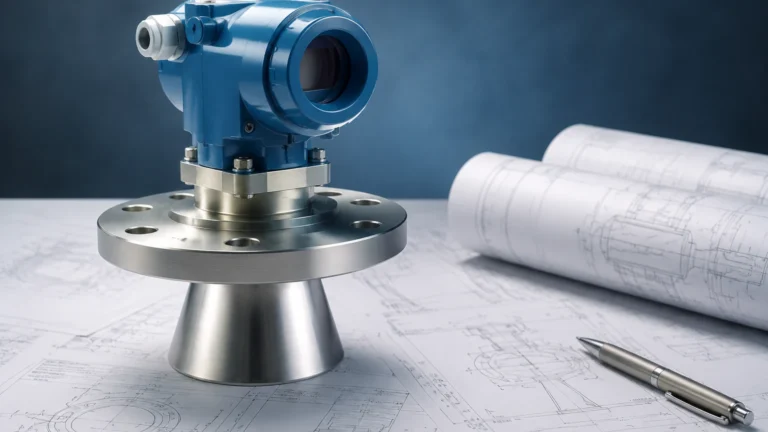
Radar monitors use electromagnetic waves rather than sound. Frequency Modulated Continuous Wave (FMCW) radar is increasingly preferred for its high precision. It emits a continuous signal with a changing frequency; the difference between the emitted and received frequency is proportional to the distance.
* Advantages: Highly accurate (up to ±1 mm), unaffected by vacuum, high pressure, or temperature variations. Radar can penetrate steam and dust effectively.
* Limitations: Higher initial capital expenditure compared to ultrasonic or hydrostatic options.
Hydrostatic Level Measurement
This contact method relies on the principle that the pressure at a specific depth in a liquid is proportional to the height of the liquid column above it ($P = \rho gh$). A submersible pressure transmitter or a flange-mounted sensor measures this head pressure.
* Advantages: Simple, reliable for deep wells or vented tanks, and relatively immune to surface turbulence or foam.
* Limitations: Requires contact with the media; accuracy can be affected by changes in the specific gravity (density) of the liquid.
Magnetic Level Gauges and Switches
Magnetic gauges utilize a float containing a permanent magnet that moves with the liquid level. This float interacts with an external indicator or a series of reed switches. This is a purely mechanical-to-visual or mechanical-to-electrical interface.
* Advantages: Provides a clear visual indication without power; highly reliable for high-pressure/high-temperature bypass applications.
* Limitations: Limited to clean liquids where debris will not jam the float mechanism.
Comparative Selection Table
When evaluating water level monitors, engineers must weigh the technical requirements against the budgetary constraints of the project. The following table provides a generalized comparison of common technologies.
| Technology | Accuracy | Measurement Range | Media Contact | Typical Applications |
| :— | :— | :— | :— | :— |
| Radar (80GHz) | ±1 mm to ±3 mm | Up to 120m | No | Chemical tanks, tall silos, precision water storage |
| Ultrasonic | ±0.25% of range | 0.5m to 20m | No | Open channels, wastewater sumps, plastic tanks |
| Hydrostatic | ±0.1% to ±0.5% | 1m to 200m+ | Yes | Deep wells, reservoirs, fuel tanks |
| Magnetic Gauge | ±5 mm | 0.3m to 6m | Yes | Boilers, oil-water separators, high-pressure vessels |
| Capacitance | ±1% | 0.1m to 5m | Yes | Small tanks, corrosive liquids, interface detection |
Application Engineering: Matching Technology to Environment
The environment in which water level monitors are deployed is often the deciding factor in technology selection.
Water and Wastewater Treatment
In wastewater applications, the presence of foam, grease, and suspended solids makes contact-based sensors problematic due to fouling. Ultrasonic sensors are traditionally used, but modern 80GHz radar is becoming the standard for its ability to ignore steam and condensation on the sensor face. For deep well monitoring or groundwater assessment, submersible hydrostatic transmitters are preferred due to their ability to withstand submersion and provide long-term stability in narrow boreholes.
Chemical and Industrial Processing
In environments involving corrosive chemicals or high-purity water (DI water), non-contact methods are essential to prevent sensor degradation and media contamination. Radar monitors with PTFE or PVDF wetted parts offer excellent chemical resistance. If the process involves high-pressure reactors, magnetic level gauges with armored chambers provide a robust secondary safety layer, allowing operators to verify levels visually even during power failures.
Oil and Gas Applications
Level monitoring in the oil and gas sector often requires explosion-proof (Ex-d) or intrinsically safe (Ex-ia) certifications. Hydrostatic transmitters used in these areas must be constructed from corrosion-resistant materials like Hastelloy or Monel to withstand sour gas (H2S) environments. Furthermore, interface measurement (e.g., the level of water beneath a layer of oil) requires specialized guided wave radar (GWR) or high-precision hydrostatic sensors calibrated for specific gravity differences.
Installation Considerations and Best Practices
Proper installation is as important as the choice of technology. Even the most advanced water level monitors will fail to provide accurate data if installed incorrectly.
1. Dead Zones (Blocking Distance): Both ultrasonic and radar sensors have a "dead zone" immediately below the transducer where measurements cannot be taken. Ensure the sensor is mounted high enough so that the maximum liquid level never enters this zone.
2. Avoid Obstructions: For non-contact sensors, the signal beam must have a clear path to the liquid surface. Internal tank structures like ladders, agitators, or heating coils can cause "false echoes." Advanced software can often "map out" these echoes, but physical clearance is always preferred.
3. Mounting Position: Sensors should generally be mounted 1/3 of the diameter away from the tank wall to avoid interference from wall reflections. They should never be mounted directly above the filling inlet, as the turbulence and falling liquid will disrupt the signal.
4. Venting: For hydrostatic sensors, ensuring the reference capillary in the cable is vented to the atmosphere is crucial. If the vent is blocked, the sensor will not account for changes in barometric pressure, leading to significant errors (a 10 mbar change in atmospheric pressure equates to approximately 10 cm of water level error).
Limitations and Common Risks
While modern instrumentation is highly advanced, certain physical limitations remain:
* Foam and Turbulence: Heavy, dense foam can absorb ultrasonic and radar signals, leading to a loss of signal (echo loss). In these cases, a stilling well or a hydrostatic sensor may be required.
* Vapor and Condensation: While radar is mostly unaffected by vapor, heavy condensation on an ultrasonic transducer face can dampen the vibration, leading to inaccurate readings. Sensors with self-cleaning or "drip-off" designs are recommended for high-humidity environments.
* Specific Gravity Changes: Hydrostatic sensors assume a constant liquid density. If a tank's temperature changes significantly or if the chemical composition varies, the density ($\rho$) changes, and the level reading will shift even if the actual volume remains the same.
Frequently Asked Questions (FAQ)
Q: Can radar level monitors work in a vacuum?
A: Yes. Unlike ultrasonic sensors which require air or gas to transmit sound waves, radar uses electromagnetic waves that travel freely through a vacuum.
Q: How often should hydrostatic water level monitors be calibrated?
A: In standard water applications, annual calibration is usually sufficient. However, in corrosive or high-fouling environments, quarterly inspections are recommended to check for diaphragm buildup or cable integrity.
Q: What is the difference between a level transmitter and a level switch?
A: A level transmitter provides continuous measurement (e.g., 4-20mA or Modbus signal representing 0-100% level), whereas a level switch provides a discrete point output (on/off) when the water reaches a specific height.
Q: Is 80GHz radar better than 26GHz radar for water?
A: 80GHz radar offers a narrower beam angle and better signal focus, making it superior for tanks with internal obstructions or for measuring through narrow nozzles. However, 26GHz radar is still highly effective for large, open reservoirs.
Conclusion
Selecting the right water level monitors requires a thorough analysis of the process media, vessel geometry, and environmental conditions. By understanding the underlying measurement principles—whether acoustic, electromagnetic, or pressure-based—engineers can implement solutions that minimize maintenance and maximize data accuracy. For those seeking to explore specific hardware configurations or request a quote for industrial-grade instrumentation, visiting the Main Page of a dedicated manufacturer is the recommended next step to ensure the selected equipment aligns with the technical demands of the project.