Ultrasonic Level Sensor for Oil
Ultrasonic Level Sensor for Oil: A Comprehensive Engineering Guide
In industrial fluid management, the accurate measurement of oil levels is critical for operational efficiency, safety, and inventory control. Whether managing diesel fuel for backup generators, lubricating oils in manufacturing plants, or crude oil in collection tanks, selecting the right instrumentation is a foundational engineering decision. Among the various technologies available, Ultrasonic Level Meters have emerged as a preferred solution due to their non-contact nature and cost-effectiveness.
This guide explores the technical principles, application considerations, and selection criteria for implementing an ultrasonic level sensor for oil, providing engineers and facility managers with the factual data needed to optimize their level measurement systems.
Measurement Principles of Ultrasonic Technology
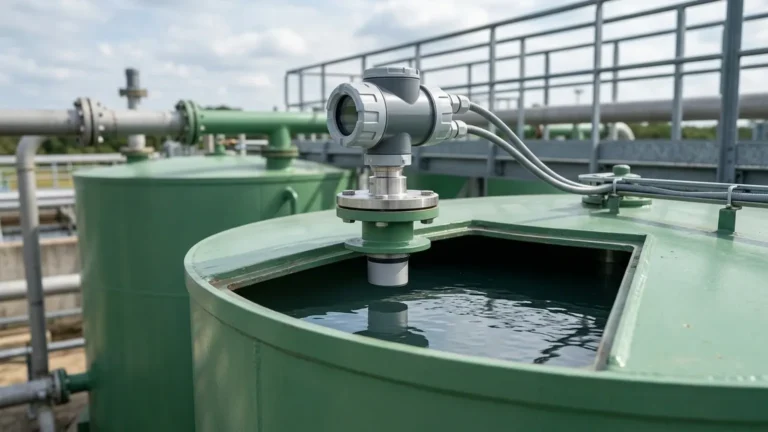
Ultrasonic level measurement is based on the "Time-of-Flight" (ToF) principle. The sensor, typically mounted at the top of a tank, contains a piezoelectric crystal that converts electrical energy into mechanical pulses. These pulses travel through the air (or vapor space) at the speed of sound, strike the surface of the oil, and reflect back to the transducer.
The Calculation Formula
The distance from the sensor to the oil surface is calculated using the following equation:
D = (c × t) / 2
Where:
* D is the distance to the liquid surface.
* c is the speed of sound in the medium (usually air).
* t is the total time elapsed from transmission to reception.
Since the height of the tank (H) is a known constant, the actual level (L) of the oil is determined by subtracting the measured distance (D) from the total height: L = H – D.
Temperature Compensation
The speed of sound is not constant; it varies with the temperature of the medium through which it travels. In oil storage applications, temperature fluctuations can lead to significant measurement errors if not addressed. Professional instruments, such as those manufactured by Welk, integrate internal temperature sensors to automatically adjust the speed-of-sound calculation, ensuring accuracy across varying environmental conditions.
Why Use an Ultrasonic Level Sensor for Oil?
Choosing an ultrasonic level sensor for oil offers several distinct advantages over traditional contact-based methods like float switches or hydrostatic transmitters:
1. Non-Contact Measurement: Because the sensor never touches the oil, there is no risk of mechanical wear, corrosion of the sensing element, or contamination of the fluid. This is particularly beneficial for high-purity lubricants or volatile fuels.
2. Low Maintenance: With no moving parts to clog or seize, ultrasonic meters require significantly less maintenance than mechanical gauges, especially in viscous oil applications where residues might interfere with floats.
3. Ease of Installation: These sensors can be installed on existing tank openings (threaded or flanged) without draining the vessel, making them ideal for retrofitting industrial sites.
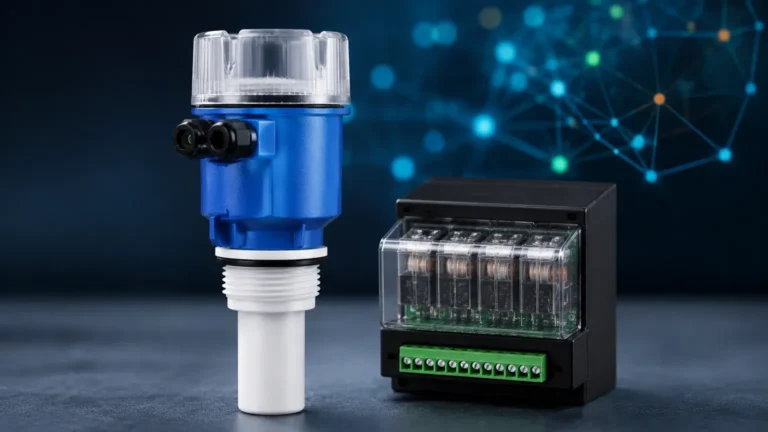
4. Versatility: Modern Ultrasonic Level Meters are capable of measuring both distance and volume, providing real-time data for PLC and SCADA integration.
Selection Criteria for Oil Applications
When selecting an ultrasonic sensor for oil, engineers must evaluate the physical properties of the oil and the environmental conditions of the storage vessel. Not all oils behave the same under ultrasonic pulses.
1. Oil Volatility and Vapor
Oils with high vapor pressure, such as certain light fuels or crude oils, can create a dense vapor layer above the liquid. These vapors can change the composition of the air space, potentially altering the speed of sound more than temperature alone. In such cases, sensors with high-gain signal processing or specialized calibration are required.
2. Viscosity and Surface Condition
While viscosity does not directly affect the sound wave, it does affect how the surface of the oil behaves. Highly viscous oils tend to have calmer surfaces, which provide excellent reflective properties. However, if the oil is being agitated or pumped rapidly, surface turbulence can scatter the ultrasonic signal.
3. Tank Geometry and Internal Obstructions
Ultrasonic waves spread in a conical beam. Any internal structures—such as heating coils, ladders, or agitators—within this beam angle will create "false echoes." Selecting a sensor with a narrow beam angle (typically 5° to 10°) and advanced false-echo suppression software is essential for complex tank environments.
Selection Table: Ultrasonic Sensors by Oil Type
| Oil Category | Typical Application | Recommended Range | Key Consideration |
| :— | :— | :— | :— |
| Lubricating Oils | Industrial machinery reservoirs | 0.2m – 5m | Compact sensors; high precision required. |
| Diesel / Fuel Oil | Backup generator tanks | 1m – 15m | Potential for light vapor; requires chemical resistance. |
| Waste / Used Oil | Collection and recycling pits | 2m – 10m | Surface debris and sludge; non-contact is mandatory. |
| Heavy Fuel Oil (HFO) | Power plant storage | 5m – 20m | High temperature; may require stand-offs to protect electronics. |
| Transformer Oil | Electrical infrastructure | 0.5m – 3m | High dielectric stability; precision monitoring for leaks. |
Installation Best Practices
To ensure the reliability of an ultrasonic level sensor for oil, proper installation is as important as the hardware itself. Following these engineering guidelines will prevent the most common measurement failures.
Avoiding the Dead Zone (Blocking Distance)
Every ultrasonic sensor has a "dead zone" (also known as the blocking distance) directly beneath the transducer face where measurement is impossible. This is the time required for the transducer to stop vibrating after transmission so it can begin listening for the return echo.
* Guideline: Ensure the maximum oil level never reaches into the dead zone. If the tank is frequently filled to the brim, use a stand-pipe or a nozzle to raise the sensor mounting position.
Mounting Position
* The 1/6th Rule: For cylindrical tanks, the sensor should ideally be mounted at 1/6th of the tank diameter away from the wall. Mounting too close to the wall can cause signal interference from wall reflections.
* Perpendicularity: The sensor face must be perfectly parallel to the oil surface. Even a few degrees of tilt can cause the reflected signal to miss the transducer, leading to a "Loss of Echo" (LOE) error.
* Inlet Flow: Never mount the sensor directly above the oil inlet pipe. The falling liquid will obstruct the ultrasonic beam and cause erratic readings.
Environmental Protection
For outdoor oil storage, sensors should be equipped with a sunshade to prevent solar heating of the sensor body, which can skew the internal temperature compensation. Additionally, ensure the cable entry points are sealed with appropriate glands to prevent moisture ingress.

Limitations and Challenges
While ultrasonic technology is robust, it is not a universal solution for every oil measurement scenario. Engineers should be aware of the following limitations:
* High Pressure/Vacuum: Ultrasonic waves require a medium (gas) to travel. In high-vacuum environments, the sound cannot propagate. Similarly, high-pressure environments (above 0.3 MPa) can significantly alter the speed of sound and signal attenuation.
* Heavy Foam: Some oils, particularly when mixed with additives or subjected to high-velocity return lines, can develop a layer of foam. Foam absorbs ultrasonic energy rather than reflecting it, which can lead to signal loss. If heavy foam is present, radar or hydrostatic sensors may be more appropriate.
* Extreme Temperatures: Most standard ultrasonic sensors are rated for process temperatures up to 80°C. For high-temperature oil applications, specialized transducers or alternative technologies are necessary.
Maintenance and Troubleshooting
Welk Ultrasonic Level Meters are designed for long-term industrial use with minimal intervention. However, periodic checks are recommended:
1. Transducer Cleaning: In environments with heavy oil mist or condensation, a film may build up on the transducer face. Wiping the face with a soft cloth and a compatible solvent will restore signal strength.
2. Signal Strength Monitoring: Most digital ultrasonic meters provide a signal-to-noise ratio (SNR) or echo strength value. A gradual decline in this value may indicate a buildup on the sensor or a change in the oil's surface characteristics.
3. Wiring Integrity: Ensure that shielded cables are used and properly grounded to prevent electromagnetic interference (EMI) from nearby pumps or motors from corrupting the 4-20mA or RS485 signal.
Frequently Asked Questions (FAQs)
Q: Can an ultrasonic sensor measure the level of crude oil?
A: Yes, but with caution. Crude oil often contains volatile components that create heavy vapors. It is essential to use a sensor with a high power output and to confirm that the sensor housing is explosion-proof (ATEX/IECEx rated) if the crude oil is stored in a hazardous area.
Q: How does the color or opacity of the oil affect the measurement?
A: Unlike optical or laser sensors, ultrasonic waves are unaffected by the color, transparency, or opacity of the oil. Whether the oil is clear, amber, or pitch black, the acoustic reflection remains the same.
Q: Is it possible to measure the interface between oil and water using ultrasonics?
A: Generally, no. A top-mounted ultrasonic sensor measures the distance to the first liquid surface it encounters. To measure an oil-water interface, a submerged technology like a magnetic level gauge or a guided wave radar is typically required.
Q: What is the typical accuracy of an ultrasonic sensor for oil?
A: Most industrial-grade ultrasonic meters offer an accuracy of ±0.25% to ±0.5% of the measured range. For a 5-meter tank, this equates to an accuracy of approximately 12.5mm to 25mm.
Conclusion
The implementation of an ultrasonic level sensor for oil provides a reliable, non-contact, and low-maintenance solution for a wide array of industrial applications. By understanding the acoustic principles and following strict installation guidelines regarding beam angles and dead zones, engineers can achieve high-precision level monitoring. For projects requiring robust performance in challenging environments, exploring the full range of Ultrasonic Level Meters ensures that the selected instrument meets the specific chemical and physical demands of the oil being measured.