7 Switches
7 Switches
In industrial process control, point level detection is a critical safety and operational requirement. Level switches serve as the primary defense against tank overfills, pump dry-running, and inventory depletion. While continuous level measurement provides a real-time percentage of volume, level switches provide a discrete "on/off" signal at specific setpoints. In many complex automation scenarios, engineers may require a sequence of multiple triggers—often referred to as a configuration of 7 switches or multi-point arrays—to manage staged filling, emptying, and emergency interlocking.
Understanding the diverse technologies available is essential for selecting the right instrument. This guide examines the seven primary types of level switches used in modern industry, their operating principles, and how to implement multi-point detection systems effectively.
Measurement Principles of Point Level Detection
Before selecting a specific switch, it is necessary to understand the physical principles that govern their operation. Level switches generally fall into five categories of physical interaction:
1. Buoyancy: Utilizing the density difference between a liquid and a gas to move a mechanical component.
2. Vibration: Monitoring changes in the resonant frequency of a probe when immersed in a medium.
3. Electrical Properties: Measuring changes in capacitance or conductivity between an electrode and the tank wall.
4. Acoustics/Optics: Detecting the attenuation or refraction of sound or light waves.
5. Mechanical Resistance: Sensing the torque required to move a paddle through bulk solids.
Each principle has specific advantages depending on the media's viscosity, dielectric constant, and the presence of foam or turbulence.
The 7 Essential Types of Level Switches
When designing a system that requires multiple setpoints, such as a series of 7 switches for a complex chemical dosing process, engineers typically choose from these seven core technologies.
1. Float Level Switches
Float switches are the most traditional form of point level detection. They operate on the principle of buoyancy, where a magnetic float moves along a stem as the liquid level rises or falls. Inside the stem, reed switches are positioned at specific heights. When the magnet in the float reaches the reed switch, it closes (or opens) the circuit.
* Best For: Clean liquids, water treatment, and simple oil tanks.
* Multi-point Capability: A single stem can house multiple reed switches (up to 7 switches or more) to provide several setpoints in one installation.
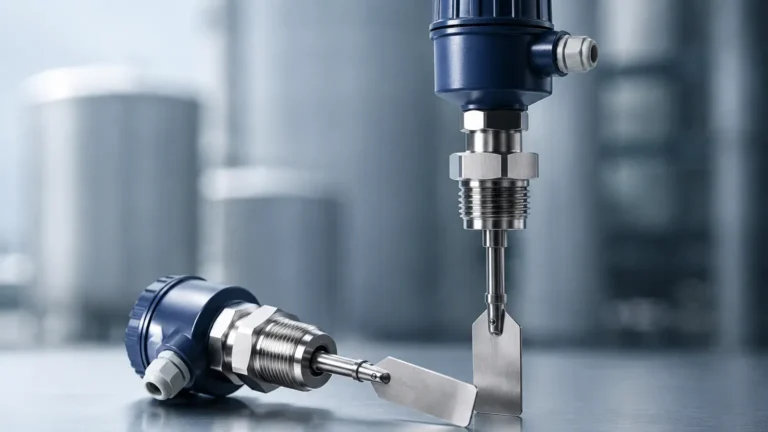
2. Vibrating Level Switches (Tuning Fork)
Vibrating switches use a piezoelectric crystal to vibrate a metal fork at its natural resonant frequency in the air. When the fork is covered by a liquid or solid, the frequency shifts or the vibration is dampened. This change is detected by the electronics and converted into a switching signal.
* Best For: High-precision liquid detection, foam-prone environments, and powders.
* Advantage: They are virtually unaffected by flow, turbulence, bubbles, or vibration in the tank.
3. Capacitive Level Switches
Capacitive switches treat the probe and the tank wall (or a second probe) as two plates of a capacitor. As the medium displaces air around the probe, the dielectric constant changes, altering the measured capacitance. Modern capacitive Level Switches often include "active shield" technology to ignore material buildup on the probe.
* Best For: Corrosive chemicals, high-temperature applications, and granular solids.
* Limitation: Requires the medium to have a stable dielectric constant.
4. Ultrasonic Level Switches
These switches utilize a pair of ultrasonic transducers separated by a small gap. When the gap is filled with air, the ultrasonic signal is attenuated. When liquid fills the gap, the signal is transmitted efficiently. This "gap technology" is highly reliable for liquid detection without moving parts.
* Best For: Highly viscous liquids and applications where mechanical floats might jam.
* Metric Range: Often used in small vessels with narrow installation clearances (e.g., 20 mm to 50 mm gaps).
5. Optical Level Switches
Optical switches use an infrared LED and a light receiver housed within a polymer or glass prism. In air, the IR light reflects internally within the prism back to the receiver. When liquid covers the prism, the light is refracted into the liquid, and the receiver detects a loss of signal.
* Best For: Leak detection in double-walled pipes and small pharmaceutical vessels.
* Limitation: Not suitable for liquids that leave a thick, opaque coating on the sensor tip.
6. Rotary Paddle Switches
Designed specifically for bulk solids, these switches use a low-speed motor to rotate a paddle. When the material reaches the paddle, it creates torque that trips a microswitch and stops the motor. When the level drops, a spring returns the motor to its original position.
* Best For: Silos containing grain, plastic pellets, or cement.
* Durability: Built to withstand the heavy impact of falling solids.
7. Conductive Level Switches
Conductive switches use a low-voltage, low-current circuit between two or more electrodes. When a conductive liquid (like water or acids) touches the electrodes, the circuit is completed. These are often used in arrays where multiple probes of different lengths are used to create a series of 7 switches for pump control.
* Best For: Conductive liquids in wastewater and food processing.
* Constraint: Cannot be used with non-conductive liquids like oils or ultrapure water.
Selection Criteria: 7 Factors to Confirm
When specifying an array of 7 switches or a single critical point sensor, engineers must evaluate the following criteria to ensure long-term reliability:
1. Media Characteristics: Is the material a liquid, solid, or slurry? What is its density (kg/m³) and viscosity (cP)?
2. Process Temperature: Standard switches operate up to 80°C, but specialized high-temperature versions can exceed 250°C.
3. Operating Pressure: Ensure the switch housing and seals can withstand the maximum vessel pressure, often measured in bar or MPa.
4. Chemical Compatibility: Select wetted materials (SS316L, PTFE, PP, PVDF) that are resistant to the process media.
5. Mounting Requirements: Determine if the switch will be mounted at the top (vertical) or the side (horizontal) of the tank.
6. Output Type: Choose between relay contacts (SPDT/DPDT), PNP/NPN transistors, or two-wire loop-powered signals.
7. Hazardous Area Ratings: Confirm if ATEX, IECEx, or SIL2/3 certifications are required for explosive or safety-critical environments.
Practical Selection Table for Level Switches
| Technology | Media Type | Temp. Range (°C) | Max Pressure (bar) | Buildup Resistance | Moving Parts |
| :— | :— | :— | :— | :— | :— |
| Float | Clean Liquids | -40 to 150 | Up to 40 | Low | Yes |
| Tuning Fork | Liquids/Solids | -50 to 150 | Up to 64 | High | No |
| Capacitive | Liquids/Solids | -100 to 250 | Up to 100 | Very High | No |
| Ultrasonic | Viscous Liquids | -40 to 100 | Up to 20 | Medium | No |
| Optical | Clean Liquids | -20 to 85 | Up to 50 | Low | No |
| Rotary Paddle | Bulk Solids | -20 to 80 | Atmospheric | Medium | Yes |
| Conductive | Conductive Liq. | -20 to 100 | Up to 10 | High | No |

Installation and Maintenance Considerations
To ensure the accuracy of a system using multiple level switches, installation must follow strict engineering guidelines:
* Avoid Turbulence: Do not install switches directly in the path of the tank inlet. If turbulence is unavoidable, use a stilling well.
* Orientation: Vibrating forks should be oriented so that material can easily flow off the blades to prevent false triggers.
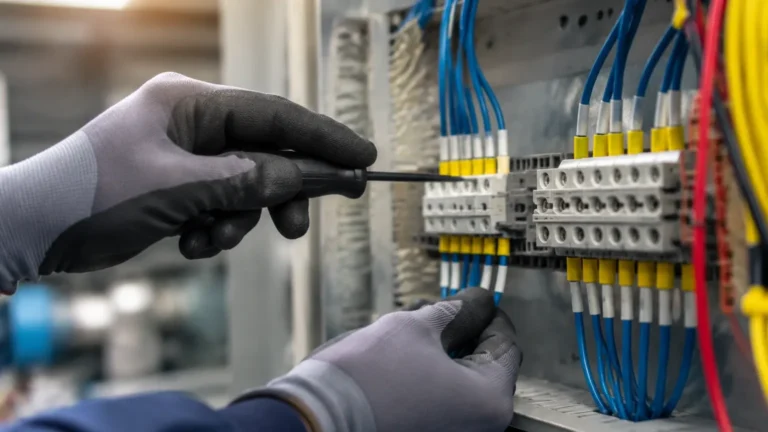
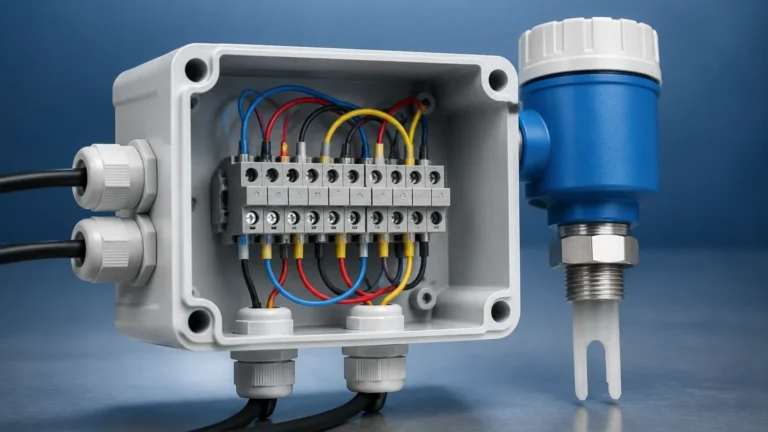
* Wiring: For systems involving 7 switches, proper labeling and the use of multi-core shielded cables are necessary to prevent electromagnetic interference (EMI) and signal confusion at the PLC.
* Calibration: While many switches are "plug-and-play," capacitive and ultrasonic types may require sensitivity adjustment to account for the specific dielectric or acoustic properties of the media.
Limitations and Common Risks
While level switches are robust, they are not infallible. Common risks include:
* Coating and Scaling: In wastewater or chemical crystallization processes, material can build up on the sensor. Vibrating forks and capacitive sensors are better suited for these environments than floats.
* Turbulence and Surface Waves: Rapidly fluctuating levels can cause "chatter" in the switch. This is typically mitigated using a time-delay relay or software-based debouncing in the control system.
* Density Shifts: Float switches rely on a specific gravity (SG) difference. If the liquid density drops below the float's design limit (e.g., if a tank is switched from water to a light solvent), the float will sink and the switch will fail.
Frequently Asked Questions (FAQs)
Q: Can I use a single probe to get 7 switches/setpoints?
A: Yes, multi-point float switches and conductive probe arrays allow for multiple setpoints on a single mounting flange. Alternatively, a continuous radar or ultrasonic transmitter can be programmed with 7 discrete alarm outputs via a PLC.
Q: What is the difference between N/O and N/C in level switches?
A: N/O (Normally Open) means the circuit is open when the switch is not activated. N/C (Normally Closed) means the circuit is closed. For safety-critical high-level alarms, N/C is often preferred because a wire break will trigger the alarm (fail-safe).
Q: How do I handle 7 switches in a high-pressure steam boiler?
A: For high-pressure and high-temperature steam applications, magnetic level gauges with external reed switch arrays or high-temperature capacitive probes are the standard choice due to their robust sealing and material properties.
For more technical specifications and to explore various models, you can Review product options and application support to find the ideal solution for your specific industrial environment.