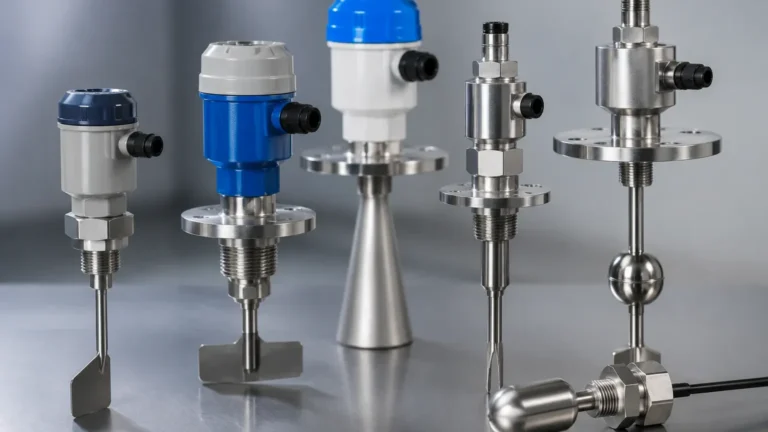
Different Types of Level Switches
Different Types of Level Switches
In industrial process control, level switches serve as critical components for automation, safety, and inventory management. Unlike continuous level transmitters that provide a constant stream of data regarding the exact height of a medium, level switches are point-level detection devices. They operate on a binary principle: they trigger an electrical signal when the material—whether liquid, slurry, or solid—reaches a predetermined height in a tank, silo, or pipe.
Selecting the correct instrument from the many different types of level switches requires a deep understanding of measurement principles, media characteristics, and environmental constraints. This guide provides a technical overview of the primary technologies used in modern engineering to help professionals specify the right solution for their applications.
Understanding Level Switch Principles
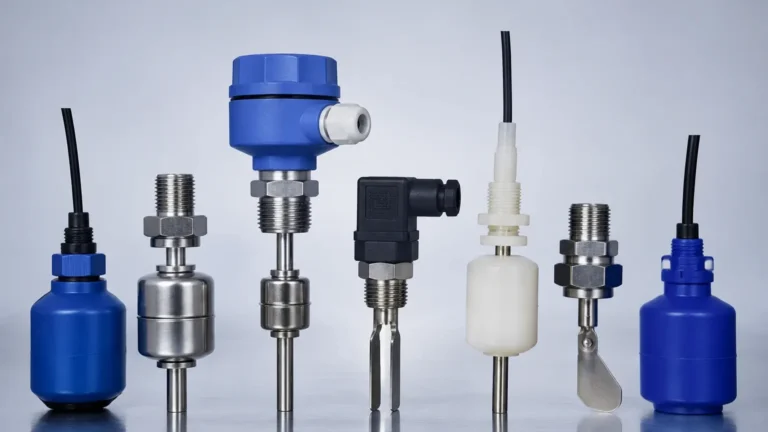
Before evaluating specific hardware, it is essential to understand the physical principles that govern point level detection. Level switches generally fall into four categories based on their interaction with the medium:
1. Mechanical/Buoyancy: These rely on the physical displacement of the medium to move a float or paddle. The movement mechanically or magnetically actuates a switch.
2. Electrical Properties: These sense changes in conductivity or capacitance. When the medium contacts the probe, the electrical circuit properties change, triggering the output.
3. Vibratory/Acoustic: These use a sensing element (like a tuning fork) that vibrates at a specific frequency in air. When immersed in a liquid or solid, the frequency shifts or the vibration is dampened, which is detected by the electronics.
4. Optical/Pressure: These utilize light refraction or hydrostatic pressure to determine the presence of a medium at a specific point.
Common Different Types of Level Switches
Each technology offers specific advantages depending on the viscosity, density, and corrosiveness of the material being measured.
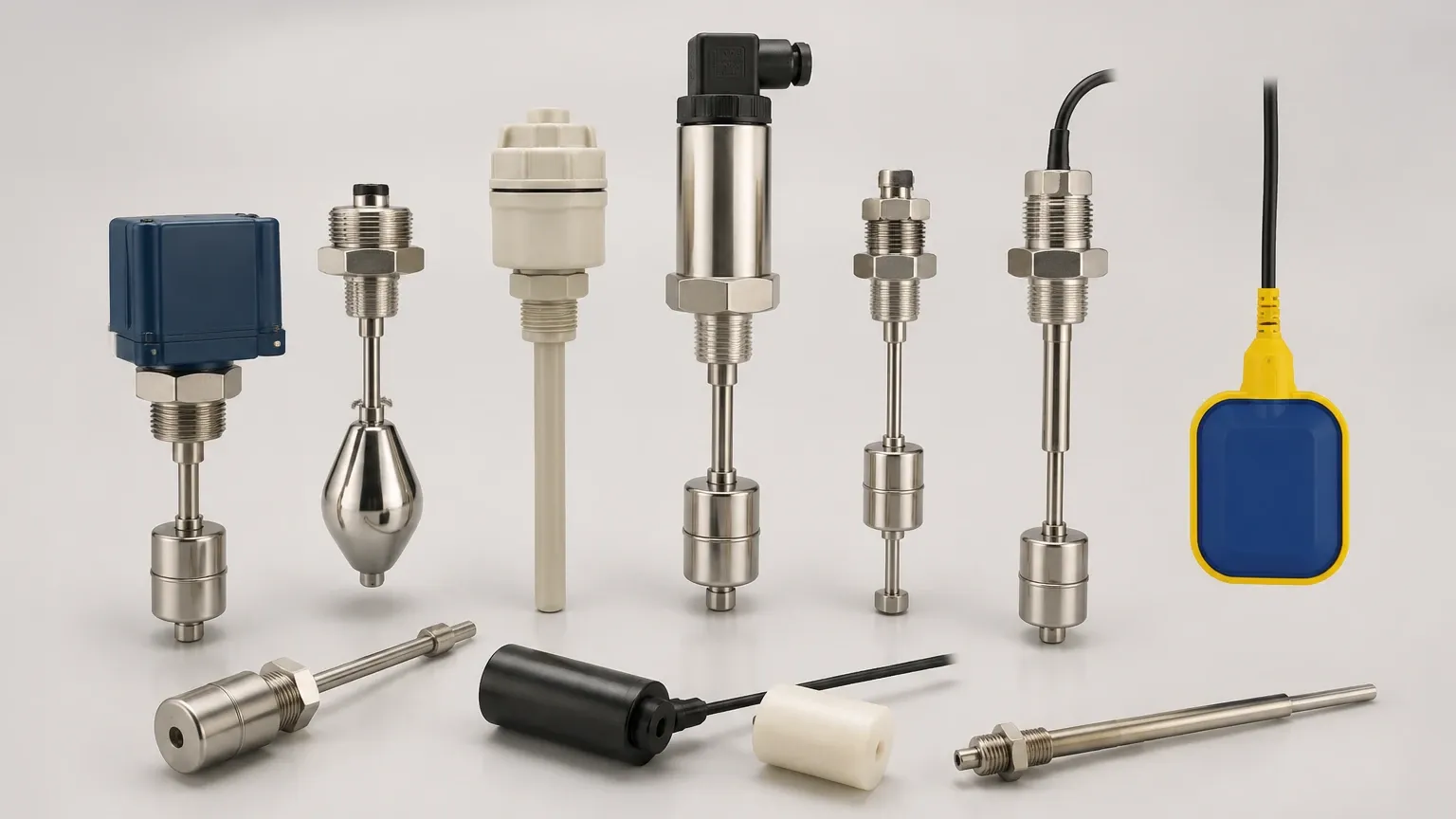
1. Float Level Switches
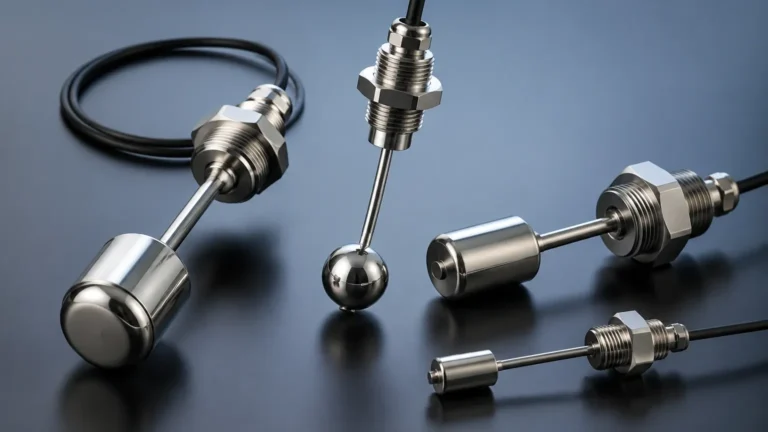
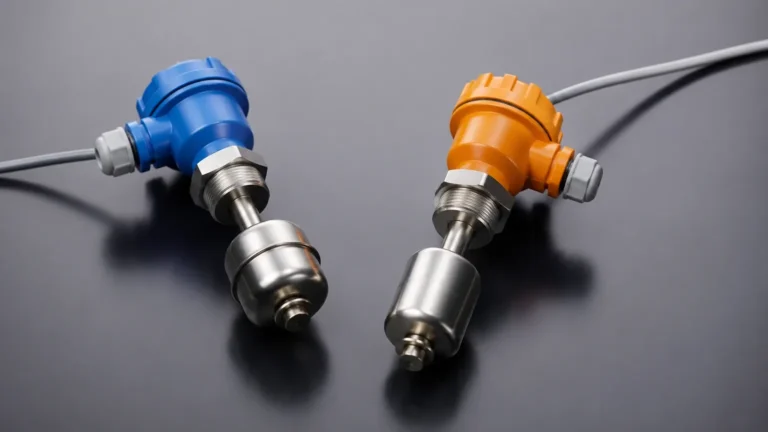
Float switches are among the most established and cost-effective methods for liquid level detection. They operate on the principle of buoyancy. A float, containing a permanent magnet, moves up and down a stem as the liquid level changes. Inside the stem, a reed switch is positioned at the desired trigger point. When the magnet in the float aligns with the reed switch, the circuit closes (or opens).
* Applications: Water treatment, fuel tanks, and lubricant monitoring.
* Advantages: Simple design, no power supply required for the sensing element, and highly reliable in clean liquids.
* Limitations: Not suitable for high-viscosity liquids or media that cause buildup, as the mechanical float can become stuck.
2. Vibrating (Tuning Fork) Level Switches
Vibrating level switches utilize a tuning fork-shaped element driven by piezoelectric crystals. In air, the fork vibrates at its natural resonant frequency. When the fork is covered by a liquid or solid, the frequency changes or the vibration amplitude drops. The internal electronics detect this shift and switch the output.
* Applications: Overfill protection in chemical tanks, dry run protection for pumps, and detection of powders or granulates.
* Advantages: Immune to changes in dielectric constant, density (to a degree), and turbulence. They are virtually maintenance-free as they have no moving parts.
* Limitations: Extreme coating or very high-viscosity materials may dampen the vibration prematurely.
3. Capacitance Level Switches
Capacitance switches operate by measuring the change in electrical capacitance between a probe and the tank wall (or a second probe). Every material has a dielectric constant. When the air surrounding the probe is replaced by the process medium, the capacitance increases. The switch triggers when this change exceeds a set threshold.
* Applications: Corrosive chemicals, liquid-liquid interface detection, and food processing.
* Advantages: Can withstand high temperatures and pressures. They are compact and can be used for both liquids and solids.
* Limitations: Requires calibration for the specific medium. Significant buildup on the probe can lead to false readings unless the switch features "active shield" technology.
4. Conductivity Level Switches
Conductivity switches are used exclusively for conductive liquids. The system consists of a low-voltage power source and two or more electrodes. When the liquid reaches the electrodes, it completes an electrical circuit. One electrode serves as a reference (ground), while others are set at high or low trip points.
* Applications: Wastewater, acids, and boiler water level control.
* Advantages: Extremely simple, low cost, and can monitor multiple points with a single installation.
* Limitations: Cannot be used with non-conductive liquids like oils or distilled water. Probes are susceptible to corrosion if not specified correctly.
5. Rotary Paddle Level Switches
Specifically designed for bulk solids, these switches use a low-speed motor that rotates a paddle. When the material reaches the paddle, the rotation is impeded. The resulting torque causes the motor to shift on its mounting, tripping a microswitch and cutting power to the motor.
* Applications: Grain silos, sand hoppers, and plastic pellet bins.
* Advantages: Robust and easy to install in heavy-duty industrial environments.
* Limitations: Mechanical wear of the motor and paddle over time; not for use with liquids.
Engineering Selection Criteria
When choosing between Level Switches, engineers must evaluate the following parameters to ensure long-term reliability:
| Criteria | Considerations |
| :— | :— |
| Media State | Liquid, slurry, powder, or granular solid? |
| Chemical Compatibility | Does the probe material (SS304, SS316, PTFE, PP) resist the process medium? |
| Process Temperature | Standard switches handle up to 80°C; high-temp versions reach 250°C or more. |
| Process Pressure | Ensure the flange or thread rating matches the vessel's maximum pressure (e.g., 10 bar, 40 bar). |
| Mounting Orientation | Side-mounted (horizontal) or top-mounted (vertical)? |
| Output Type | Relay (SPDT/DPDT), PNP/NPN, or NAMUR for hazardous areas. |
Installation and Maintenance Considerations
Proper installation is as critical as technology selection. For float switches, ensure there is sufficient clearance from tank walls and internal structures like agitators to prevent mechanical interference. For tuning fork switches, the orientation of the forks is important; in liquid applications, they should be oriented so that the liquid can easily drain off the tines to avoid false "wet" signals.
Key Installation Tips:
* Avoid Turbulence: Do not install switches directly under a fill pipe. If turbulence is unavoidable, use a stilling well.
* Cable Entry: Always point cable glands downward or use a drip loop to prevent moisture from entering the housing via the conduit.
* Grounding: For capacitance and conductivity switches, ensure the tank is properly grounded, or use a reference electrode in non-metallic tanks.
Maintenance requirements vary by type. Mechanical switches should be inspected periodically for scale buildup or pivot wear. Electronic switches like tuning forks generally only require a visual check to ensure the sensing element isn't physically damaged or excessively coated.
Limitations of Point Level Detection
While level switches are indispensable for safety and basic control, they have inherent limitations:
* No Trend Data: They cannot tell you if a tank is 40% or 60% full; they only indicate if it has passed a specific point.
* Fixed Points: Once installed, the switching point is physically fixed. Changing the level setpoint often requires re-drilling the tank or using an adjustable mounting sleeve.
* Media Sensitivity: Some switches (like conductivity or capacitance) are highly dependent on the electrical properties of the medium. If the process fluid changes, the switch may require recalibration.
Frequently Asked Questions
Q: Can I use a liquid level switch for solids?
A: Generally, no. A float switch will not work in solids. However, vibrating tuning fork switches have specific versions designed for low-density powders, and capacitance switches can often handle both.
Q: What is the difference between N.O. and N.C. in level switches?
A: N.O. (Normally Open) means the circuit is open when the switch is not activated. N.C. (Normally Closed) means the circuit is closed. For safety applications like high-level alarms, N.C. is often preferred so that a wire break triggers an alarm (fail-safe).
Q: How do I handle viscous liquids that stick to the probe?
A: Vibrating forks with high-frequency electronics or capacitance switches with "coat-rejection" or "active shield" technology are the best choices for sticky or viscous media.
Q: Are there switches for high-pressure boilers?
A: Yes, specialized magnetic float switches or conductivity probes with ceramic-to-metal seals are designed specifically for high-pressure and high-temperature steam applications.
For professional-grade measurement, Welk provides a comprehensive range of industrial level instruments. Whether you require a simple float for a water tank or a sophisticated tuning fork for a chemical reactor, understanding the different types of level switches ensures your process remains safe, efficient, and compliant with industrial standards.