Electrode Level Switches
Electrode Level Switches
In the landscape of industrial process control, point level detection remains a fundamental requirement for safety, inventory management, and automation. Among the various technologies available, electrode level switches—often referred to as conductive level switches—stand out as a robust, cost-effective, and reliable solution for managing conductive liquids. These instruments are essential in applications ranging from simple pump control in water treatment plants to complex high-low alarm systems in chemical processing facilities.
Selecting the right instrumentation requires a deep understanding of the underlying physics, the chemical compatibility of the materials, and the specific constraints of the installation environment. As a professional manufacturer, Welk provides a comprehensive range of Level Switches designed to meet these rigorous industrial standards.
Understanding the Measurement Principle of Electrode Level Switches
The operation of electrode level switches is based on the electrical conductivity of the process medium. Unlike float switches that rely on buoyancy or ultrasonic sensors that use sound waves, conductive switches use the liquid itself as part of an electrical circuit.
The Conductive Circuit
An electrode level switch system typically consists of a controller (relay unit) and one or more sensing probes (electrodes). The probes are mounted into the vessel at the desired detection points. When the conductive liquid rises and makes contact with the electrode, it completes an electrical path between the probe and a reference electrode (or the metallic tank wall, which acts as the ground).
AC vs. DC Excitation
To prevent the buildup of ions and the eventual degradation of the electrodes through electrolysis, modern electrode level switches use a low-voltage Alternating Current (AC) signal rather than Direct Current (DC). This AC signal passes through the liquid to the controller, which then triggers a relay output to start or stop a pump, open a valve, or activate an alarm. The sensitivity of the controller can often be adjusted to account for liquids with varying degrees of conductivity.
Minimum Conductivity Requirements
For the switch to function correctly, the liquid must have a minimum level of conductivity, typically measured in microsiemens per centimeter (µS/cm). Most industrial electrode switches require the medium to have a conductivity of at least 5 µS/cm to 10 µS/cm. This makes them ideal for water, acids, alkalis, and various aqueous solutions, but unsuitable for non-conductive fluids like oils, hydrocarbons, or pure distilled water.
Key Components and Construction Materials
The durability of electrode level switches in harsh environments depends heavily on their construction. Because the electrodes are in direct contact with the process media, material selection is critical to prevent corrosion and ensure long-term stability.
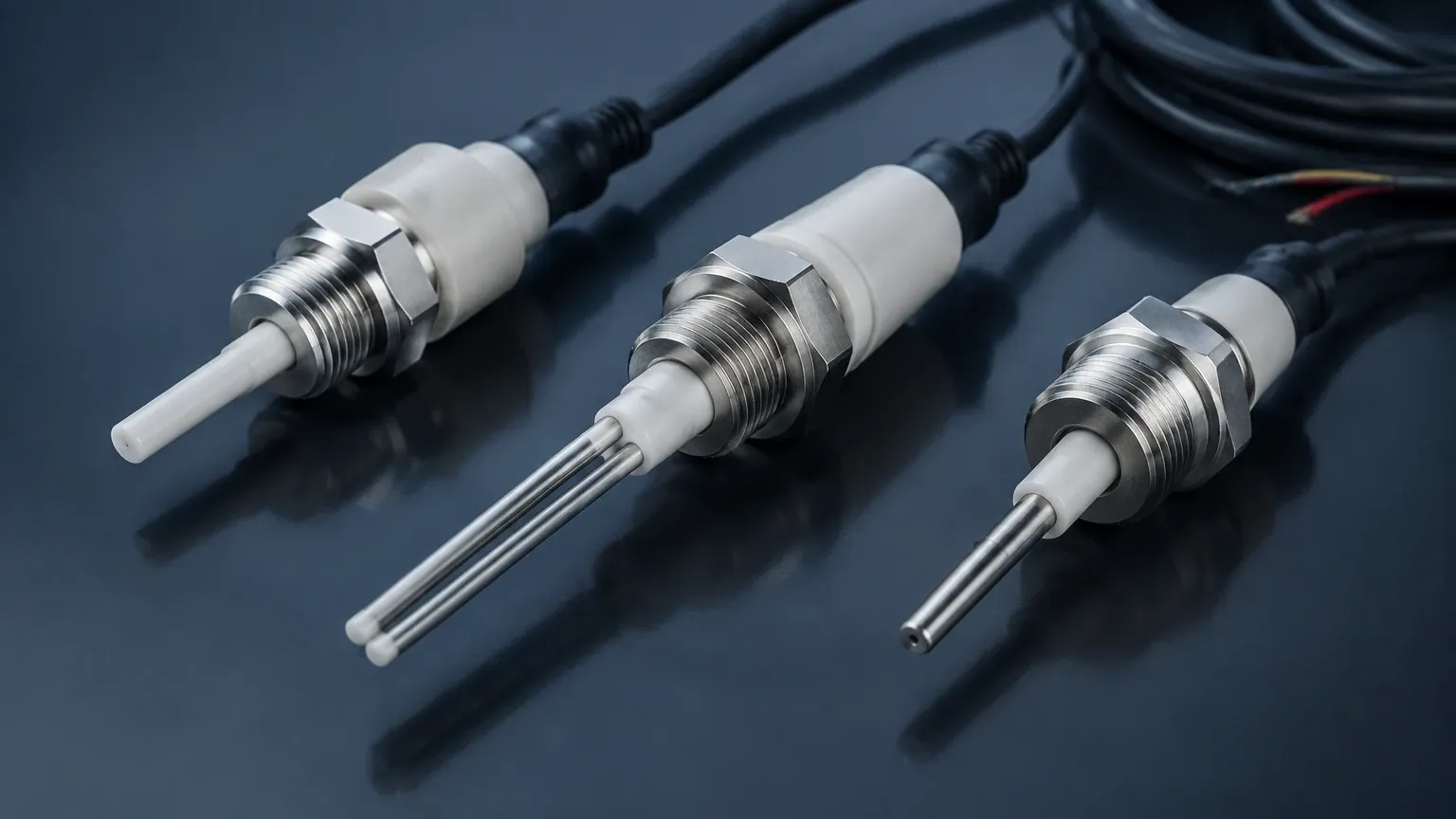
1. Sensing Probes (Electrodes): These are usually manufactured from Stainless Steel 304 or 316L. For highly aggressive chemical environments, electrodes may be coated with protective materials such as PTFE (Polytetrafluoroethylene) or Polyolefin, leaving only the very tip exposed for sensing.
2. Insulators: The probes must be electrically isolated from the tank mounting and from each other. High-performance plastics or ceramics are used to provide this insulation, ensuring that the circuit is only completed by the liquid and not by moisture or condensation on the mounting head.
3. Mounting Heads: The housing that holds the electrodes can be made of reinforced plastics (like PP or ABS) for light-duty applications or die-cast aluminum and stainless steel for heavy-duty industrial use. These housings often carry IP65 to IP68 ratings for dust and water resistance.
4. The Controller/Relay Unit: This is the "brain" of the system. It is usually mounted remotely in a control panel or integrated into the head of the sensor. It converts the micro-current signal from the probes into a standard industrial output, such as a SPDT (Single Pole Double Throw) relay contact.
Technical Selection Criteria for Project Engineering
When specifying electrode level switches for a project, engineers must evaluate several parameters to ensure the device will operate reliably over its intended lifespan. The following table provides a general guideline for selecting components based on the application environment.
Selection Reference Table
| Feature | Standard Water Treatment | Chemical Processing | High-Temperature Steam | Boiler Feedwater |
| :— | :— | :— | :— | :— |
| Probe Material | SS304 / SS316 | SS316L + PTFE Coating | Titanium or Hastelloy | SS316 |
| Insulation | PVC / Polyolefin | PTFE / FEP | Ceramic | PEEK / Ceramic |
| Max Temperature | 80°C (176°F) | 120°C (248°F) | 250°C (482°F) | 200°C (392°F) |
| Max Pressure | Atmospheric | 1.0 MPa (145 psi) | 4.0 MPa (580 psi) | 2.5 MPa (362 psi) |
| Mounting | Threaded (G1", G1.5") | Flanged (ANSI/DIN) | High-Pressure Flange | Threaded / Flanged |
Sensitivity Adjustment
Different liquids have different resistance levels. For example, wastewater has higher conductivity than purified process water. A high-quality controller should allow for sensitivity adjustments (often ranging from 5kΩ to 100kΩ) to prevent "false positives" caused by foam or high humidity while ensuring the switch triggers reliably when the liquid level is reached.
Industrial Application Suitability
Electrode level switches are versatile tools across many sectors. Their lack of moving parts makes them particularly attractive in applications where mechanical float switches might fail due to clogging or jamming.
* Water and Wastewater: Used for pump control in sumps, well level monitoring, and overflow protection in storage tanks. Because they can support multiple probes in a single mounting head, one device can manage "Pump Start," "Pump Stop," and "High Alarm."
* Food and Beverage: Conductive switches are used in mixing tanks for milk, juices, and beer. Hygienic versions with tri-clamp fittings and polished stainless steel probes ensure compliance with sanitary standards.
* Chemical Industry: For monitoring levels of acids, bases, and electrolytes. The use of PTFE-coated probes allows these switches to operate in highly corrosive environments where other sensors would degrade rapidly.
* Boiler Control: In steam boilers, electrode switches are critical for low-water cut-off (LWCO) safety functions. They must be rated for high temperature and pressure to ensure boiler safety and prevent "dry firing."
Installation and Maintenance Guidelines
Proper installation is paramount to the accuracy of electrode level switches. Even the most robust sensor can provide erratic readings if installed incorrectly.
Vertical vs. Horizontal Mounting
Electrode switches are almost exclusively mounted vertically from the top of the tank. This allows the probes to hang down to the specific depths required for detection. If horizontal mounting is necessary, specialized short-probe versions must be used, and care must be taken to ensure the liquid drains away from the insulator to prevent bridging.
Preventing Interference and False Triggers
1. Electrode Spacing: Probes should be kept at a consistent distance from each other. In deep tanks, spacers (separators) are used every 1m to 1.5m (3.3 to 5 ft) to prevent the rods from touching due to liquid turbulence.
2. Turbulence and Stillwells: If the tank has an agitator or high-velocity inflow, the electrodes should be installed inside a stillwell (a pipe that dampens liquid movement) to ensure a stable surface level.
3. Grounding: In non-metallic tanks (plastic or fiberglass), a "common" or "reference" electrode must be installed that reaches deeper than the lowest control electrode. In metallic tanks, the tank wall itself can serve as the reference.
Maintenance Procedures
While electrode switches have no moving parts, they are not entirely maintenance-free. In liquids that cause scaling or have high suspended solids, a film can build up on the probes. This film can act as an insulator, preventing the probe from detecting the liquid, or it can hold moisture, causing the switch to stay "on" even after the level has dropped. Periodic cleaning with a non-abrasive cloth or chemical descaling agent is recommended.
Limitations and Prohibitions
Despite their advantages, electrode level switches are not a universal solution. Engineers must be aware of the following limitations:
* Non-Conductive Media: They cannot detect oils, diesel, pure alcohols, or demineralized water with conductivity below the threshold.
* Coating and Fouling: Liquids that leave a thick, non-conductive coating (like heavy grease or paraffin) will eventually insulate the probes and cause failure.
* Explosive Environments: While intrinsically safe barriers can be used with conductive switches, extra care must be taken in hazardous zones. In many cases, non-contact radar or ultrasonic sensors may be preferred for flammable liquids.
* Electrolysis Risk: If a DC voltage is used instead of AC, the probes will corrode rapidly and the liquid may be contaminated. Always verify the controller uses an AC sensing signal.
Frequently Asked Questions (FAQs)
Q: Can I cut the electrode rods to a specific length on-site?
A: Yes, most stainless steel rod electrodes are designed to be cut to the required length during installation. However, if the probes are factory-coated with PTFE, cutting them may require resealing the tips to maintain chemical resistance.
Q: How many points can a single electrode level switch monitor?
A: Standard industrial heads typically support between 1 and 5 electrodes (plus a common electrode). This allows for up to five distinct level points in a single tank penetration.
Q: What is the maximum length for the electrode probes?
A: For rigid rods, the practical limit is usually around 3m to 4m (10 to 13 ft) due to weight and the risk of bending. For deeper tanks, cable-type electrodes with weighted ends are used, which can reach depths of up to 20m (65 ft) or more.
Q: Will foam trigger an electrode level switch?
A: It depends on the conductivity of the foam. In many cases, dense, conductive foam will trigger the switch. If foam is a problem, the sensitivity of the controller should be turned down, or a different technology, like a vibration fork level switch, should be considered.
Conclusion
Electrode level switches provide a highly reliable and cost-effective method for point level detection in conductive liquids. By eliminating moving parts and utilizing the inherent properties of the process media, these devices offer a long-service life with minimal maintenance. For engineers and procurement professionals, selecting the correct probe materials and ensuring proper controller sensitivity are the keys to a successful installation. Whether managing simple water storage or complex chemical processing, the right Level Switches are an indispensable component of modern industrial automation.