Level Switch Ultrasonic
Level Switch Ultrasonic
In the landscape of industrial automation, point level detection serves as a critical safeguard for process efficiency and safety. Among the various technologies available, the level switch ultrasonic stands out as a versatile solution for detecting the presence or absence of liquids in tanks, pipes, and vessels. Utilizing high-frequency sound waves, these instruments provide reliable switching without the mechanical wear associated with traditional float-based systems.
As a professional manufacturer, Welk specializes in providing advanced level measurement instruments tailored for water treatment, chemical processing, and industrial automation. This guide explores the technical principles, selection criteria, and installation best practices for ultrasonic level switches to assist engineers in making informed procurement decisions.
Measurement Principles of Ultrasonic Level Switches
Ultrasonic technology for level switching generally operates on one of two primary principles: the ultrasonic gap (contact) method or the non-contact pulse-echo method. Understanding these principles is essential for selecting the correct instrument for a specific application.
The Ultrasonic Gap Principle (Contact)
An ultrasonic gap switch consists of a sensor head with two piezoelectric crystals separated by a small physical gap. One crystal acts as a transmitter, while the other acts as a receiver.
* Dry State: When the gap is filled with air or gas, the ultrasonic signal emitted by the transmitter is attenuated and cannot reach the receiver because air is a poor conductor of high-frequency sound waves.
* Wet State: When liquid enters the gap, the acoustic impedance changes. The liquid acts as a bridge, allowing the ultrasonic signal to pass through the gap to the receiver. This change in signal reception triggers the internal electronics to change the state of the output relay or transistor.
The Pulse-Echo Principle (Non-Contact)
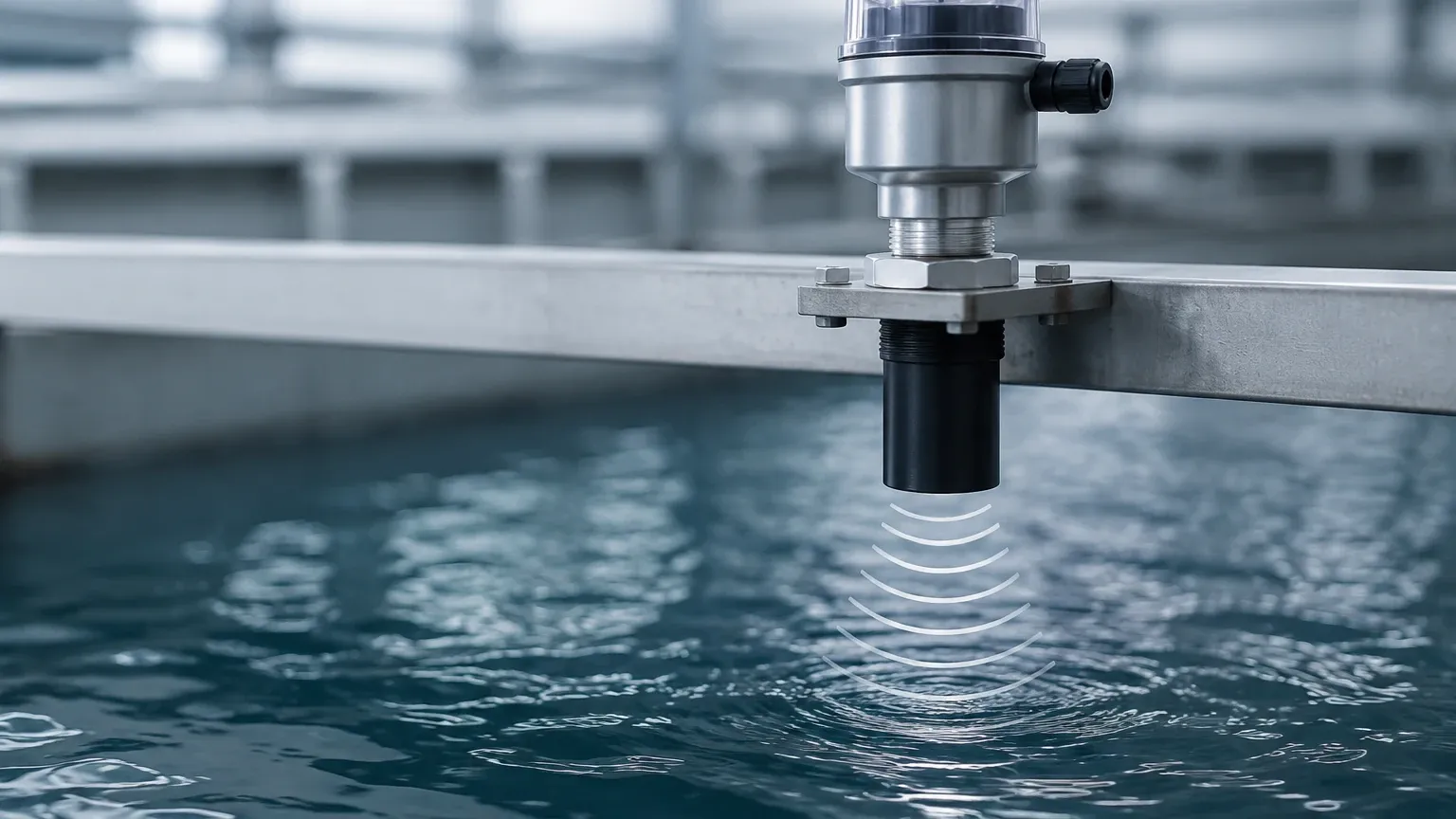
While many non-contact ultrasonic devices are used for continuous level measurement, they can also be configured as point level switches. These devices emit a burst of ultrasonic energy toward the surface of the material. The sensor measures the "Time of Flight" (ToF)—the time it takes for the pulse to travel to the surface and reflect back. If the measured distance matches a pre-programmed setpoint, the switch is activated. This method is ideal for applications where the sensor must remain isolated from corrosive or hazardous media.
Key Advantages of Level Switch Ultrasonic Technology
Choosing a level switch ultrasonic over mechanical or capacitive alternatives offers several distinct benefits for industrial operators:
1. No Moving Parts: Unlike float switches, ultrasonic sensors have no mechanical components that can jam, corrode, or wear out over time. This significantly reduces maintenance requirements and increases the mean time between failures (MTBF).
2. Media Independence: Ultrasonic gap switches are largely unaffected by changes in the dielectric constant, conductivity, or density of the liquid, provided the liquid can transmit sound.
3. Compact Design: Many ultrasonic switches feature a small footprint, making them suitable for installation in small-diameter pipes or tight vessel spaces.
4. High Reliability: Advanced electronics in Welk instruments allow for self-diagnostics and high immunity to electrical noise and vibration.
Technical Selection Criteria
Selecting the right level switch ultrasonic requires a thorough evaluation of the process environment. Engineers should consider the following parameters before finalizing a specification.
Selection Table: Ultrasonic vs. Other Point Level Technologies
| Feature | Ultrasonic Gap Switch | Tuning Fork (Vibrating) | Float Switch |
| :— | :— | :— | :— |
| Moving Parts | None | Minimal (Vibration) | Yes |
| Viscosity Limit | Up to 5,000 cP | Up to 10,000 cP | Low |
| Foam Sensitivity | Low (Contact type) | High | Moderate |
| Coating/Buildup | Moderate Sensitivity | Low Sensitivity | High Sensitivity |
| Installation | Any orientation | Any orientation | Vertical/Horizontal |
Application Variables
* Viscosity: While ultrasonic switches handle many liquids, extremely viscous fluids (e.g., heavy resins or thick syrups) may attenuate the signal too much or cause "bridging" across the gap. Generally, liquids with a viscosity below 5,000 cP are ideal.
* Aeration and Bubbles: Excessive entrained air or heavy foaming can interfere with sound transmission. In such cases, a contact-type gap switch is often more reliable than a non-contact pulse-echo switch, as the gap switch is submerged in the liquid.
* Temperature and Pressure: Standard ultrasonic switches typically operate within a range of -40°C to 125°C (-40°F to 257°F). For high-pressure applications, ensure the sensor housing and seal materials are rated for the specific vessel pressure.
Installation Considerations and Best Practices
Proper installation is paramount to the performance of a level switch ultrasonic. Incorrect placement can lead to false triggers or failure to detect the liquid level.
Positioning for Gap Switches
Ultrasonic gap switches can be mounted horizontally or vertically.
* Horizontal Mounting: This is the most common orientation for high or low-level alarms. The gap should be oriented vertically (with the slot facing up and down) to allow liquid to drain freely and prevent air bubbles from becoming trapped in the gap.
* Vertical Mounting: When mounted from the top of a tank, the switch can detect the rising level. It is important to ensure the gap is fully submerged at the desired trip point.
Avoiding Turbulence and Obstructions
For non-contact ultrasonic switches, the sensor must have a clear line of sight to the liquid surface.
* Beam Angle: The ultrasonic pulse spreads in a cone shape. Ensure there are no ladders, pipes, or agitators within this beam path.
* Dead Zone: All non-contact sensors have a "blocking distance" or dead zone near the sensor face where measurements are impossible. Ensure the maximum liquid level does not enter this zone.
* Nozzle Height: If mounting the sensor on a nozzle, the nozzle diameter and height must be configured so they do not interfere with the ultrasonic pulse.
Common Applications in Industry
Welk Level Switches are deployed across various sectors to solve complex measurement challenges:
* Chemical Processing: Detecting levels in reagent tanks where corrosive liquids might damage mechanical components. The use of Tefzel® or stainless steel sensors provides excellent chemical resistance.
* Water and Wastewater: Pump control in sumps and wet wells. Ultrasonic switches are preferred here because they are not affected by the debris or grease that often fouls float switches.
* Food and Beverage: High-level alarm systems in storage tanks. Hygienic versions with Tri-Clamp fittings ensure compliance with sanitary standards.
* Industrial Automation: Overfill protection in hydraulic oil reservoirs and coolant tanks for CNC machinery.
Limitations and Environmental Factors
While highly versatile, the level switch ultrasonic is not a universal solution. Certain environmental factors can limit its effectiveness:
1. Vacuum Conditions: Sound requires a medium to travel. In a total vacuum, ultrasonic waves cannot propagate, making these switches unusable.
2. Heavy Foam: Thick, dense foam can absorb ultrasonic energy. In non-contact applications, the signal may not return to the sensor. In contact applications, the foam might not be dense enough to trigger the gap switch, which can be an advantage if only the liquid level needs to be detected.
3. High-Pressure Vapors: Some gases at high pressure can change the speed of sound significantly, potentially affecting the accuracy of non-contact distance-based switching.
Maintenance and Troubleshooting
Maintenance requirements for ultrasonic switches are minimal, but periodic inspections are recommended:
* Cleaning: In applications with scaling or heavy buildup, the sensor gap or face should be cleaned periodically to prevent signal attenuation. Use a soft cloth and a compatible solvent.
* Signal Integrity: If the switch fails to trigger, check for air bubbles trapped in the gap or excessive coating on the sensor faces.
* Wiring Check: Ensure that the cable entry is sealed to prevent moisture ingress, which can damage the internal electronics.
Frequently Asked Questions (FAQs)
Q: Can an ultrasonic level switch detect the interface between two liquids?
A: Standard ultrasonic gap switches are typically designed to detect the presence of any liquid. However, if the two liquids have significantly different acoustic impedances, specialized ultrasonic interface switches can be calibrated to detect the transition between them.
Q: Is the switch affected by the color or transparency of the liquid?
A: No. Unlike optical sensors, ultrasonic technology relies on mechanical sound waves and is completely unaffected by the color, transparency, or opacity of the media.
Q: What is the typical response time for an ultrasonic level switch?
A: Most industrial ultrasonic switches have a response time of less than one second, making them suitable for rapid filling or emptying processes.
Conclusion
The level switch ultrasonic offers a robust, low-maintenance alternative to mechanical level detection. By leveraging the principles of acoustic impedance and time-of-flight, these instruments provide precise point level control across a wide array of industrial media. When selecting a switch, engineers must balance the physical properties of the liquid—such as viscosity and aeration—with the specific requirements of the installation environment.
For technical specifications and to explore the full range of point level solutions, including ultrasonic, radar, and magnetic technologies, visit the Welk product catalog for Level Switches. Our engineering team is available to provide customized OEM/ODM services to ensure your level measurement systems operate with maximum accuracy and reliability.