Level Sensor Infrared
Level Sensor Infrared
In the diverse field of industrial automation, selecting the appropriate point level detection technology is critical for system reliability, safety, and efficiency. Among the various methods used to monitor liquid levels in tanks, pipes, and reservoirs, the level sensor infrared—frequently categorized under the broader umbrella of optical Level Switches—stands out for its compact design, lack of moving parts, and high sensitivity.
This guide provides a comprehensive technical overview of infrared level measurement, detailing the physical principles that govern these devices, their practical advantages in industrial settings, and the specific engineering considerations required for successful deployment.
Measurement Principles: The Physics of Refraction
The operation of a level sensor infrared is based on the principles of optical refraction and reflection, specifically the behavior of light as it passes between media of different densities. Unlike ultrasonic sensors that rely on sound waves or capacitive sensors that measure dielectric changes, infrared sensors utilize light in the near-infrared spectrum (typically around 850nm to 940nm).
Total Internal Reflection (TIR)
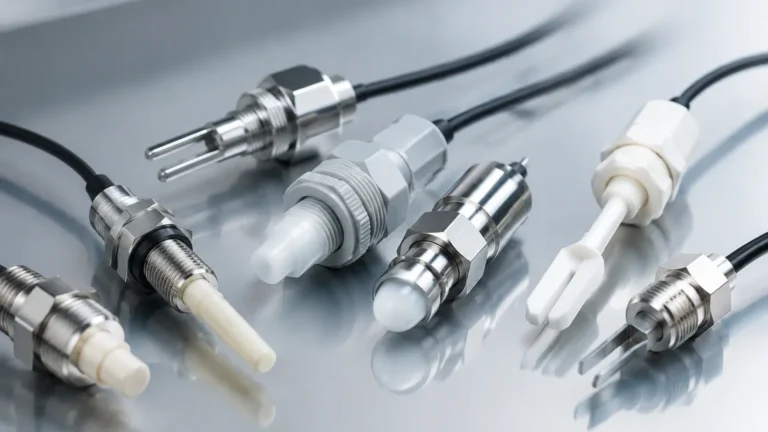
A standard infrared level switch consists of three primary components housed within a single probe: an infrared Light Emitting Diode (LED), a phototransistor (receiver), and a transparent hemispherical or conical prism (the sensor tip).
When the sensor tip is surrounded by air or gas, the infrared light emitted by the LED is reflected internally within the prism. Because the refractive index of the prism material (such as polysulfone or glass) is significantly higher than that of air, the light hits the internal surface of the prism at an angle that causes it to reflect back toward the phototransistor. The receiver detects a high intensity of light, signaling a "dry" state.
Light Refraction in Liquid
When the sensor tip is submerged in a liquid, the refractive index of the surrounding medium changes. Most liquids have a refractive index much closer to that of the prism material than air does. Consequently, the infrared light is no longer reflected internally; instead, it escapes (refracts) through the prism into the liquid. This results in a significant drop in the amount of light returning to the phototransistor. The electronic circuit detects this change in light intensity and toggles the output state, signaling a "wet" condition.
Technical Components and Construction
To ensure durability in industrial environments, manufacturers like Welk design these sensors with robust materials and integrated electronics. Understanding the construction helps engineers determine the sensor's suitability for specific chemical or thermal environments.
1. The Housing and Prism: The most common materials for the optical tip include Polysulfone (PSU), which offers excellent chemical resistance and transparency, or Trogamid. For high-temperature or high-pressure applications, borosilicate glass or fused silica prisms are utilized, often paired with stainless steel housings (typically 316L grade).
2. Internal Electronics: The LED and phototransistor are typically encapsulated in epoxy resin to protect them from vibration and moisture. Modern level sensor infrared units include integrated signal conditioning, allowing for direct connection to Programmable Logic Controllers (PLCs) or DCS systems via NPN, PNP, or push-pull outputs.
3. Sealing: Industrial units often feature IP67 or IP68 ingress protection ratings, ensuring they can withstand washdown procedures or total submersion.
Comparison with Alternative Level Switches
Choosing a level sensor infrared over other technologies depends on the specific requirements of the application. The following table compares infrared technology with other common point level detection methods.
| Feature | Infrared (Optical) | Ultrasonic | Tuning Fork (Vibrating) | Float Switch |
| :— | :— | :— | :— | :— |
| Moving Parts | None | None | None | Yes |
| Size | Extremely Small | Medium | Medium/Large | Large |
| Viscosity Limit | Low to Medium | High | High | Medium |
| Foam Sensitivity | Low | High | Medium | Low |
| Bubbles Sensitivity | High | High | Low | Low |
| Typical Cost | Low to Moderate | Moderate to High | Moderate | Low |
| Response Time | Very Fast (<1ms) | Fast | Moderate | Slow |
Strategic Advantages in Industrial Applications
Space-Constrained Environments
Because the level sensor infrared does not require a large float or a vibrating tine, it can be manufactured in very small form factors. Probes with M12 or even smaller threads are common, making them ideal for leak detection in double-walled pipes, medical laboratory equipment, and small cooling tanks where space is at a premium.
High Reliability and Low Maintenance
The absence of moving parts eliminates the risk of mechanical failure due to wear, jamming, or pivot fatigue. This is a significant advantage over traditional float switches, which can become stuck due to debris or calcification. In clean, non-coating liquids, an infrared switch can operate for years without requiring calibration or cleaning.
Rapid Response Time
Optical sensing is nearly instantaneous. This makes infrared sensors particularly useful in high-speed filling lines or in safety-critical applications where a pump must be shut down immediately upon detecting a dry-run condition to prevent catastrophic damage.

Installation Considerations and Best Practices
Proper installation is paramount to preventing false triggers and ensuring the longevity of the sensor. Engineers should consider the following guidelines during the design and installation phases:
Orientation and Positioning
* Horizontal Mounting: This is the most common orientation for high/low level alarms. The sensor should be installed such that the prism tip is at the exact point where detection is required.
* Vertical Mounting: When mounted from the top of a tank, the sensor can detect the maximum fill level. When mounted from the bottom, it acts as a low-level or dry-run protector.
* Tip Clearance: Ensure there is at least 15mm to 20mm (0.6" to 0.8") of clearance between the sensor tip and any opposite wall or reflective surface. If the sensor is too close to a reflective surface, the infrared light may reflect off the wall and back into the receiver even when the sensor is submerged, leading to a false "dry" reading.
Environmental Interference
* Ambient Light: While most industrial infrared sensors use modulated light to filter out constant background noise, extremely bright sunlight or high-intensity halogen lamps directed at the sensor tip can interfere with the phototransistor. In such cases, using a light-shielded mounting or an opaque housing is recommended.
* Vapor and Condensation: Heavy condensation can occasionally form droplets on the sensor tip. While many sensors are designed to ignore thin films, significant buildup can cause false triggers. Mounting the sensor at a slight downward angle can help droplets run off the prism.
Wiring and Integration
Most infrared level switches operate on DC power (typically 5V to 24V). It is essential to verify the output logic (Normally Open vs. Normally Closed) to ensure the system fails to a safe state. For example, in a high-level alarm application, a "Normally Closed" configuration is often preferred so that a power failure or broken wire triggers the alarm.
Limitations and Prohibitions
While the level sensor infrared is a versatile tool, it is not a universal solution. Engineers must be aware of the following limitations:
1. Coating and Scaling: If the liquid is highly viscous or prone to leaving thick deposits (such as heavy oils, slurries, or crystallizing salts), a coating may form over the prism. This coating can trap light and mimic the presence of liquid even when the tank is empty.
2. Aerated Liquids and Bubbles: Large bubbles or significant aeration in the liquid can reflect light back to the sensor, potentially causing a false "dry" signal in a submerged state. If the process involves significant agitation, a stilling well or a different technology, like a tuning fork switch, may be more appropriate.
3. Refractive Index Matching: In rare cases, if the liquid has a refractive index identical to the prism material, the sensor may not function correctly. However, for most common industrial fluids like water, oils, and alcohols, this is rarely an issue.
Frequently Asked Questions (FAQs)
Can infrared sensors detect the interface between two liquids?
Generally, no. Infrared level switches are binary devices designed to detect the presence or absence of a liquid based on the refractive index difference between the liquid and air. They are not typically sensitive enough to distinguish between two different liquids (e.g., oil and water) unless their refractive indices are vastly different and the sensor is specifically calibrated for that interface.
Are these sensors suitable for hazardous areas?
Yes, many manufacturers provide intrinsically safe (IS) or explosion-proof versions of infrared switches. These are encapsulated in specialized housings and must be used with appropriate Zener barriers or galvanic isolators to limit energy in potentially explosive atmospheres.
How do I clean the sensor prism?
If the sensor tip becomes fouled, it can usually be cleaned with a soft cloth and a mild detergent or solvent compatible with the prism material (e.g., isopropyl alcohol for glass or PSU). Abrasive cleaners should be avoided as scratches on the prism can scatter light and degrade performance.
What is the typical lifespan of a level sensor infrared?
The lifespan is primarily determined by the MTBF (Mean Time Between Failures) of the infrared LED, which is typically in the range of 50,000 to 100,000 hours of continuous operation. In practice, these sensors often last a decade or more in stable industrial environments.
Conclusion
The level sensor infrared represents a sophisticated yet cost-effective solution for point level detection in modern industrial processes. By leveraging the physics of light refraction, these sensors provide a solid-state, low-maintenance alternative to mechanical switches. When selected with careful attention to material compatibility, pressure requirements, and potential environmental interference, they offer unparalleled reliability for critical monitoring tasks. For organizations looking to optimize their liquid management systems, exploring the full range of Level Switches is a vital step toward achieving robust process automation.