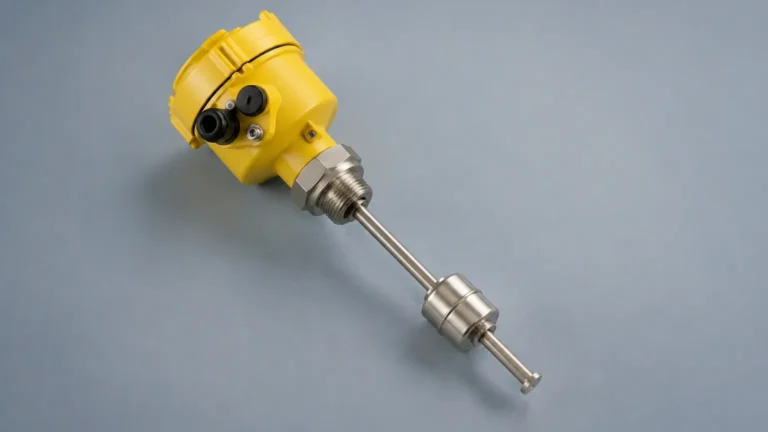
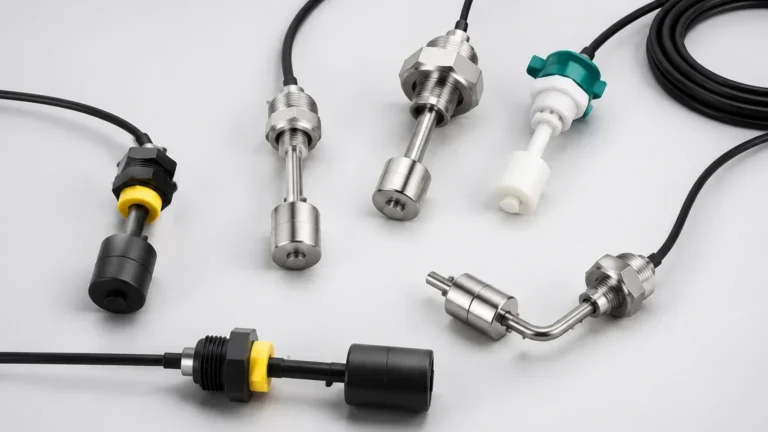
Level Switch Probe
Level Switch Probe
In industrial process control, point-level detection serves as a critical safeguard against tank overfills, pump dry-running, and inventory depletion. At the heart of these systems is the level switch probe—the physical sensing element that interacts directly with the process media. Understanding the engineering nuances of probe design, material compatibility, and sensing physics is essential for selecting a reliable instrument that can withstand the rigors of chemical processing, water treatment, or food production.
A level switch probe is not a universal tool; rather, it is a specialized component engineered to respond to specific physical properties of a liquid or solid, such as electrical conductivity, dielectric constant, or mechanical vibration damping. This guide provides a technical overview of how these probes function, how to select the correct configuration for your application, and the best practices for installation and maintenance.
Core Measurement Principles of Level Switch Probes
Before selecting a probe, it is necessary to understand the underlying physics that trigger the switching action. Level Switches utilize several distinct technologies to detect the presence or absence of material at a specific point.
Conductive Probes
Conductive level switch probes operate on the principle of electrical resistance. The system typically consists of one or more metallic probes (electrodes) and a reference ground (which can be the metallic tank wall or a separate ground probe). When a conductive liquid reaches the probe, it completes an electrical circuit between the probe and the ground. This small current is then amplified by a controller to trigger a relay.
* Best for: Conductive liquids like water, acids, and alkalis.
* Requirement: The media must have a minimum conductivity, typically $>10$ µS/cm.
Capacitive Probes
Capacitive probes treat the probe and the tank wall as two plates of a capacitor, with the process media acting as the dielectric. As the media rises and covers the level switch probe, the capacitance increases because the dielectric constant of the liquid or solid is higher than that of air. The electronics detect this change in capacitance and trigger the switch.
* Best for: Both liquids and solids (powders, granules).
* Advantage: Can detect non-conductive materials like oils or plastic pellets.
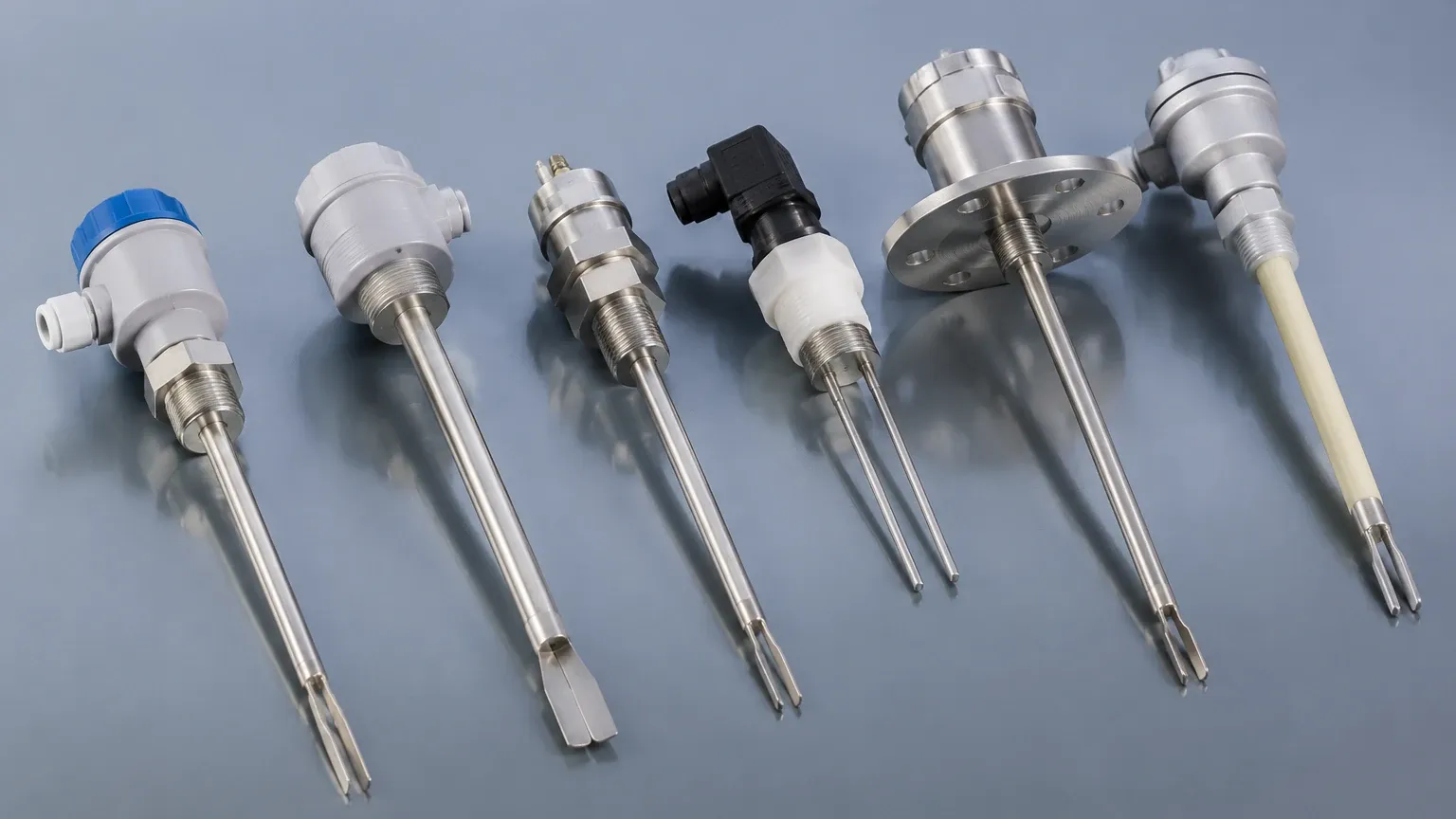
Vibrating Probes (Tuning Fork and Rod)
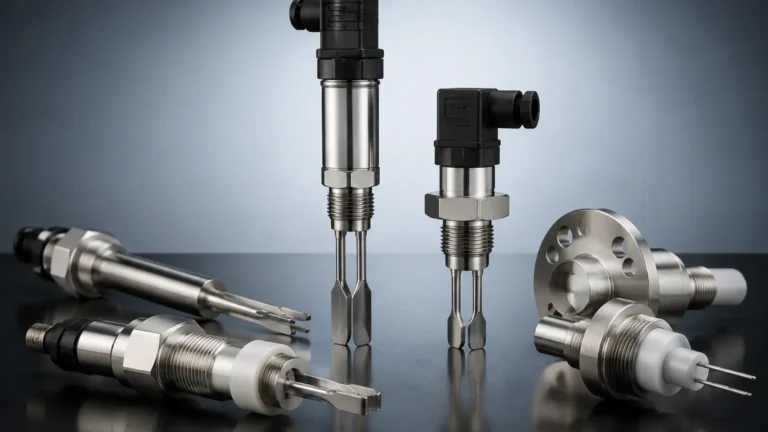
Vibrating level switch probes utilize piezo-electric crystals to energize a sensing element—either a tuning fork or a single rod—at its natural resonance frequency in the air. When the media covers the probe, the vibration is dampened or the frequency shifts. This change is detected by the internal electronics.
* Best for: High-viscosity liquids, powders, and applications where the dielectric constant may vary.
* Advantage: Highly resistant to turbulence and bubbles.
Probe Construction and Material Selection
The durability of a level switch probe depends heavily on its construction materials. Since the probe is often submerged in corrosive or high-pressure environments, material selection is a primary engineering concern.
Wetted Materials
1. Stainless Steel (304/316L): The standard for most industrial applications, offering good corrosion resistance and mechanical strength.
2. Hastelloy C: Used for highly aggressive chemical environments where standard stainless steel would succumb to pitting or stress corrosion.
3. PTFE/PFA Coating: For extremely corrosive acids or to prevent media build-up (clinging) on the probe surface, a fluoropolymer coating is applied. This is common in capacitive and conductive probes.
4. Ceramic: Used in high-temperature environments (up to 250°C or higher) where plastic insulators would melt.
Probe Geometry
* Rigid Rod Probes: Typically used for top-mounted applications where the detection point is within 3 to 4 meters (approx. 10 to 13 feet) of the process connection.
* Flexible Cable Probes: Essential for deep silos or tanks where a rigid rod would be impractical to install or prone to bending under the weight of bulk solids. These can extend up to 20 or 30 meters.
Technical Selection Criteria
When evaluating a level switch probe for a specific project, engineers must confirm the following parameters to ensure long-term reliability.
| Criteria | Consideration | Impact on Probe Choice |
| :— | :— | :— |
| Media Type | Liquid, Slurry, or Bulk Solid | Determines if a tuning fork (liquids) or vibrating rod (solids) is better. |
| Dielectric Constant (εr) | Low vs. High | Low dielectric materials (oils) require high-sensitivity capacitive probes. |
| Operating Pressure | Vacuum to High Pressure | Probes must be rated for the maximum tank pressure (e.g., 40 bar / 580 psi). |
| Operating Temperature | Cryogenic to Steam | High-temp applications require remote electronics or ceramic insulators. |
| Viscosity/Coating | Does the media stick? | Coated probes or vibrating probes with "active shield" technology prevent false trips. |
| Conductivity | µS/cm | Conductive probes only work if the liquid can carry a current. |
Installation Considerations for Level Switch Probes
Proper installation is as critical as selecting the right technology. A perfectly functioning probe will fail if placed in a position where it cannot accurately interact with the media.
Orientation
Probes can be mounted horizontally (through the side of the tank) or vertically (from the top).
* Vertical Mounting: Ideal for high-level alarms to ensure the probe is not damaged by falling material.
* Horizontal Mounting: Common for low-level detection or pump protection. The probe should be angled slightly downward to allow liquid to drain off the sensing surface.
Avoiding Interference
1. Inflow Streams: Never install a level switch probe directly beneath a fill pipe. The falling material will cause false triggers or mechanical damage.
2. Agitators: Ensure the probe is outside the sweep radius of any mixing blades. In turbulent tanks, a stilling well (a pipe surrounding the probe) may be necessary to provide a calm surface for detection.
3. Tank Walls: For capacitive probes, maintaining a consistent distance from the tank wall is vital. If the tank is non-metallic (plastic or fiberglass), a ground reference electrode must be used.
Grounding
For conductive and capacitive technologies, the electrical ground is half of the circuit. In plastic tanks, a metal flange or a second ground probe must be installed to provide a reference point for the measurement.
Limitations and Common Risks
While level switch probes are robust, they are not immune to environmental challenges:
* Material Build-up: In sticky applications like wastewater or syrups, media can coat the probe. If the coating remains conductive or holds a charge, the switch may stay in the "alarm" state even after the level has dropped. Vibrating forks or coated capacitive probes are designed to mitigate this.
* Foam: Some technologies (like ultrasonic gap or standard capacitive) may struggle to distinguish between dense foam and the actual liquid level. If foam is a concern, a tuning fork probe is generally the more reliable choice.
* Turbulence: Rapidly moving liquid surfaces can cause "chattering" (the relay rapidly switching on and off). This is usually managed by setting a time delay (e.g., 0.5 to 3 seconds) in the switch electronics.
Maintenance and Troubleshooting
Level switch probes are generally low-maintenance because they have few or no moving parts. However, a periodic inspection schedule should include:
1. Visual Inspection: Check for signs of corrosion, pitting, or mechanical wear on the probe body.
2. Cleaning: Remove any accumulated scale or material build-up that could interfere with the sensing physics.
3. Seal Integrity: Inspect the process connection (threads or flange) and the cable entry for signs of moisture ingress, which can short out the electronics.
4. Functional Test: Manually raise the liquid level or use a test magnet (if equipped) to ensure the relay still trips at the designated point.
Frequently Asked Questions (FAQ)
Q: Can a level switch probe be used for continuous level measurement?
No. A level switch probe is designed for point-level detection (On/Off). For continuous measurement (0-100%), you would require a radar level meter, ultrasonic sensor, or hydrostatic transmitter.
Q: What is the maximum length for a rigid level switch probe?
Generally, rigid probes are limited to 3 or 4 meters (approx. 10-13 feet). Beyond this, the mechanical stress on the process connection becomes too high, and a flexible cable probe is recommended.
Q: How do I choose between a tuning fork and a capacitive probe?
If the media is a liquid with varying dielectric properties or if there is significant foam, a tuning fork is usually better. If you are measuring dry bulk solids or need a probe with no gaps where material can get stuck, a capacitive probe is often preferred.
Q: Are level switch probes safe for use in hazardous areas?
Yes, many probes are available with Intrinsically Safe (IS) or Explosion-Proof (Ex d) ratings for use in environments with flammable gases or dust. Always check the local certification requirements (ATEX, IECEx, etc.) before installation.
By carefully matching the probe technology to the physical properties of the media and following strict installation guidelines, process engineers can ensure that their Level Switches provide accurate, fail-safe performance in any industrial environment.