Level Switch Digital
Level Switch Digital
In modern industrial automation, the transition from simple mechanical float switches to advanced digital point level detection has revolutionized how process plants manage inventory and safety. A level switch digital system provides more than just an on/off signal; it offers high-precision sensing, microprocessor-based signal filtering, and integrated communication protocols like IO-Link or Modbus. These instruments are critical for preventing tank overfills, protecting pumps from dry running, and ensuring consistent batch processing in sectors ranging from water treatment to chemical manufacturing.
As a professional manufacturer, Welk specializes in these high-reliability Level Switches, providing engineering teams with the data-driven insights necessary to optimize complex fluid handling systems. This guide explores the measurement principles, digital integration benefits, and selection criteria for digital level switching technology.
Measurement Principles of Digital Level Switches
Before selecting a specific digital interface, it is essential to understand the physical sensing technology. Modern digital level switches utilize internal microprocessors to interpret physical changes in the vessel, filtering out noise and turbulence that often trigger false alarms in traditional mechanical devices.
1. Vibrating (Tuning Fork) Technology
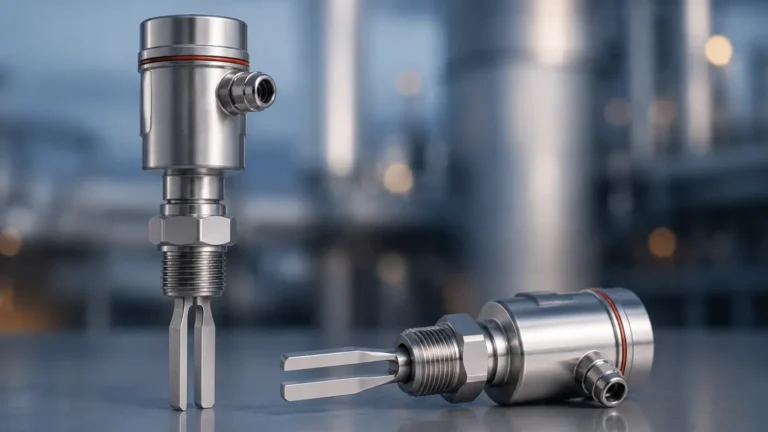
Vibrating level switches utilize a piezoelectric crystal to energize a tuning fork at its natural resonance frequency. When the fork is immersed in a liquid or solid medium, the frequency shifts or the amplitude of vibration decreases. The internal electronics detect this change and convert it into a digital output signal. This method is highly reliable because it is largely independent of the medium's chemical properties, such as density or conductivity.
2. Capacitance and Radio Frequency (RF)
Digital capacitance switches measure the change in electrical capacitance between the probe and the tank wall (or a reference electrode). As the medium displaces air, the dielectric constant changes. A digital capacitance switch uses sophisticated algorithms to ignore "build-up" or coating on the probe, a common issue in viscous or sticky fluids. This makes them ideal for high-sensitivity applications where the dielectric constant of the material is known.
3. Ultrasonic Point Level Sensing
Ultrasonic digital switches operate by emitting high-frequency sound waves across a sensor gap. If the gap is filled with liquid, the sound waves are transmitted to a receiver; if the gap is empty (filled with air or gas), the signal is attenuated. Because these sensors have no moving parts and use digital signal processing, they are exceptionally durable in hygienic or corrosive environments.
4. Optical Level Sensing
Optical switches use an infrared LED and a light receiver housed within a prism. When the prism is in air, the light reflects back to the sensor. When immersed in liquid, the light is refracted into the medium, breaking the circuit. Digital versions of these switches can adjust their sensitivity to account for ambient light interference or slight film build-up on the prism.
The Advantages of Digital Integration
The term "level switch digital" refers primarily to the evolution of the output and diagnostic capabilities of the sensor. Traditional switches provide a simple dry contact or a transistor output (PNP/NPN). While these are still common, digital integration offers several key advantages:
* IO-Link Compatibility: Many modern digital switches support IO-Link, allowing for bi-directional communication. This enables remote parameterization, where the switch points can be adjusted from a central PLC without physical access to the sensor.
* Diagnostic Feedback: Unlike a simple mechanical switch, a digital sensor can report its "health status." It can alert the control system if there is a sensor failure, an internal electronic fault, or if the probe requires cleaning due to excessive build-up.
* Signal Filtering: Digital switches can be programmed with a "switching delay." This prevents the switch from toggling rapidly due to surface turbulence or splashing, which is common in agitated tanks.
* Hysteresis Control: Users can digitally define the difference between the switch-on and switch-off points, providing greater control over pump cycles and preventing equipment wear.
Selection Criteria for Digital Level Switches
Choosing the correct instrument requires a detailed analysis of the process media and the environmental conditions of the installation. The following table provides a comparison of common digital level switch technologies used in industrial applications.
Technical Selection Table
| Technology | Suitable Media | Max Pressure | Max Temperature | Digital Interface Options |
| :— | :— | :— | :— | :— |
| Vibrating Fork | Liquids, Powders, Granules | Up to 64 bar | -50°C to +250°C | IO-Link, PNP/NPN, Relay |
| Capacitance | Liquids, Slurries, Solids | Up to 100 bar | -40°C to +200°C | Modbus, IO-Link, 4-20mA |
| Ultrasonic | Clean Liquids | Up to 40 bar | -40°C to +150°C | PNP/NPN, Digital Display |
| Optical | Clear Liquids | Up to 50 bar | -20°C to +125°C | Transistor Output |
Key Considerations
1. Media Density: Vibrating forks require a minimum density (typically >0.5 g/cm³) to function correctly. If the medium is too light, the frequency shift may not be detectable.
2. Dielectric Constant ($ε_r$): For capacitance-based digital switches, the medium must have a dielectric constant significantly different from air ($ε_r = 1$). Most aqueous liquids have high dielectric constants, making them easy to detect.
3. Viscosity and Coating: If the liquid is highly viscous or prone to crystallization, a digital switch with "active shield" technology or a vibrating fork with a polished finish is recommended to prevent false triggers from coating.
Installation and Engineering Best Practices
Proper installation is critical to the longevity and accuracy of a level switch digital setup. Engineering teams should adhere to the following guidelines:
* Orientation: Vibrating forks should be installed with the tines oriented vertically (if mounted horizontally) so that liquid can easily drain off them. This prevents "bridging" where liquid gets trapped between the tines.
* Nozzle Length: Ensure that the sensing element extends fully into the vessel. If the sensor is recessed inside a long mounting nozzle, air pockets or material build-up can interfere with the measurement.
* Cable Shielding: Because digital signals (especially IO-Link or Modbus) are sensitive to electromagnetic interference (EMI), use shielded cables and ensure proper grounding, especially near high-power motors or variable frequency drives (VFDs).
* Turbulence Zones: Avoid installing switches directly in the path of an inflow stream or near an agitator blade. If installation in a turbulent area is unavoidable, use a digital switch with a programmable damping or delay function.

Limitations and Common Risks
While digital level switches are highly advanced, they are not universal solutions. Engineers must be aware of specific limitations:
* Foam Interference: Standard ultrasonic and optical switches may struggle with thick foam. Foam can absorb ultrasonic waves or scatter light, leading to inconsistent switching. In these cases, a vibrating fork or a specialized capacitance probe is often superior.
* Extreme Temperatures: While digital electronics are robust, the internal microprocessors have thermal limits. For applications exceeding 200°C, remote-mounted electronics or high-temperature cooling extensions (fins) are required to protect the digital components.
* Gas Bubbles: In ultrasonic gap sensors, heavy aeration or large gas bubbles in the liquid can interrupt the signal path, causing the switch to indicate an "empty" state even when the sensor is submerged.
Frequently Asked Questions (FAQ)
Q: Can a digital level switch replace a continuous level transmitter?
A: Generally, no. A level switch is designed for point detection (High/Low alarms). However, some digital switches can be linked via IO-Link to provide basic process data, but they do not provide a continuous 0-100% level reading like a radar or hydrostatic transmitter.
Q: What is the benefit of a "fail-safe" digital output?
A: Digital switches can be configured as "Normally Open" or "Normally Closed." In a fail-safe configuration, the switch remains energized during normal operation. If power is lost or the sensor fails, the circuit opens, triggering an alarm. This is vital for overfill prevention.
Q: How do I calibrate a level switch digital?
A: Most modern digital switches from Welk are factory-calibrated. However, for capacitance or ultrasonic models, calibration can often be performed via a "teach-in" button on the device or remotely through a digital communication interface by setting the empty and full thresholds.
Q: Are digital switches compatible with hazardous areas?
A: Yes, many digital level switches are available with ATEX, IECEx, or UL certifications for use in explosive atmospheres. These typically require an intrinsic safety barrier or an explosion-proof housing.
Conclusion
The integration of digital technology into level switching has moved these devices from simple mechanical components to intelligent process sensors. By understanding the underlying measurement principles—whether vibrating, capacitive, or ultrasonic—and leveraging digital features like IO-Link and advanced diagnostics, industrial operators can significantly improve plant safety and efficiency.
When specifying a system, it is crucial to match the sensor technology to the specific chemical and physical properties of the media. For technical support or to explore a wide range of industrial sensing solutions, Review product options and application support to ensure your facility is equipped with the most reliable point level detection available.