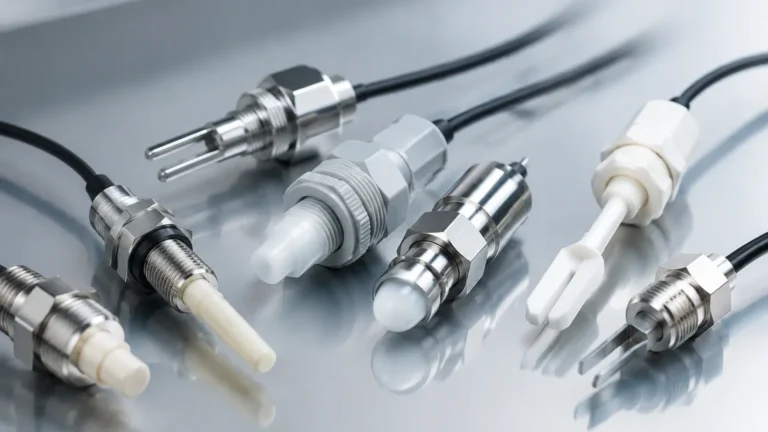
Level Switch Baumer
Level Switch Baumer
In the landscape of industrial automation and process control, point level detection serves as a critical safeguard for preventing tank overfills, protecting pumps from dry running, and managing automated filling sequences. Among the various technologies available, the level switch Baumer series—particularly those utilizing frequency sweep technology—has gained significant traction in sectors requiring high hygiene standards and the ability to distinguish between different media types.
This guide explores the technical principles, application criteria, and installation requirements for these sophisticated sensors, providing engineers with the data needed to integrate reliable Level Switches into their process architectures.
Measurement Principles of Advanced Level Switches
To understand why a level switch Baumer model like the CleverLevel series is specified over traditional technologies, one must first examine the underlying physics of frequency sweep and capacitive sensing.
Frequency Sweep Technology
Unlike standard vibrating forks that rely on mechanical resonance, frequency sweep technology emits a high-frequency signal (typically around 100 MHz to 180 MHz) into the medium. The sensor measures the change in the phase shift of the reflected signal. This phase shift is directly related to the dielectric constant (Dk) of the material in contact with the sensor tip.
Because the sensor operates at such high frequencies, it is largely unaffected by foam, bubbles, or moderate coating on the sensor tip. The electronics can be programmed to "ignore" certain dielectric ranges, allowing the switch to trigger only when the primary liquid reaches the probe, even if a layer of foam is already present.
Capacitive Point Level Detection
Traditional capacitive switches measure the capacitance between the probe and the tank wall (or a reference electrode). As the medium displaces air, the capacitance increases due to the higher dielectric constant of the liquid. While effective for many applications, traditional capacitive switches can struggle with conductive coatings or sticky media that leave a residue, which the frequency sweep method handles with greater precision.
Vibrating Fork (Tuning Fork) Principles
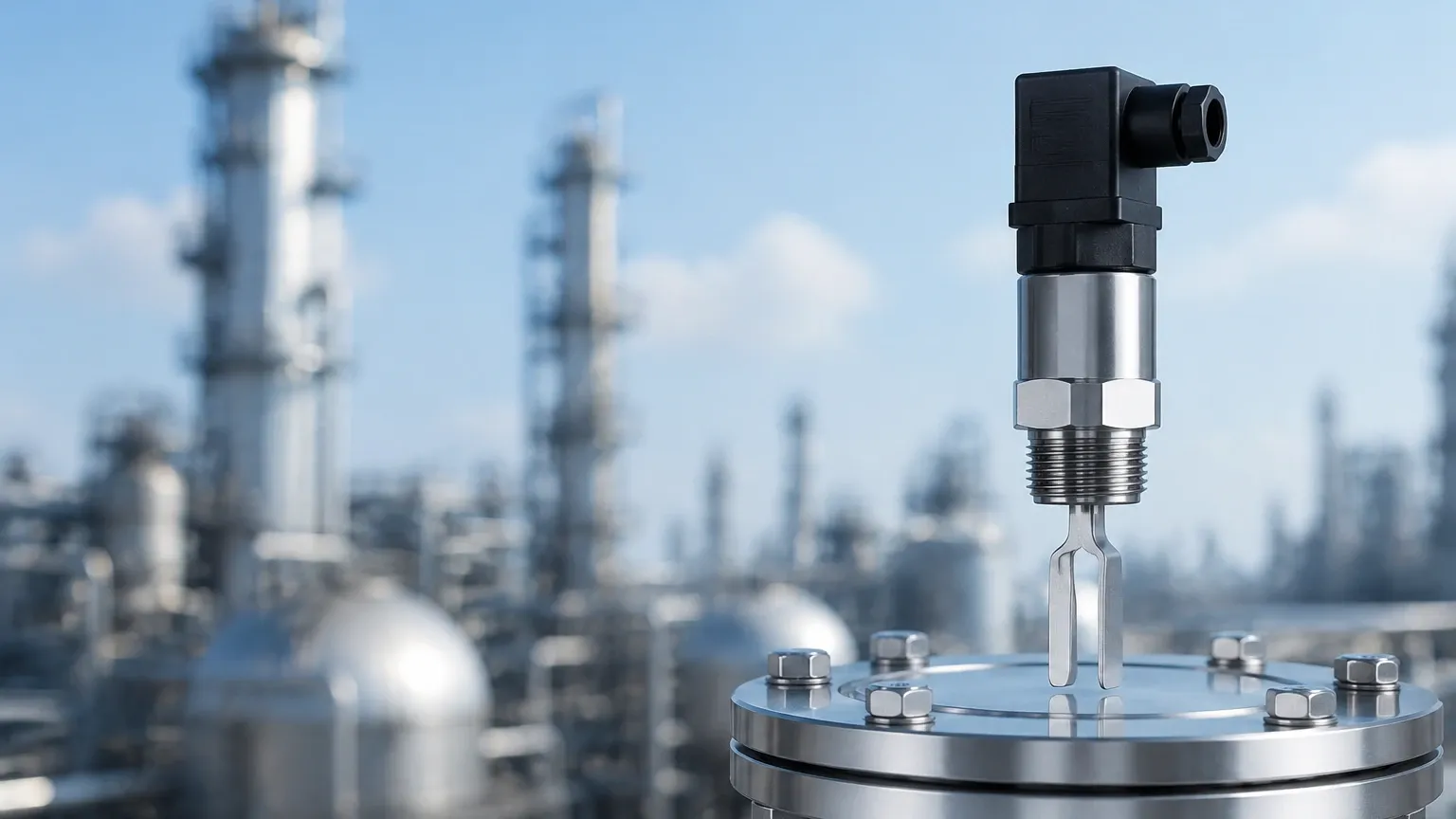
Vibrating forks operate on the principle of mechanical resonance. A piezo-electric crystal vibrates the fork at its natural frequency in air. When the fork is submerged in a liquid, the frequency drops. This change is detected by the electronics and converted into a switching signal. While robust, these are susceptible to media with high viscosity or large solid particles that can jam the forks.
Technical Specifications and Series Overview
The Baumer portfolio is categorized into different series based on the application environment and the physical properties of the media.
| Series | Technology | Primary Application | Temperature Range | Pressure Range |
| :— | :— | :— | :— | :— |
| LBFS | Frequency Sweep | General Purpose / Industrial | -40°C to +115°C | Up to 100 bar |
| LBFH | Frequency Sweep | Hygienic / Food & Pharma | -40°C to +135°C (150°C SIP) | Up to 40 bar |
| LFFS | Frequency Sweep | High Temperature / Corrosive | -40°C to +200°C | Up to 40 bar |
| Hygienic Adapters | N/A | Mounting accessories | N/A | Dependent on seal |
The CleverLevel LBFH/LBFS Advantage
The "CleverLevel" branding refers to the sensor's ability to be taught (via Teach-in or IO-Link) to distinguish between two different media. For example, in a CIP (Clean-in-Place) process, the sensor can be configured to detect the interface between water and a cleaning agent, or between a highly viscous yogurt and the air, regardless of the residue left on the PEEK tip.
Selection Criteria for Process Industries
Choosing the correct level switch involves more than just identifying the media. Engineers must consider the physical and chemical dynamics of the entire process.
1. Media Characteristics
* Dielectric Constant (Dk): Most frequency sweep switches require a minimum Dk value (often > 1.5). For very low Dk fluids like certain oils or liquid gases, specialized sensitivity settings are required.
* Viscosity and Stickiness: If the media is prone to building up a thick layer (e.g., chocolate, honey, or heavy crude), a sensor with a smooth PEEK tip and frequency sweep logic is preferable to a vibrating fork.
* Conductivity: Highly conductive liquids can cause false positives in low-end capacitive sensors, but frequency sweep technology remains stable.
2. Process Environment
* Hygienic Requirements: For the food, beverage, and pharmaceutical industries, sensors must meet EHEDG or 3-A standards. This requires 316L stainless steel housings and specific surface finishes (Ra < 0.8 µm).
* CIP/SIP Compatibility: The sensor must withstand Steam-in-Place (SIP) temperatures, often reaching 150°C (302°F) for 30 to 60 minutes, without losing calibration or suffering seal failure.
* Turbulence and Agitation: In tanks with mixers, the sensor must be positioned to avoid mechanical impact from the blades and should have a switching delay programmed to prevent "chattering" caused by splashing.
Installation Considerations and Best Practices
Proper installation is paramount to the longevity and accuracy of any level switch. Failure to follow geometric constraints often leads to false triggers or premature sensor wear.
Orientation and Positioning
* Horizontal Mounting: This is the most common for high/low level alarms. The sensor should be tilted slightly (approx. 5 degrees) so that liquid drains off the tip when the level drops.
* Vertical Mounting: Used primarily for low-level protection at the bottom of a tank. Ensure the sensor is not placed directly under a fill pipe, as the falling stream will cause false triggers.
* Dead Zones: Avoid mounting the sensor in long nozzles where air pockets can form or where thick media can get trapped and fail to drain, keeping the sensor "wet" even when the tank is empty.
Electrical Integration
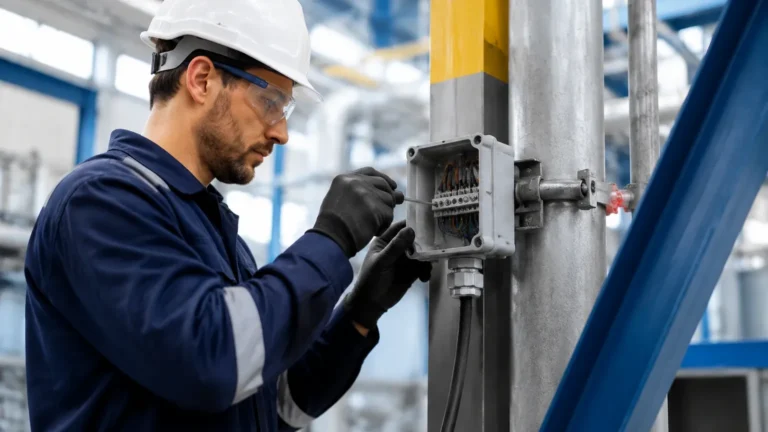
Most modern Level Switches offer PNP/NPN outputs or IO-Link. IO-Link is particularly beneficial for the Baumer series as it allows for real-time monitoring of the dielectric value, enabling predictive maintenance. If the "measured value" starts to drift over several weeks, it may indicate a gradual buildup that requires a cleaning cycle.
Torque and Sealing
When installing into a threaded socket (e.g., G 1/2"), use the manufacturer-specified torque (typically 20-25 Nm for metal-to-metal seals). Over-tightening can damage the hygienic seal or the internal electronics. For hygienic applications, always use the matching welding mandrel to ensure a flush-mounted finish.
Limitations and Technical Constraints
While highly versatile, the level switch Baumer range and similar frequency sweep sensors have specific limitations:
1. Metallic Proximity: Because these sensors emit high-frequency signals, mounting them too close to a metallic wall or a baffle can interfere with the signal. A minimum clearance of 10 mm to 20 mm from the sensor tip to any metal surface is usually required.
2. Dielectric Extremes: While they can detect almost any liquid, transitioning from a very high Dk liquid (water) to a very low Dk liquid (oil) requires careful calibration to ensure the switch point remains accurate for both.
3. Solid Bulk Materials: While some models can be used for solids, frequency sweep technology is optimized for liquids and pastes. For dry, dusty powders, a rotating paddle or a heavy-duty vibrating rod may be more appropriate.
4. Pressure Limits: Although industrial versions can handle up to 100 bar (1450 psi), standard hygienic versions are often limited to 40 bar. High-pressure hydraulic applications require specific heavy-duty housing options.
Maintenance and Troubleshooting
One of the primary advantages of the frequency sweep design is the lack of moving parts, which drastically reduces maintenance compared to float switches or paddles. However, periodic checks are still necessary.
Common Issues and Solutions
* False Triggering (Sensor stays ON): This is often caused by a thick coating of conductive material. Solution: Increase the switching threshold via the Teach-in wire or IO-Link software.
* No Signal (Sensor stays OFF): Check if the media has changed. If the new liquid has a significantly lower dielectric constant than the previous one, the sensor may not "see" it. Solution: Re-calibrate the sensor to the new media.
* Intermittent Signals: Usually caused by turbulence or foam. Solution: Increase the damping (switching delay) to 1.0 or 2.0 seconds to smooth out the output.
Comparative Analysis: Frequency Sweep vs. Ultrasonic
In some B2B contexts, engineers may weigh the level switch Baumer against ultrasonic point levels. Ultrasonic sensors use sound waves and are non-contact, which is excellent for highly corrosive acids. However, ultrasonic sensors fail in vacuums (sound cannot travel) and are heavily affected by steam and heavy foam. Frequency sweep switches, being contact-based, are immune to vacuum conditions and provide much higher precision in pressurized, steamy environments like those found in industrial boilers or food processing vessels.
Frequently Asked Questions (FAQ)
Q: Can a level switch Baumer be used in explosive atmospheres?
A: Yes, many models (like the LBFS series) are available with ATEX/IECEx certifications for use in Zone 0, 1, and 2 (Gas) and Zone 20, 21, and 22 (Dust).
Q: How does the sensor handle a mixture of oil and water?
A: The sensor can be calibrated to detect only the water (high Dk) and ignore the oil (low Dk), making it an effective tool for oil/water interface detection in separation tanks.
Q: Is the PEEK tip resistant to aggressive chemicals?
A: PEEK (Polyether ether ketone) is highly resistant to most organic and inorganic chemicals. However, for extremely aggressive acids at high temperatures, a chemical compatibility chart should be consulted to ensure the 316L housing and PEEK tip will not degrade.
Q: Can I shorten the probe length?
A: Most frequency sweep switches have a fixed probe length. If you require a longer reach, you must specify a "rod version" at the time of order, which can extend the sensing tip deep into the tank or sump.
Conclusion
Selecting the right point level solution requires a balance between technology, environmental constraints, and budget. The level switch Baumer series represents a high-end solution for processes where reliability cannot be compromised by foam, residue, or high temperatures. By understanding the frequency sweep principle and adhering to strict installation guidelines, process engineers can ensure long-term stability in their level control loops.
For those evaluating a broader range of industrial measurement tools, exploring various Level Switches and their respective strengths—from magnetic to ultrasonic—is a necessary step in optimizing plant efficiency and safety.