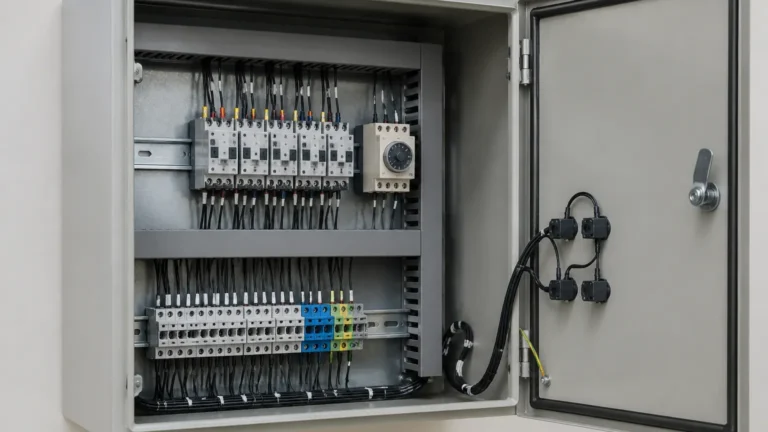
Level Switch High
Level Switch High
In industrial process control, protecting assets and personnel from vessel overfills is a primary safety requirement. A level switch high (LSH) serves as a critical point-level detection device designed to trigger a specific action—such as sounding an alarm, closing an inlet valve, or stopping a pump—when a substance reaches a predetermined upper limit within a tank or silo. Unlike continuous level transmitters that provide a constant data stream of the current volume, a level switch high operates on a binary principle: it is either "on" or "off."
Reliable high-level detection is the cornerstone of spill prevention and environmental compliance. Selecting the correct technology requires an understanding of the physical properties of the media, the environmental conditions of the process, and the mechanical constraints of the vessel. This guide examines the principles, selection criteria, and installation practices for Level Switches used in high-level applications.
Core Measurement Principles for High-Level Detection
Before selecting a level switch high, engineers must understand the underlying physics of the various sensing technologies. Each principle offers distinct advantages depending on whether the media is a liquid, a solid, or a slurry.
1. Buoyancy (Float Switches)
Float switches are among the most common and cost-effective solutions for high-level detection in clean liquids. They operate on the principle of buoyancy, where a float moves up and down with the liquid level. Inside the float or the stationary stem, a magnet actuates a reed switch when the float reaches the high set point.
* Best for: Water, oils, and non-coating chemicals.
* Limitations: Not suitable for high-viscosity liquids or media with suspended solids that may cause the mechanical float to stick.
2. Vibrating Tuning Fork
Vibrating level switches utilize a tuning fork-shaped sensing element driven by piezoelectric crystals at its natural resonant frequency (typically around 1200 Hz). When the media reaches the fork and submerses it, the frequency changes or the vibration is damped. The electronics detect this shift and switch the output state.
* Best for: A wide range of liquids, powders, and granulates. They are highly resistant to changes in pressure, temperature, and conductivity.
* Limitations: Heavy buildup or extremely high-viscosity media can occasionally bridge the forks, leading to false readings.
3. Capacitance (RF Admittance)
Capacitive switches measure the change in electrical capacitance between the sensor probe and the tank wall (or a reference electrode). As the media covers the probe, the dielectric constant changes, increasing the capacitance and triggering the switch.
* Best for: Corrosive liquids, slurries, and interfaces between different liquids.
* Limitations: Requires calibration to the specific dielectric constant of the media and can be sensitive to coating if not equipped with "active shield" technology.
4. Conductivity
Conductive level switches use the liquid itself as a conductor. When the liquid touches the high-level probe, an electrical circuit is completed between the probe and the tank wall (or a ground probe), signaling the high level.
* Best for: Conductive liquids like water, acids, and alkalis.
* Limitations: Cannot be used with non-conductive liquids like oils or hydrocarbons.
5. Ultrasonic Point Level
Ultrasonic switches use two crystals separated by a gap. One crystal transmits an ultrasonic signal, and the other receives it. When the gap is filled with liquid, the signal transmits efficiently; when the gap is filled with air or gas, the signal is attenuated.
* Best for: Highly aerated liquids or applications where mechanical moving parts are undesirable.
* Limitations: Performance can be affected by heavy foam or bubbles at the liquid surface.
The Hierarchy of High-Level Alarms: LSH vs. LSHH
In high-risk environments, a single level switch high may not provide sufficient protection. Engineering standards often dictate a tiered approach:
1. Level Switch High (LSH): The primary operational switch. It is usually set to trigger a control action, such as stopping a filling pump or closing a valve, to prevent the tank from reaching its maximum capacity during normal operations.
2. Level Switch High-High (LSHH): This is a secondary, independent safety switch mounted higher than the LSH. If the LSH fails to stop the filling process, the LSHH acts as an emergency stop. It is often integrated into a Safety Instrumented System (SIS) and may require manual reset after being triggered.
Practical Selection Table for Level Switch High
The following table provides a general comparison of common technologies used for high-level detection across various industrial media.
| Technology | Media Type | Temp. Range (Typical) | Max Pressure (Typical) | Key Advantage |
| :— | :— | :— | :— | :— |
| Float | Clean Liquids | -40°C to 150°C | 40 bar (580 PSI) | Simple, no power required |
| Vibrating Fork | Liquids/Solids | -50°C to 250°C | 64 bar (928 PSI) | Maintenance-free, versatile |
| Capacitance | Slurries/Liquids | -100°C to 400°C | 100 bar (1450 PSI) | Handles extreme temperatures |
| Conductive | Conductive Liquids | -20°C to 100°C | 10 bar (145 PSI) | Low cost, multi-point capable |
| Rotary Paddle | Bulk Solids | -20°C to 80°C | Atmospheric | Robust for heavy powders |
Key Evaluation Criteria for Level Switch High Applications
When specifying a level switch high for a project, several technical factors must be confirmed to ensure long-term reliability.
Media Characteristics
* Viscosity: High-viscosity liquids (e.g., molasses or heavy crude) may stick to probes. Vibrating forks or capacitance switches with coating rejection are preferred.
* Density: Float switches require the float to be less dense than the liquid. If the liquid density changes significantly, the float may not rise correctly.
* Corrosivity: Ensure the wetted materials (316L Stainless Steel, PTFE, Hastelloy, etc.) are compatible with the process media.
Process Conditions
* Temperature and Pressure: High-temperature applications (above 200°C / 392°F) often require remote electronics or specialized cooling fins on the sensor housing.
* Turbulence and Agitation: In tanks with mixers, a level switch high may be subjected to mechanical stress. A stilling well or a robust probe design is necessary to prevent false triggers or mechanical failure.
Electrical and Output Requirements
* Switch Type: Decide between Relay (SPDT/DPDT), Transistor (PNP/NPN), or Two-wire (NAMUR) outputs.
* Fail-Safe Mode: For a level switch high, the device should be configured as "Fail-Safe High." This means the relay is energized when the level is low and de-energizes when the high level is reached or if power is lost, ensuring the system defaults to a safe state.

Installation Considerations and Best Practices
Proper installation is as important as technology selection. Even the most advanced level switch high will fail if positioned incorrectly.
1. Avoid the Inlet Stream: Never install a level switch high directly under the tank's filling inlet. The falling media can trigger false alarms or physically damage the sensor.
2. Mounting Orientation: While many switches can be mounted horizontally or vertically, vibrating forks used in liquids are often best mounted horizontally so that the liquid can easily drain off the blades when the level drops.
3. No-Go Zones for Solids: In silos, solids form a cone (repose angle). The level switch high must be positioned to account for the peak of the cone to prevent overfilling the center while the edges remain empty.
4. Dead Zones: Be aware of the "dead zone" near the mounting flange where the sensor cannot detect media. Ensure the active sensing element extends far enough into the vessel to reach the desired set point.
5. Wiring and Conduits: Always use a drip loop in the electrical conduit to prevent moisture from traveling down the cable and entering the sensor housing.
Limitations and Common Risks
Despite their utility, level switches have limitations that must be managed through engineering design:
* Coating and Buildup: In applications involving wastewater or sticky resins, material can accumulate on the probe. This "bridging" can make the switch think the tank is full when it is not. Regular cleaning or selecting a switch with "active shield" or vibration-based self-cleaning is required.
* Foam Interference: Standard ultrasonic and some optical switches may struggle with thick foam, either seeing the top of the foam as the liquid level or losing the signal entirely. Capacitance or tuning fork switches are generally better suited for foamy environments.
* Mechanical Wear: Any device with moving parts, such as a float or a rotary paddle, is subject to mechanical wear and fatigue over time. These require more frequent inspection than solid-state electronic switches.
Frequently Asked Questions (FAQ)
Q: Can a level switch high be used for dry run protection?
No, dry run protection typically requires a "Level Switch Low" (LSL) located at the bottom of a tank or in a pump suction line. A level switch high is specifically for overfill prevention.
Q: What is the difference between a N.O. and N.C. contact in LSH?
Normally Open (N.O.) means the circuit is open until the high level is reached. Normally Closed (N.C.) means the circuit is closed until the high level is reached. For safety-critical high-level alarms, N.C. (or de-energize to trip) is preferred to ensure that a broken wire also triggers the alarm.
Q: How often should a level switch high be proof-tested?
This depends on the safety integrity level (SIL) of the process. In standard industrial applications, annual proof testing (physically raising the level or manually moving the switch to verify the alarm) is common practice.
Q: Can I use one switch for both high and low levels?
Only if the switch is a continuous level transmitter with programmable set points. A standard point-level switch can only detect one specific level. For high and low detection, you typically need two separate switches.
Conclusion
The implementation of a level switch high is a fundamental step in ensuring process safety and operational efficiency. By matching the measurement principle—whether buoyancy, vibration, or capacitance—to the specific media and environmental conditions, engineers can mitigate the risks of costly spills and equipment damage. For complex applications involving high pressures or aggressive chemicals, consulting with a manufacturer of Level Switches ensures that the selected device meets all regulatory and safety standards.