Level Switch Ifm
Level Switch Ifm
In the realm of industrial automation and process control, point level detection serves as a critical safeguard against tank overfills, pump dry-running, and inventory mismanagement. While continuous level measurement provides a constant stream of data regarding the volume of a vessel, a level switch is designed to trigger a discrete output at a specific height. Among the industry leaders in this space, the level switch ifm series is frequently cited for its integration of IO-Link technology and robust electronic designs. For engineers and procurement specialists, understanding the underlying principles of these devices—and how they compare to broader industrial Level Switches—is essential for optimizing plant uptime.
Measurement Principles of Modern Level Switches
Before selecting a specific sensor, such as a level switch ifm or a Welk alternative, it is vital to understand the physics governing the detection. Different media and environmental conditions require distinct sensing technologies.
Capacitive Level Detection
Capacitive sensors operate on the principle of a capacitor's electrical capacity. The sensor probe and the tank wall (or a second probe) act as two electrodes. When the medium (liquid or solid) displaces air between the electrodes, the dielectric constant changes, which in turn changes the capacitance. This change is processed by the electronics to trigger a switching signal.
* Advantages: No moving parts, suitable for aggressive media, and can often detect through non-metallic tank walls.
* Limitations: Highly dependent on the dielectric constant ($ε_r$) of the material. If the medium changes significantly, recalibration may be required.
Vibrating Fork (Tuning Fork) Technology
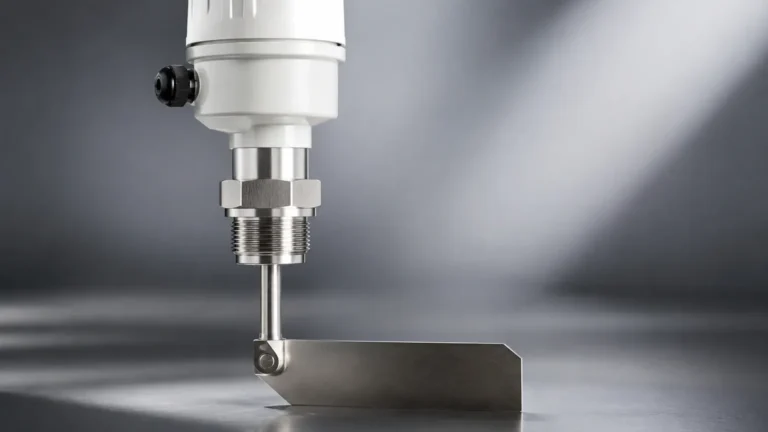
Vibrating level switches utilize a sensing element in the shape of a tuning fork, which is piezoelectrically energized to vibrate at its resonance frequency in air. When the fork is submerged in a liquid or covered by solids, the frequency shifts or the amplitude is damped. The electronics detect this change and switch the output.
* Advantages: Highly reliable, unaffected by bubbles, foam, or changes in the medium's electrical properties.
* Limitations: Susceptible to material buildup between the forks if the medium is extremely viscous or contains long fibers.
Impedance Spectroscopy (Frequency Sweep)
Many modern sensors, including several models in the level switch ifm catalog (like the LMT series), use high-frequency impedance spectroscopy. The sensor emits a high-frequency signal into the medium. By analyzing the return signal, the sensor can differentiate between the actual liquid level and the residue or foam clinging to the probe. This is particularly useful in the food and beverage industry where CIP (Clean-in-Place) processes leave films on the sensors.
Hydrostatic Pressure Switching
Hydrostatic switches measure the pressure exerted by a liquid column. According to Pascal's Law, the pressure at the bottom of a tank is proportional to the height of the liquid. While often used for continuous measurement, pressure switches can be set to trigger at specific thresholds.
Comparative Analysis: Level Switch Ifm and Industrial Standards
The level switch ifm brand is well-regarded for its focus on electronic integration. Most of their modern units are equipped with IO-Link, a standardized point-to-point communication protocol that allows for remote parameterization and advanced diagnostics.
However, when evaluating Level Switches for heavy industrial applications—such as wastewater treatment, chemical processing, or oil and gas—engineers must also consider the mechanical robustness and material compatibility offered by specialized manufacturers like Welk. While ifm excels in factory automation and hygienic food-grade applications, industrial-grade level switches often prioritize high-pressure ratings (exceeding 40 bar) and exotic materials like Hastelloy or PTFE for corrosive environments.
Key Evaluation Criteria
1. Media Characteristics: Is the medium conductive or non-conductive? Is it prone to foaming or turbulence?
2. Process Temperature: Standard electronic sensors often operate up to 85°C or 100°C. High-temperature applications may require remote electronics or cooling fins.
3. Process Pressure: Ensure the sensor housing and process connection can withstand the maximum possible vessel pressure.
4. Output Requirements: Do you need a simple PNP/NPN transistor output, a relay contact, or a digital protocol like IO-Link?
Practical Selection Table for Level Switches
Choosing the right technology requires balancing performance with cost. The following table provides a general guideline for selecting level switches based on common industrial scenarios.
| Technology | Suitable Media | Typical Application | Key Advantage | Limitation |
| :— | :— | :— | :— | :— |
| Capacitive | Liquids, Powders, Granules | Plastic pellets, non-conductive oils | Compact, no moving parts | Sensitive to buildup |
| Vibrating Fork | Most Liquids, Fine Solids | Water tanks, pump protection | Media independent | Buildup between forks |
| Impedance/LMT | Viscous liquids, Creams | Food & Beverage, CIP | Ignores foam/residue | Higher relative cost |
| Optical | Clear Liquids | Leak detection in small pipes | Very small footprint | Fails if coated in opaque oil |
| Hydrostatic | Water, Chemicals | Deep wells, large reservoirs | Robust for high head | Density dependent |
Installation Considerations and Best Practices
Correct installation is as important as sensor selection. Even a high-quality level switch ifm unit will fail if positioned incorrectly.
Orientation and Positioning
* Vertical Mounting: Ideal for high-level alarms to ensure the sensor is only triggered when the tank is truly full. However, ensure the probe length is sufficient to clear any dead zones at the top of the tank.
* Horizontal Mounting: Common for low-level or dry-run protection. The sensor should be tilted slightly (approx. 20 degrees) to allow liquid to drain off the sensing face, preventing false triggers due to droplets.
Avoiding Interference
* Inflow Streams: Never install a level switch directly in the path of a filling stream. The turbulence and force of the liquid can cause premature wear or false switching.
* Agitators: If the tank has a mixer, ensure the sensor is located outside the vortex zone. In some cases, a stilling well (a pipe surrounding the sensor) may be necessary to provide a stable surface for measurement.
* Dead Zones: Be aware of the "switching point distance." For most electronic switches, there is a small area near the process connection where detection is not possible.
Wiring and Grounding
For electronic level switches, proper grounding of the tank (if metallic) or the use of a ground reference electrode is crucial for capacitive technologies. Shielded cables are recommended in environments with high electromagnetic interference (EMI) from large motors or variable frequency drives (VFDs).
Limitations and Common Risks
While modern Level Switches are highly reliable, certain conditions can compromise their accuracy:
1. Coating and Buildup: In applications involving wastewater or syrups, material can dry on the sensor face. If the sensor cannot differentiate between a "covered" state and a "coated" state, it will remain in the alarm position even when the tank is empty.
2. Gas Bubbles and Aeration: Ultrasonic and some capacitive sensors can be fooled by heavy aeration. In these cases, a vibrating fork is usually the superior choice.
3. Dielectric Shifts: If a capacitive level switch ifm is calibrated for water (ε_r ≈ 80) and the process is switched to oil (ε_r ≈ 2), the sensor may not detect the oil at all without recalibration.
4. Ambient Temperature Fluctuations: Extreme cold can lead to condensation inside the housing if not properly sealed (IP69K rating is preferred for washdown or outdoor areas).
Why Choose Welk Level Measurement Solutions?
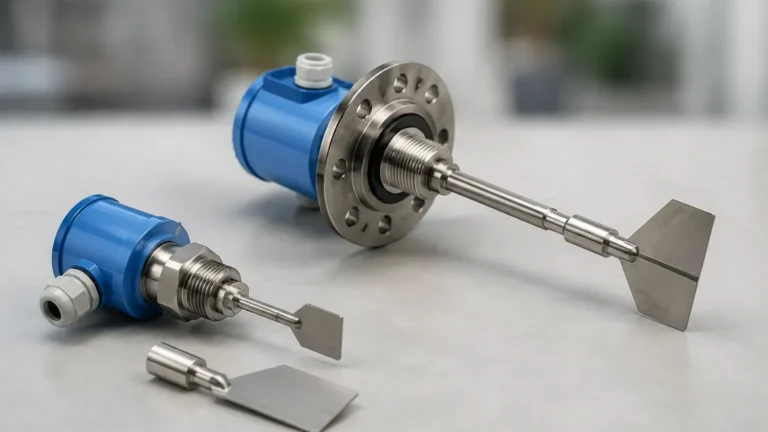
As a professional manufacturer, Welk provides a comprehensive range of industrial level instruments that serve as robust alternatives or complements to the level switch ifm ecosystem. Our focus is on providing cost-effective, high-accuracy solutions tailored to specific industrial challenges.
* Customization: We offer OEM/ODM services, allowing for specific probe lengths, process connections (NPT, G, Flanged), and housing materials that may not be available in standard catalogs.
* Global Reliability: Our instruments are widely utilized in water treatment, chemical processing, and industrial automation, backed by strict quality control protocols.
* Technical Support: Beyond providing hardware, we assist in the engineering phase to ensure the selected technology matches the chemical and physical properties of your media.
For more detailed specifications and to explore our full range of point-level detection technology, you can Review product options and application support on our official site.
Frequently Asked Questions (FAQ)
1. Can a level switch ifm be used for both liquids and solids?
It depends on the specific model. Capacitive and vibrating fork sensors are often available in versions for both media. However, bulk solids require more robust mechanical designs to withstand the lateral forces of shifting material.
2. What is the benefit of IO-Link in a level switch?
IO-Link allows the sensor to transmit more than just a "high/low" signal. It can provide internal temperature data, signal quality metrics (to predict when cleaning is needed), and allow for remote adjustment of the switching thresholds without accessing the sensor physically.
3. How do I handle foam in my tank?
If you want to detect the liquid *under* the foam, use a vibrating fork or a frequency sweep sensor (like the LMT series). If you want to detect the foam itself, a specifically tuned capacitive sensor is usually required.
4. What is the difference between NPN and PNP outputs?
This refers to the type of transistor switching. PNP (Positive-Negative-Positive) switches the positive load, which is the standard in Europe and most modern PLC systems. NPN (Negative-Positive-Negative) switches the ground/negative side and is more common in older systems or specific Asian markets.
5. Are these sensors suitable for hygienic applications?
Yes, many level switches are designed with 3A or EHEDG certifications, featuring stainless steel 316L bodies and PEEK sensing faces to ensure they can withstand high-pressure steam cleaning and aggressive chemicals used in the food industry.
By understanding the technical nuances of the level switch ifm and the broader market of industrial Level Switches, process engineers can ensure they select a device that provides long-term reliability and precise control over their most critical assets.