Level Switch in Tank
Level Switch in Tank
In industrial process control, the reliable detection of liquid or solid levels at specific points is critical for operational safety, inventory management, and automation. A level switch in tank applications serves as a point level controller, providing a discrete output—typically a relay or transistor signal—when a substance reaches a predetermined height. Unlike continuous level transmitters that provide a constant stream of data, level switches are optimized for "high-alarm," "low-alarm," or pump control functions.
Selecting and installing the correct Level Switches requires a deep understanding of the physical properties of the media, the environmental conditions within the vessel, and the mechanical constraints of the tank itself. This guide explores the engineering principles, selection criteria, and installation best practices for point level detection.
Principles of Operation for Tank Level Switches
Before selecting a level switch in tank environments, engineers must understand the underlying physical principles that trigger the device. Different technologies respond to different physical changes, such as buoyancy, conductivity, or vibration dampening.
1. Float-Based Level Switches
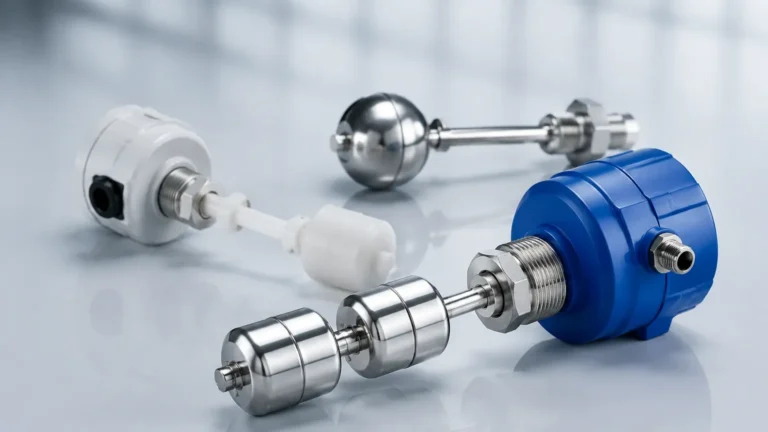
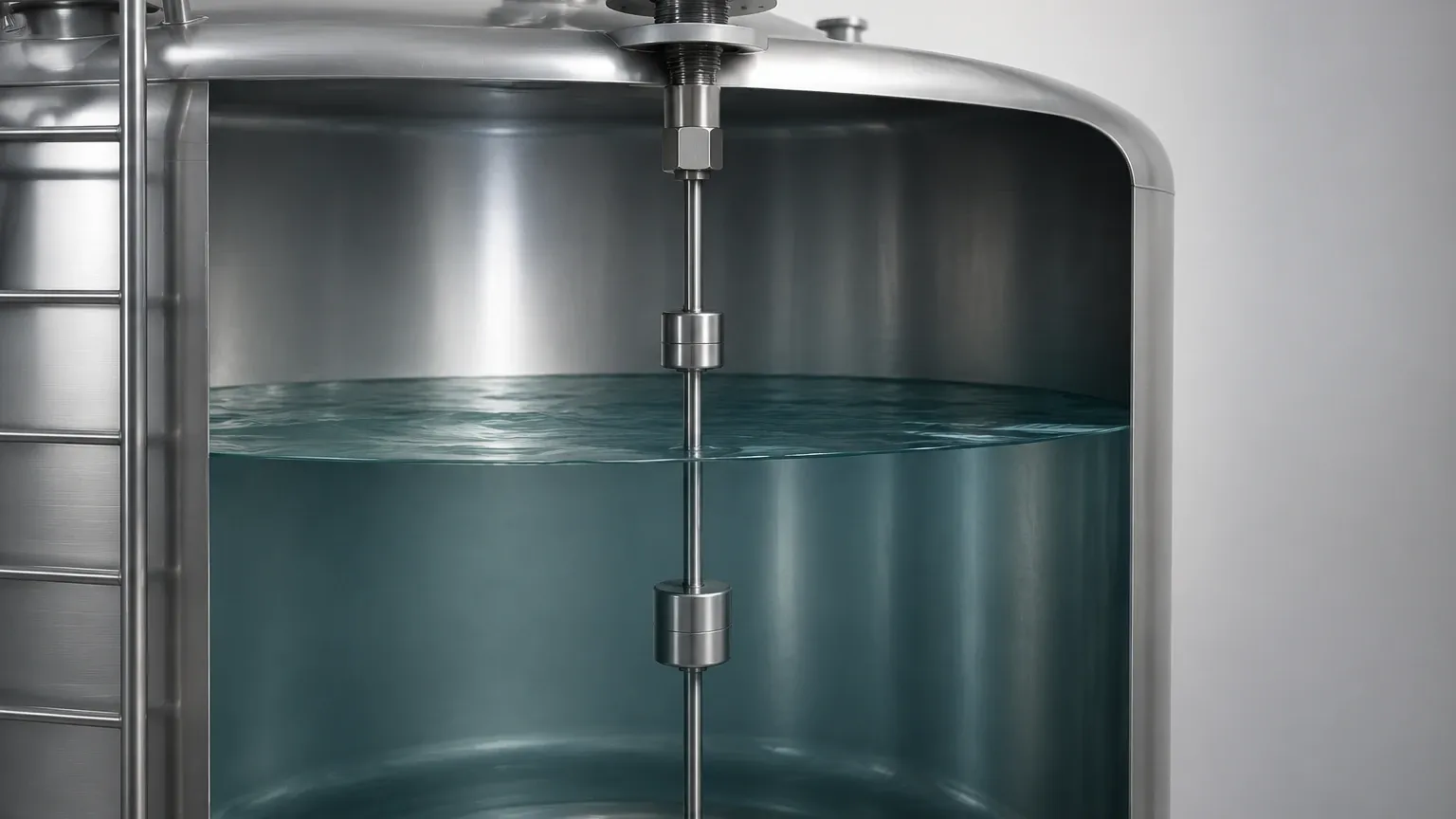
Float switches operate on the principle of buoyancy. A float, typically made of stainless steel or plastic (such as PP or PVDF), contains a permanent magnet. As the liquid level rises, the float moves along a stem. When the magnet reaches a specific position, it actuates a hermetically sealed reed switch inside the stem. These are widely used due to their simplicity and lack of power requirement for the sensing element itself.
2. Vibrating Tuning Fork Switches
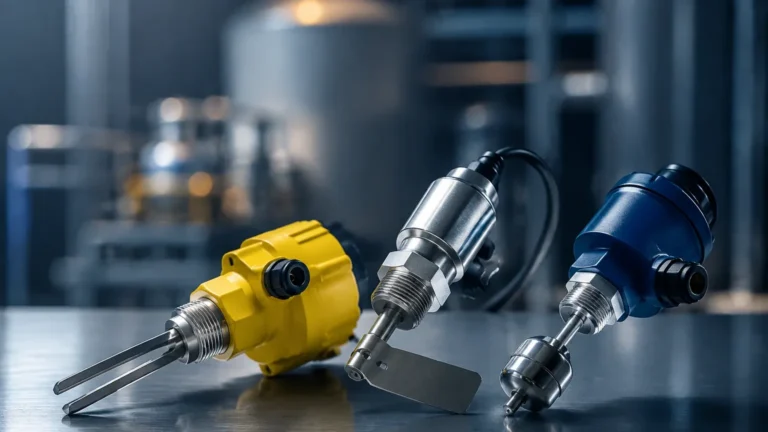
Vibrating level switches utilize piezoelectric crystals to energize a tuning fork at its natural resonant frequency (typically around 1,200 Hz to 1,400 Hz). When the fork is submerged in a liquid or covered by a solid, the frequency shifts or the amplitude of the vibration is dampened. An electronic circuit detects this change and switches the output. These are highly versatile and resistant to changes in flow, turbulence, or bubbles.
3. Capacitive Level Switches
Capacitive sensors treat the tank wall and the probe as two plates of a capacitor. The medium acting as the dielectric changes the total capacitance as it covers the probe. This technology is effective for both liquids and solids, though it requires calibration based on the dielectric constant of the material. Modern versions often include "active shield" technology to ignore buildup on the probe.
4. Conductive Level Switches
Conductive switches are used exclusively with conductive liquids (e.g., water, acids, or alkalis). They work by applying a low-voltage AC signal between two electrodes. When the liquid touches both electrodes, the circuit is completed, and the switch is triggered. These are cost-effective but limited to non-flammable, conductive media.
5. Hydrostatic and Pressure-Based Switches
While often used for continuous measurement, specialized hydrostatic switches trigger when the pressure at the bottom of the tank exceeds a set point, indicating a specific head of liquid. These are common in deep wells or large water reservoirs.
Selection Criteria for Level Switch in Tank Applications
Choosing a level switch in tank setups involves more than just matching a thread size. Engineers must evaluate the following factors to ensure long-term reliability:
* Media Density: Float switches require the medium to have a higher density than the float itself. For example, a float designed for water (1.0 g/cm³) may not function in light oils (0.7 g/cm³).
* Viscosity and Coating: High-viscosity liquids or materials that leave a film (like resins or thick oils) can cause mechanical floats to stick. In these cases, vibrating forks or capacitive switches with coating rejection are preferred.
* Temperature and Pressure: Industrial tanks often operate at high temperatures (up to 250°C or more) and pressures (up to 4.0 MPa or 40 bar). The material of the switch housing and the wetted parts must be rated for these extremes.
* Chemical Compatibility: Wetted parts must resist corrosion. Stainless steel 316L is standard, but aggressive chemicals may require PTFE, PVDF, or Hastelloy coatings.
* Explosion Protection: In oil and gas or chemical processing, switches must often meet ATEX or IECEx standards for intrinsically safe or flameproof operation.
Installation Guidelines and Engineering Best Practices
The performance of a level switch in tank systems is heavily dependent on its placement and orientation. Improper installation is the leading cause of false triggers or mechanical failure.
Mounting Orientation
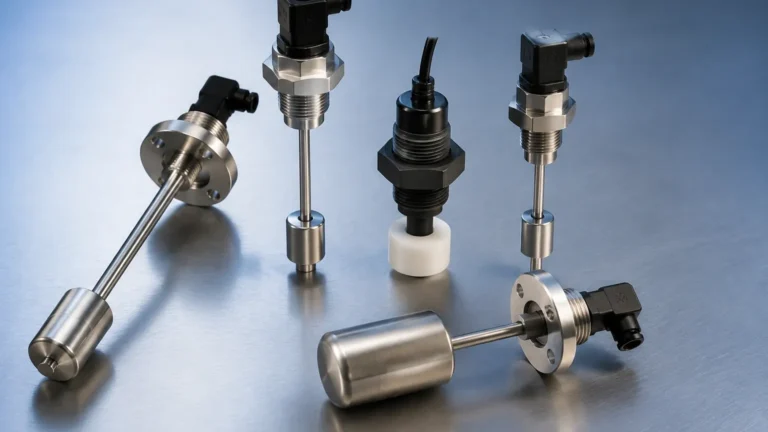
* Top Mounting: Usually involves a long probe or a cable-suspended float. This is ideal for low-level alarms in deep tanks.
* Side Mounting: The switch is installed through the tank wall at the exact point where detection is required. This is common for high-level overfill protection.
Avoiding Turbulence and Agitation
In tanks equipped with agitators or high-velocity inlet flows, the physical force of the liquid can damage delicate probes or cause "chatter" (rapid switching).
* Stilling Wells: If turbulence is high, the switch should be installed inside a stilling well (a vertical pipe with vent holes) to provide a calm surface for measurement.
* Baffles: Mechanical baffles can be installed to shield the switch from direct fluid impact.
Clearance and Dead Zones
Ensure there is sufficient clearance between the switch and the tank wall or internal structures like heating coils. For vibrating forks, a minimum clearance of 50mm from the wall is usually recommended to prevent material from bridging between the fork and the wall.
Wiring and Sealing
Always use a drip loop in the cabling to prevent moisture from following the wire into the housing. Ensure the cable glands are tightened to the correct torque to maintain the IP rating (typically IP65 to IP68).
Comparison of Level Switch Technologies
The following table provides a practical engineering reference for comparing common technologies used for a level switch in tank environments.
| Technology | Best For | Advantages | Limitations |
| :— | :— | :— | :— |
| Float Switch | Clean liquids, water | Low cost, no power needed for reed types | Moving parts can stick; sensitive to density |
| Vibrating Fork | Liquids, powders, granules | Reliable, no calibration, ignores foam | Can be affected by very high viscosity |
| Capacitive | Solids, slurries, interfaces | No moving parts, handles high temp | Requires calibration; sensitive to dielectric changes |
| Conductive | Conductive liquids | Very inexpensive, simple | Only for conductive media; probe corrosion |
| Optical | Clear liquids, small spaces | Very compact, fast response | Sensitive to coating and ambient light |
Limitations and Operational Challenges
While robust, no single level switch in tank application is universal. Engineers must be aware of specific limitations:
1. Build-up and Scaling: In wastewater or lime slurry applications, material can build up on the sensor. If a vibrating fork becomes too heavily coated, its frequency may drop permanently, causing a false "covered" signal.
2. Foam Interference: Some technologies, like ultrasonic or certain capacitive sensors, may struggle to distinguish between the liquid surface and a thick layer of foam. Vibrating forks are generally superior here as they ignore the low-density foam and only trigger upon contact with the liquid phase.
3. Dielectric Shifts: Capacitive switches rely on a stable dielectric constant ($ε$). If a tank is used for different liquids interchangeably, the switch may require recalibration for each new substance.
4. Mechanical Wear: In abrasive media (like sand or ores), the wetted parts of the switch can erode over time, eventually leading to seal failure or loss of sensitivity.
Frequently Asked Questions (FAQs)
How do I test a level switch in tank without draining the fluid?
Many modern electronic level switches, such as vibrating forks, feature a magnetic test point or a local test button on the housing. Touching a magnet to the test point simulates a frequency shift, allowing the operator to verify that the relay and downstream alarms are functioning correctly without changing the tank level.
Can a level switch be used for pump control?
Yes. Typically, two switches are used: one for the "start" level and one for the "stop" level. These are wired into a controller or a latching relay circuit. Alternatively, some float switches come with a built-in hysteresis (differential) that allows a single switch to manage a pump over a specific range.
What is the difference between NPN and PNP outputs?
These refer to the type of transistor switching used in DC-powered switches. PNP (Sourcing) provides a positive voltage when triggered, while NPN (Sinking) connects the load to the negative/ground. The choice depends on the input requirements of your PLC (Programmable Logic Controller).
Does the tank material affect the switch?
For capacitive switches, the tank material is critical. In a metal tank, the wall acts as the ground reference. In a plastic or fiberglass tank, a ground rod or a dual-probe switch must be used to provide a reference for the capacitance measurement.
What is the maximum temperature a level switch can handle?
Standard industrial switches usually handle up to 80°C or 100°C. However, high-temperature variants with cooling fins or ceramic insulators can operate in environments exceeding 250°C. Always verify the specification of the specific model for your process.
By carefully matching the technology to the application and following rigorous installation standards, a level switch in tank systems provides a vital layer of protection and efficiency for industrial processes. For specific product data and technical specifications, engineers should consult the latest documentation on Level Switches to ensure compliance with local safety and environmental regulations.