Level Switch Sapcon
Level Switch Sapcon
In the landscape of industrial automation, point level detection serves as a fundamental safety and process control mechanism. Whether preventing a storage tank from overflowing or ensuring a pump does not run dry, the reliability of a level switch is paramount. Among the established names in the sector, Sapcon Instruments has developed a specialized range of sensors tailored for diverse industrial environments. Understanding the technical nuances of a level switch Sapcon solution requires a deep dive into the measurement principles, application constraints, and selection criteria that engineers must navigate to ensure process integrity.
Understanding Measurement Principles in Level Switching
Before selecting a specific model, it is essential to understand the physics governing different level switching technologies. Level switches are binary devices—they detect the presence or absence of material at a specific height. The choice of technology depends heavily on the physical properties of the medium, such as density, dielectric constant, and viscosity.
Vibrating Fork Technology
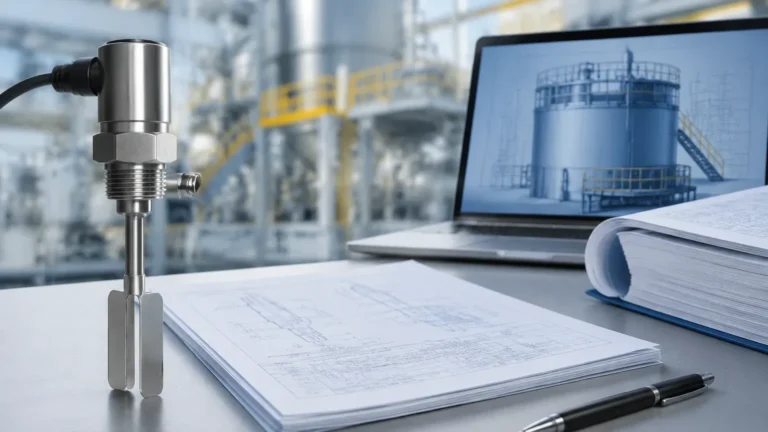
Vibrating fork level switches, often referred to as tuning forks, utilize piezoelectric crystals to vibrate a metal fork at its natural resonant frequency in free air. When the fork is submerged in a liquid or covered by a solid, the frequency of vibration shifts. An internal electronic circuit detects this change and triggers a relay or transistor output. This technology is highly robust because it is largely unaffected by flow, turbulence, bubbles, or foam.
Capacitance and RF Admittance
Capacitance-based switches treat the sensor probe and the tank wall as two plates of a capacitor. The material in the tank acts as the dielectric. As the level rises and covers the probe, the capacitance increases. However, standard capacitance switches can struggle with "coating"—where sticky material remains on the probe even after the level drops, causing false alarms.
RF Admittance technology is an evolution of capacitance. It uses a high-frequency radio signal and a specialized "driven shield" section on the probe. This allows the electronics to mathematically ignore the resistance and capacitance of the coating, measuring only the change in admittance caused by the bulk material. This makes it ideal for sticky liquids or slurries.
Conductivity Measurement
For conductive liquids like water or acids, conductivity switches offer a simple, low-cost solution. A small voltage is applied to an electrode. When the liquid touches the electrode, a circuit is completed through the liquid to the tank wall (or a reference electrode), triggering the switch. While effective, these cannot be used with non-conductive oils or distilled water.
Key Technologies in the Level Switch Sapcon Range
Sapcon’s portfolio is categorized by the specific challenges they address in the field. For engineers evaluating these systems, the following categories represent the core of their offerings:
1. Vibrating Fork Series (e.g., Elixir): Designed for both liquids and solids. The liquid versions are compact and often used in pipe detection or small vessels, while the solids versions feature larger forks to handle bulk density variations in powders and granules.
2. RF Admittance Series (e.g., SLA): These are the workhorses for challenging environments. They are frequently deployed in cement silos, chemical processing, and mining where material buildup is a constant threat to sensor accuracy.
3. Conductivity Series (e.g., DLC): Primarily used in water treatment and boiler level control, these switches provide multi-point detection (up to five levels) using a single process connection.
4. Rotary Paddle Switches: For heavy bulk solids like sand or grain, a motor-driven paddle rotates slowly. When material reaches the paddle, the rotation is impeded, and the motor shifts to trigger a microswitch. This is a purely mechanical-electrical interface suitable for high-density solids.
Technical Selection Parameters
Selecting a Level Switches solution involves more than just identifying the medium. Engineers must consult the following table to narrow down the appropriate technology based on process conditions:
| Feature | Vibrating Fork | RF Admittance | Conductivity | Rotary Paddle |
| :— | :— | :— | :— | :— |
| Medium State | Liquid / Fine Solids | Liquid / Slurry / Solid | Conductive Liquid | Bulk Solids |
| Max Temperature | Up to 150°C (302°F) | Up to 250°C (482°F) | Up to 200°C (392°F) | Up to 80°C (176°F) |
| Max Pressure | 40 bar (580 psi) | 25 bar (362 psi) | 10 bar (145 psi) | Atmospheric |
| Coating Resistance | Moderate | Excellent | Poor | High |
| Moving Parts | None | None | None | Yes |
| Dielectric Sensitivity | Low | High | N/A | Low |
Installation and Engineering Considerations
Proper installation is the difference between a sensor that lasts a decade and one that fails in a week. When integrating a level switch Sapcon unit into a system, consider the following:
* Mounting Position: For solids, sensors should be mounted away from the fill stream to prevent damage from falling material. For liquids, horizontal mounting is common for high/low alarms, but vertical mounting is preferred if the switch must be adjustable or if there is limited side access.
* Nozzle Length: The active part of the sensor (the fork or the probe tip) must extend fully into the vessel. If the mounting nozzle is too long, material can get trapped in the nozzle, causing the sensor to remain "covered" even when the tank is empty.
* Grounding: For capacitance and RF admittance switches, a solid ground connection to the metal tank is mandatory. If the tank is plastic or lined, a reference probe or a metal grounding strip must be used.
* Cable Glands: Always point cable entries downward to prevent moisture from entering the housing via the conduit. Use a drip loop in the cabling.
Comparative Analysis: Choosing the Right Sensor
When comparing a level switch Sapcon model to other industrial alternatives, the decision often hinges on the "Build-up" factor.
In the food and beverage industry, where Clean-In-Place (CIP) processes are standard, a vibrating fork is often the best choice due to its polished stainless steel construction and lack of moving parts. However, in a wastewater treatment plant where grease and sludge are prevalent, an RF Admittance switch is superior because it can differentiate between a thick layer of grease on the probe and the actual rise in water level.
For simple applications like high-level alarms in water tanks, the conductivity switch remains the most cost-effective choice, provided the liquid has a conductivity of at least 25 µS/cm.
Limitations and Common Risks
While highly reliable, level switches are not universal tools. Engineers should be aware of the following limitations:
1. Mechanical Wear: Rotary paddle switches have motors and seals that eventually wear out, especially in abrasive environments like glass cullet or ore processing.
2. Material Bridging: In silos containing damp powders, material can "bridge" over the sensor, creating a void that prevents the switch from detecting the actual level. In such cases, vibration or aeration may be required.
3. Dielectric Changes: Capacitance switches are calibrated to a specific material. If the process changes from a high-dielectric liquid to a low-dielectric liquid, the switch may require recalibration.
4. Turbulence: In highly agitated tanks, a vibrating fork might experience mechanical stress. Installing a baffle or a stilling well can mitigate this risk.
Frequently Asked Questions (FAQs)
Q: Can a vibrating fork level switch be used for viscous oils?
A: Yes, but with caution. If the oil is so viscous that it sticks between the tines of the fork (bridging), the switch will fail to reset. For extremely thick oils, an RF admittance probe is generally safer.
Q: What is the benefit of a DPDT relay output in these switches?
A: A Double Pole Double Throw (DPDT) relay provides two independent sets of contacts. This allows one set to be used for a local alarm (like a siren or light) while the other set sends a signal to a PLC or DCS for process logic.
Q: How do I test the switch without filling the tank?
A: Most modern level switches, including many Sapcon models, feature a "test" magnet or button on the housing. Touching a magnet to a specific spot on the enclosure simulates a covered condition, allowing you to verify the loop and alarm logic.
Q: Are these switches suitable for hazardous areas?
A: Yes, many models are available with flameproof (Ex d) or intrinsically safe (Ex i) certifications for use in explosive atmospheres common in the oil and gas or chemical industries.
Conclusion
Selecting the right level switch Sapcon configuration requires a balance between budget, process conditions, and maintenance capabilities. By understanding the underlying physics—whether it be the resonance of a tuning fork or the complex impedance of RF admittance—engineers can implement a level control strategy that minimizes downtime and maximizes safety. For those seeking high-performance alternatives or customized OEM solutions, exploring a wide range of industrial Level Switches ensures that the specific demands of your application are met with precision and reliability.