Bin Level Switch
Bin Level Switch
In industrial bulk solids handling, maintaining inventory control and preventing vessel overfills or dry-run conditions is critical for operational efficiency and safety. A bin level switch serves as a point-level detection device, providing a discrete signal (on/off) when material reaches a specific height within a silo, hopper, or bin. Unlike continuous level transmitters that provide a constant percentage of volume, these switches are designed for high-level alarm, low-level alarm, or intermediate demand signaling.
Welk provides a range of robust level measurement solutions tailored for the demanding environments of the chemical, water treatment, and industrial automation sectors. Understanding the underlying physics of different sensing technologies is the first step in selecting the correct instrument for a specific bulk material.
Understanding Bin Level Switch Technologies
Selecting a bin level switch requires a thorough understanding of the material properties, such as bulk density, moisture content, and particle size. Different measurement principles offer distinct advantages depending on whether the material is a fine powder, a heavy granulate, or a sticky solid.
Rotary Paddle Switches
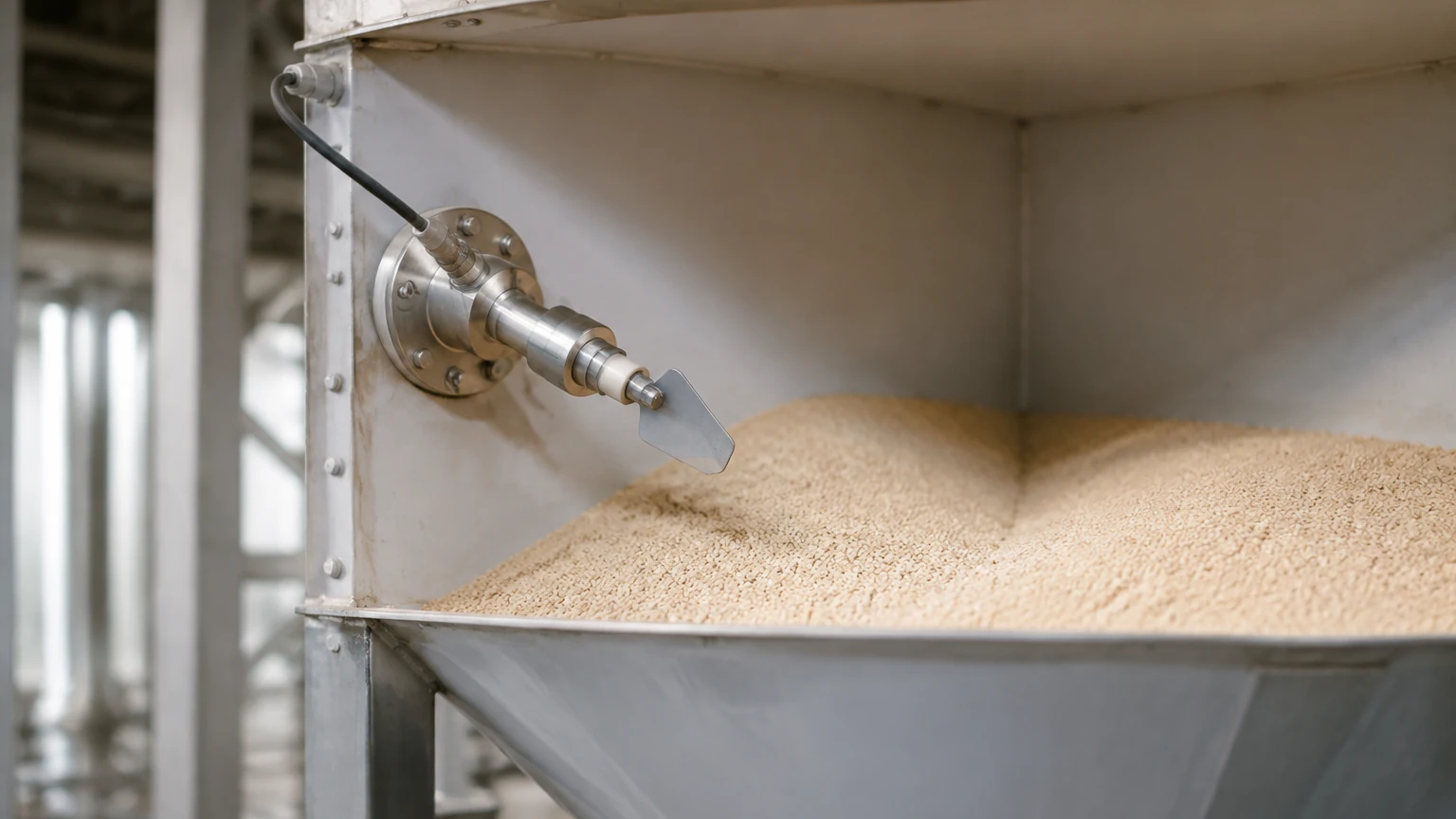
The rotary paddle switch is one of the most widely used mechanical instruments for bulk solids. The operating principle involves a low-speed electric motor that rotates a paddle via a shaft. When the material level rises and reaches the paddle, it creates mechanical resistance. This resistance exceeds the torque threshold of the internal motor, causing it to stall or rotate a microswitch assembly. This action triggers the output signal and simultaneously cuts power to the motor to prevent overheating and extend service life. When the material level drops, a spring return mechanism restarts the motor, and the switch reverts to its normal state.
Vibrating Rod and Tuning Fork Switches
Vibrating level switches utilize piezoelectric crystals to energize a sensing element (either a single rod or a dual-pronged fork) at its natural resonant frequency in free air. When the material covers the probe, the vibration is dampened. The electronic circuit detects this change in amplitude or frequency and converts it into a switching signal.
These sensors are particularly effective for fine powders and low-density materials. Because the vibration helps shed small amounts of material buildup, they are often considered "self-cleaning." However, they are sensitive to extremely high-viscosity coatings or very large aggregate that could mechanically wedge between the tines of a tuning fork.
Capacitance Level Switches
Capacitance switches operate based on the dielectric constant of the material. The sensor probe and the vessel wall (if conductive) act as two plates of a capacitor. As material replaces the air between the probe and the wall, the capacitance increases because most solids have a higher dielectric constant than air (which has a dielectric constant of 1).
Modern capacitance switches often incorporate "active shield" technology. This involves an additional conductive section on the probe that is driven at the same potential as the main sensing element, effectively ignoring the capacitance contributed by material buildup on the probe itself. This makes them suitable for sticky materials or applications where coating is a concern.
Diaphragm (Pressure) Switches
Diaphragm switches are pressure-sensitive devices mounted to the side of a bin. As the material level rises, the weight or head pressure of the solids pushes against a flexible diaphragm (typically made of neoprene, stainless steel, or silicone). This mechanical pressure activates a sensitive microswitch. These are purely mechanical and often do not require an external power supply to operate the switch itself, making them a cost-effective choice for heavy, free-flowing granulates.
Key Selection Criteria for Bulk Solids
Choosing the wrong bin level switch can lead to frequent false alarms or mechanical failure. Engineers must evaluate the following parameters before procurement:
1. Bulk Density: This is measured in kilograms per cubic meter (kg/m³). Rotary paddles and vibrating forks have minimum density requirements (e.g., 10 kg/m³ to 100 kg/m³). If the material is too light, it may not provide enough resistance to stop a paddle or dampen a vibration.
2. Particle Size and Shape: Large, heavy rocks can damage delicate vibrating forks, whereas fine, aerated powders might flow around a rotary paddle without triggering it.
3. Moisture and Conductivity: High moisture content increases the dielectric constant and the stickiness of the material. This typically favors capacitance switches with coating rejection or vibrating rods over mechanical paddles.
4. Process Temperature and Pressure: Standard switches handle up to 80°C, but high-temperature versions with ceramic insulators or cooling fins are required for fly ash or hot clinker applications reaching 250°C or higher.
5. Vessel Geometry: The angle of repose—the steepest angle at which a material remains stable without sliding—determines where the material will actually contact a side-mounted switch.
Comparison Table: Choosing the Right Switch
The following table provides a general guideline for technology selection based on common material characteristics.
| Technology | Best For | Advantages | Limitations |
| :— | :— | :— | :— |
| Rotary Paddle | Pellets, grains, heavy powders | Low cost, easy to understand, robust | Mechanical wear, not for very light powders |
| Vibrating Rod | Fine powders, light flakes | No moving parts, high sensitivity | Can be damaged by heavy falling material |
| Capacitance | Liquids, slurries, sticky solids | No moving parts, works in high pressure | Requires calibration, sensitive to dielectric changes |
| Diaphragm | Heavy granulates, sand | No power required, very low cost | Diaphragm wear, only for side-mounting |
| Microwave | Non-contact detection | Non-invasive, handles aggressive media | Higher cost, requires clear line of sight |
For a complete range of industrial instrumentation and to Main Page, engineers should evaluate the specific material characteristics of their process to ensure long-term reliability.
Installation Best Practices and Considerations
Proper installation is as important as technology selection. Even the best bin level switch will fail if it is positioned incorrectly or exposed to excessive mechanical stress.
Mounting Position
* High-Level Detection: Sensors should be mounted in the top section of the bin but away from the fill stream. If a switch is placed directly under the inlet, the falling material will cause false triggers and premature wear.
* Low-Level Detection: Sensors are mounted in the hopper or the lower side wall. In these positions, the sensor must be able to withstand the static pressure of the entire material column.
Protection from Material Flow
In silos where heavy materials are dropped from significant heights, a protective baffle or "shield" should be installed above the sensor. This angled metal plate diverts the direct impact of the falling material, protecting the probe or paddle from bending or breaking while still allowing the rising material to reach the sensor.
Wiring and Grounding
For capacitance and electronic switches, proper grounding to the metal vessel is essential for a stable reference point. In non-metallic (plastic or fiberglass) bins, a ground wire or a dedicated ground plate must be installed. Additionally, always use a "drip loop" in the conduit to prevent moisture from entering the housing via the cable entry.
Common Risks and Operational Limitations
While bin level switches are designed for industrial use, they are subject to several common failure modes:
* Material Bridging: In some hoppers, material can form a "bridge" or arch over the discharge outlet. A low-level switch might indicate the bin is full because it is covered by the bridge, even though the area below it is empty.
* Rat-Holing: This occurs when material flows down a narrow center channel, leaving a stagnant ring of material along the walls. A side-mounted switch may remain covered (indicating "full") while the actual usable volume is exhausted.
* Mechanical Fatigue: Rotary paddles involve moving parts and seals. Over time, the shaft seals can fail, allowing fine dust to enter the motor housing, leading to internal failure.
* False Triggers from Buildup: In high-moisture environments, material can cake onto the probe. If the sensor does not have buildup compensation (like an active shield capacitance probe), it may indicate a "covered" state indefinitely.
Maintenance and Troubleshooting FAQ
Q: How often should a bin level switch be calibrated?
A: Mechanical switches like rotary paddles and diaphragm switches generally do not require calibration. Capacitance switches should be calibrated at the time of installation with the bin empty and, if possible, again when the probe is covered. Periodic checks are recommended every 6 to 12 months, depending on the stability of the material's dielectric properties.
Q: Can these switches be used in hazardous (explosive) dust environments?
A: Yes, but you must select a model with the appropriate ATEX, IECEx, or North American hazardous area ratings. Dust ignition-proof housings and intrinsically safe circuits are standard requirements for grain elevators, coal bunkers, and chemical silos.
Q: What is the "Fail-Safe" mode?
A: Fail-safe refers to the state the relay takes if power is lost. For high-level applications, you should select "Fail-Safe High" (FSH), meaning the relay de-energizes to the "full" state upon power loss, preventing an accidental overfill. For low-level applications, "Fail-Safe Low" (FSL) is used to prevent dry-run conditions.
Q: What is the maximum probe length for a top-mounted switch?
A: For rotary paddles and vibrating rods, extension shafts can reach up to 3 or 4 meters. However, very long shafts require steady brackets or supports to prevent the shaft from bending due to the lateral forces of shifting material.
By carefully matching the sensing technology to the physical properties of the bulk solid and following rigorous installation standards, facilities can ensure reliable level detection. For further technical specifications and to review product options and application support, visit the Welk Main Page to explore the full catalog of industrial level measurement instruments.