Cooling Tower Basin
Cooling Tower Basin
In industrial cooling systems, the cooling tower basin serves as the primary reservoir for collecting cooled water before it is recirculated through the heat exchangers or process equipment. While often viewed simply as a structural component, the basin is the heart of the tower's hydraulic balance. Precise management of the water level within the cooling tower basin is critical for preventing pump cavitation, ensuring efficient chemical treatment, and minimizing water waste through overflow or excessive blowdown.
Effective basin management requires a deep understanding of the physical dynamics at play, including turbulence, chemical scaling, and environmental exposure. This guide provides an engineering-focused overview of level measurement technologies, selection criteria, and installation strategies specifically tailored for the cooling tower basin.
The Role of the Cooling Tower Basin in Process Efficiency
The cooling tower basin, typically located at the base of the tower, performs several vital functions. It acts as a buffer tank, providing the necessary net positive suction head (NPSH) for the circulation pumps. If the level drops too low, air can be drawn into the pump suction, leading to cavitation, mechanical damage, and loss of cooling capacity.
Conversely, maintaining an excessively high level leads to water loss through the overflow drain, which wastes both water and expensive treatment chemicals. The basin is also the primary site for water quality management. Make-up water—fresh water added to replace losses from evaporation and drift—is usually introduced here. Simultaneously, "blowdown" (the intentional discharge of a portion of the circulating water) is managed based on the concentration of dissolved solids in the basin. Accurate level sensing is the foundation upon which these automated control loops operate.
Level Measurement Technologies for Basin Monitoring
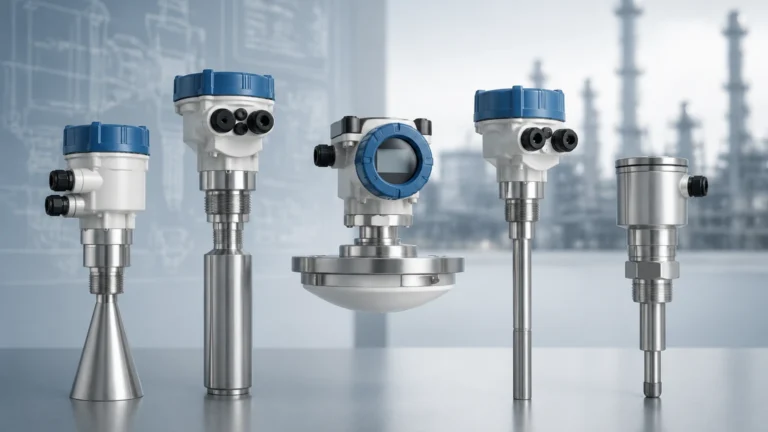
Choosing the right sensor for a cooling tower basin involves balancing accuracy, maintenance requirements, and environmental resilience. Several technologies are commonly deployed in industrial settings.
1. Ultrasonic Level Sensors
Ultrasonic sensors are non-contact devices that emit high-frequency sound pulses toward the water surface. The sensor measures the time it takes for the echo to return, calculating the distance based on the speed of sound.
* Principle: Time-of-Flight (ToF).
* Advantages: No moving parts and no contact with the process fluid, which reduces corrosion risks. They are generally cost-effective for standard basins.
* Limitations: Since sound speed varies with air temperature, these sensors require temperature compensation. In cooling towers, heavy steam or fog can attenuate the signal, leading to false readings if the sensor is not high-quality.
2. Radar Level Meters
Radar technology, particularly 80 GHz high-frequency radar, has become the gold standard for cooling tower basin applications. Like ultrasonic sensors, radar is non-contact, but it uses electromagnetic waves instead of sound.
* Principle: Frequency Modulated Continuous Wave (FMCW) or Pulsed Radar.
* Advantages: Radar is unaffected by air temperature, pressure, or the presence of steam and vapor. It provides extreme precision (often within ±2 mm) and is highly resistant to the turbulent surface conditions common in basins.
* Limitations: Higher initial capital expenditure compared to ultrasonic or float-based systems.
3. Hydrostatic Level Transmitters
These sensors are submerged at the bottom of the basin and measure the pressure exerted by the liquid column above them.
* Principle: $P = \rho gh$ (Pressure = Density × Gravity × Height).
* Advantages: They are simple to install and provide a direct measurement of the liquid head. They are unaffected by surface foam or steam.
* Limitations: Because they are in constant contact with the water, they are susceptible to scaling and biofouling. In cooling towers with high mineral content, the sensing diaphragm must be cleaned regularly to maintain accuracy.
4. Magnetic Level Gauges and Switches
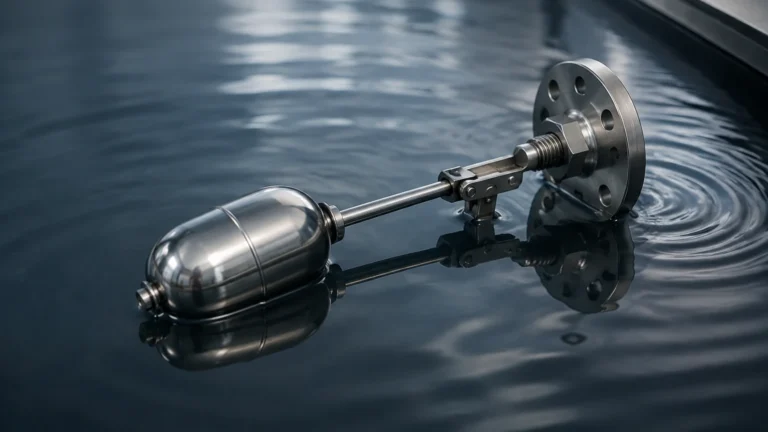
For point-level detection (such as high-level alarms or low-level pump cut-offs), magnetic floats or conductivity switches are often used as redundant safety measures.
* Principle: Buoyancy or electrical conductivity.
* Advantages: Highly reliable for discrete switching logic.
* Limitations: Mechanical floats can get stuck due to debris or scale buildup in the basin.
Selection Criteria for Basin Level Sensors
When specifying a level instrument for a cooling tower basin, engineers must evaluate several environmental and operational factors. The following table provides a comparison of the most common technologies used in these applications.
Technology Comparison Table
| Feature | Ultrasonic | Radar (FMCW) | Hydrostatic | Magnetic Float |
| :— | :— | :— | :— | :— |
| Measurement Type | Non-contact | Non-contact | Contact (Submerged) | Contact |
| Accuracy | Moderate (±0.25%) | High (±2 mm) | Moderate (±0.5%) | N/A (Point level) |
| Steam/Vapor Resistance | Low to Moderate | Excellent | Excellent | Good |
| Maintenance Needs | Low | Very Low | Moderate (Cleaning) | Moderate (Moving parts) |
| Typical Range | 0.25m – 10m | 0.1m – 30m+ | 0m – 5m | Fixed |
| Cost | Economy | Premium | Mid-range | Low |
For comprehensive technical specifications and to Review product options and application support, consulting the manufacturer's Main Page is recommended to ensure the selected hardware aligns with specific industrial standards.
Installation Best Practices in Cooling Tower Environments
The physical environment of a cooling tower basin is challenging. Proper installation is just as important as selecting the right technology.
Avoiding the "Splash Zone"
In many towers, water falls from the fill media directly into the basin, creating significant turbulence and splashing. Sensors should be installed away from the direct path of falling water. If a non-contact sensor is placed directly under the fill, the "noise" from the falling droplets can interfere with the signal.
Use of Stilling Wells
If the basin surface is excessively turbulent due to high-velocity return flows, a stilling well (a vertical pipe with a small vent hole) should be used. The stilling well acts as a mechanical filter, providing a calm surface for ultrasonic or radar sensors to measure. For hydrostatic sensors, a stilling well protects the probe from lateral movement caused by currents.
Mounting and Dead Zones
Every non-contact sensor has a "dead zone" or "blocking distance" (typically 100 mm to 500 mm depending on the model). The sensor must be mounted high enough so that the maximum possible water level never enters this zone. For basins with limited overhead clearance, radar sensors are often preferred because they typically have much smaller dead zones than ultrasonic units.
Cable Management and Corrosion
Cooling tower water is often chemically treated with biocides and corrosion inhibitors. All sensor housings should be rated at least IP67 or IP68. Cables should be routed through conduits to protect them from UV exposure and chemical splashes. Stainless steel (316L) or plastic (PVDF/PP) wetted parts are recommended for any contact-based sensors to prevent premature failure.

Common Operational Risks and Mitigation
Managing a cooling tower basin involves navigating several risks that can compromise level measurement accuracy:
1. Foaming: Chemical imbalances or high organic loads can cause foam to form on the water surface. Ultrasonic sensors may struggle with foam as it absorbs sound waves. Radar or hydrostatic sensors are better suited for foaming environments.
2. Silt and Sludge Accumulation: Over time, airborne dust and biological solids settle at the bottom of the basin. This can bury hydrostatic transmitters. Sensors should be mounted slightly above the basin floor or cleaned during scheduled outages.
3. Temperature Fluctuations: In outdoor towers, the air temperature above the water can change rapidly. If using ultrasonic sensors, ensure they have integrated temperature sensors to adjust the speed-of-sound calculations in real-time.
4. Wind Effects: In large, open-air basins, wind can push water to one side, creating a false level reading. Placing the sensor in a central location or using multiple sensors for averaging can mitigate this effect.
Frequently Asked Questions (FAQs)
Q: How often should I calibrate my basin level sensor?
A: For most digital radar and ultrasonic sensors, an annual check is sufficient. Hydrostatic sensors may require semi-annual calibration checks if the water has high mineral content that could cause drift through scaling.
Q: Can I use a simple float switch for make-up water control?
A: While possible, float switches only provide on/off control. This leads to frequent cycling of the make-up valve, which increases wear. A continuous level transmitter (like radar) allows for modulated valve control, maintaining a steady level and reducing mechanical stress on the plumbing.
Q: What is the ideal water level for a cooling tower basin?
A: This is determined by the tower manufacturer, but generally, the level should be high enough to prevent vortexing at the pump suction (usually at least 300 mm to 500 mm above the suction outlet) while remaining at least 150 mm below the overflow weir.
Q: Does the material of the basin (concrete vs. fiberglass) affect the sensor?
A: Generally, no. However, for radar sensors, if the basin is very narrow and made of metal, you must ensure the beam angle is narrow enough to avoid hitting the side walls, which could cause false echoes.
Conclusion
The cooling tower basin is more than just a tank; it is a critical node in the industrial cooling loop. By implementing robust level measurement technologies like radar or hydrostatic transmitters, facilities can significantly improve water efficiency, protect expensive pumping equipment, and reduce maintenance costs. When selecting a solution, always consider the specific turbulence, chemical profile, and physical constraints of your basin. For further technical guidance and to explore specific measurement hardware, visit the Main Page of an established instrument manufacturer to Review product options and application support.