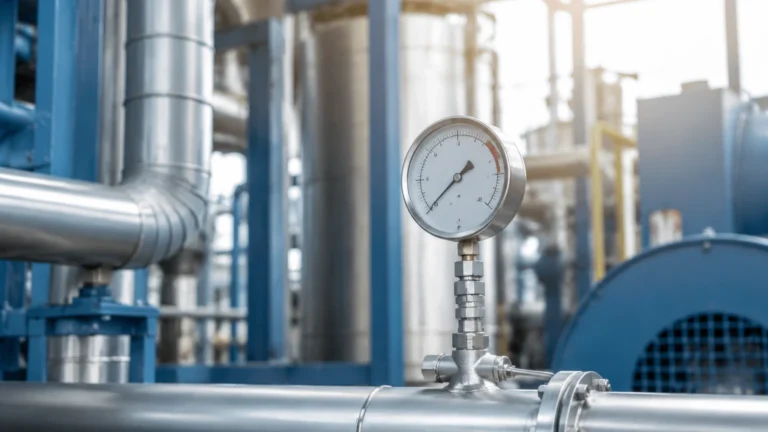
Differential Pressure Flow Measurement
Differential Pressure Flow Measurement
Differential pressure flow measurement remains one of the most widely used methods for determining the flow rate of liquids, gases, and steam in industrial processes. Based on well-established physical principles, this technology offers a robust and cost-effective solution for applications ranging from water treatment to high-pressure chemical processing. Understanding the underlying physics, the variety of primary elements available, and the critical installation requirements is essential for engineers and technicians tasked with optimizing process efficiency.
Principles of Differential Pressure Flow Measurement
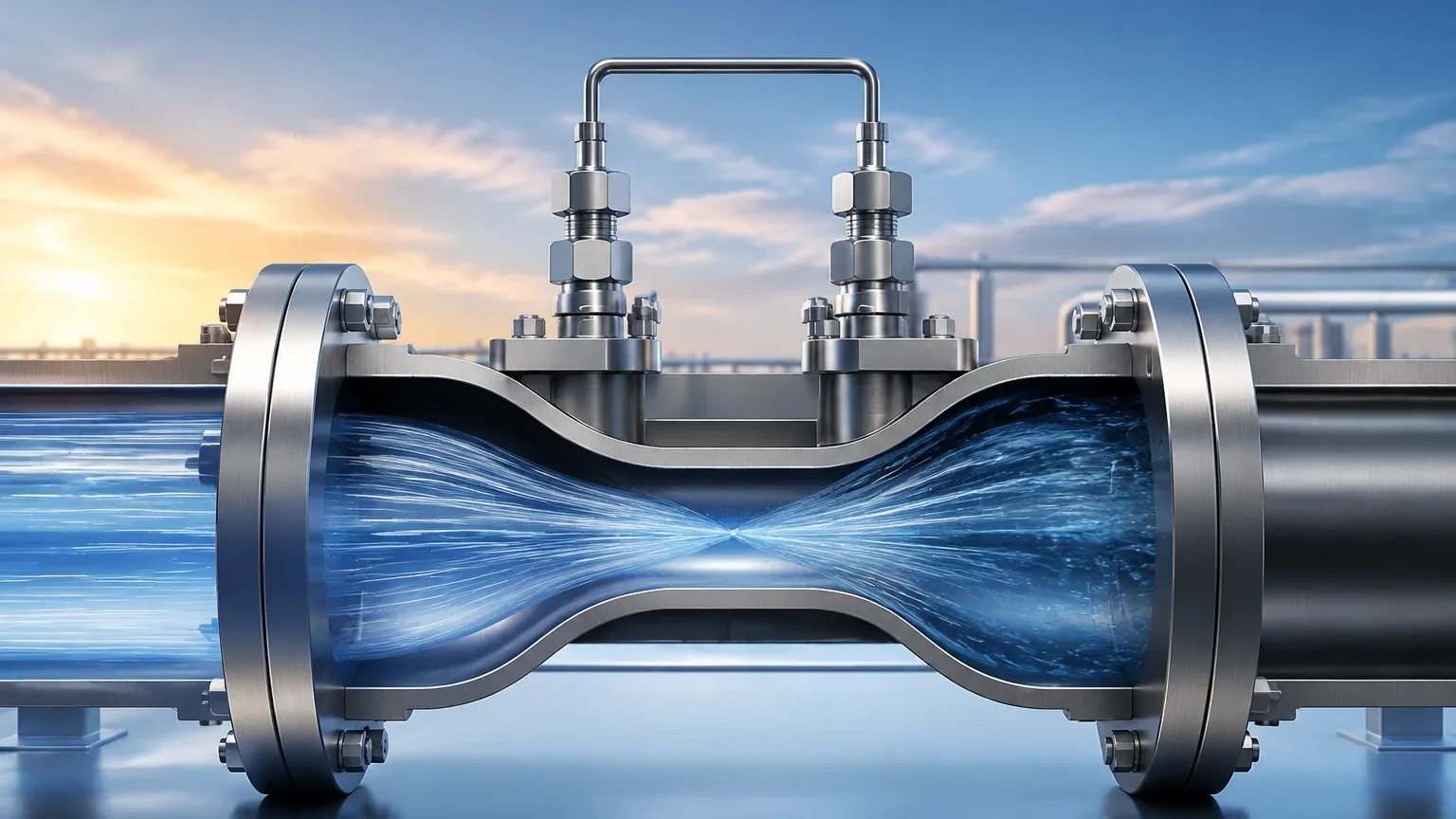
The fundamental principle behind differential pressure (DP) flow measurement is Bernoulli’s equation, which describes the relationship between the velocity of a fluid and its pressure. When a fluid moving through a closed pipe encounters a physical restriction, its velocity increases according to the principle of continuity. As the velocity increases, the kinetic energy rises, causing a corresponding decrease in static pressure.
By measuring the difference between the pressure upstream of the restriction and the pressure at the point of maximum constriction (or immediately downstream), the flow rate can be calculated. The relationship is mathematically expressed as:
Q = k × √ΔP
Where:
- Q is the flow rate (volumetric or mass).
- k is a constant derived from the geometry of the device and fluid properties (discharge coefficient).
- ΔP is the differential pressure (the difference between high-pressure and low-pressure taps).
Because the flow rate is proportional to the square root of the differential pressure, DP flow meters typically have a limited "turndown ratio" (the range between maximum and minimum measurable flow). Typically, a standard DP transmitter provides a 4:1 or 5:1 turndown ratio, although modern smart transmitters can extend this range through advanced signal processing.
Primary Elements in DP Flow Systems
The "primary element" is the hardware installed directly in the pipeline to create the pressure drop. The choice of primary element depends on the fluid state, required accuracy, and allowable permanent pressure loss.
Orifice Plates
Orifice plates are the most common primary elements due to their simplicity and low cost. They consist of a thin metal plate with a precisely machined hole (usually concentric) placed perpendicular to the flow. While easy to install and replace, they generate a significant permanent pressure loss (PPL) and are susceptible to wear over time, which can degrade accuracy.
Venturi Tubes
A Venturi tube features a tapered inlet, a narrow throat, and a diverging outlet. This streamlined design minimizes turbulence and allows for excellent pressure recovery. Venturi tubes are ideal for applications where low pressure loss is critical or where the fluid contains solids (slurries), as the smooth profile prevents clogging. However, they are larger and more expensive than orifice plates.
Flow Nozzles
Flow nozzles are essentially a hybrid between an orifice plate and a Venturi tube. They are particularly effective for high-velocity flows and abrasive fluids. In power generation, flow nozzles are frequently used for high-temperature, high-pressure steam measurement because of their structural integrity and resistance to erosion.
Pitot Tubes and Averaging Pitot Tubes
Pitot tubes measure the difference between static pressure and total (impact) pressure at a specific point in the flow stream. Averaging Pitot tubes (APTs) feature multiple sensing ports across the pipe diameter to account for the flow profile. These devices cause very little permanent pressure loss and are often used in large-diameter ducts for gas and air flow measurement.
Selection Criteria for Industrial Applications
Selecting the correct hardware for differential pressure flow measurement requires a thorough evaluation of the process conditions. Engineers must consider the following factors:
1. Fluid Type and Phase: Is the fluid a clean liquid, a gas, steam, or a slurry? Slurries require Venturi tubes or wedge meters to prevent sediment buildup.
2. Operating Pressure and Temperature: High-temperature steam requires specialized materials and impulse line configurations to protect the secondary transmitter.
3. Accuracy Requirements: While orifice plates typically offer ±1% to ±2% accuracy, calibrated Venturi tubes can achieve better than ±0.5%.
4. Permanent Pressure Loss (PPL): In systems where pumping costs are a significant concern, selecting a low-PPL device like a Venturi tube or an averaging Pitot tube can result in long-term energy savings.
5. Pipe Size: Orifice plates are practical for pipes from 25 mm to 600 mm, while Pitot tubes are often preferred for much larger conduits where the cost of a full-bore meter would be prohibitive.
Comparison Table of Primary Elements
| Feature | Orifice Plate | Venturi Tube | Flow Nozzle | Averaging Pitot Tube |
| :— | :— | :— | :— | :— |
| Accuracy | Moderate (1-2%) | High (0.5-1%) | Moderate (1%) | Moderate (1-2%) |
| Pressure Loss | High | Low | Medium | Very Low |
| Initial Cost | Low | High | Medium | Low |
| Installation | Simple | Complex (Long) | Moderate | Simple |
| Suitability | Clean fluids | Slurries/Gases | High-velocity steam | Large ducts/pipes |
Secondary Elements: The Differential Pressure Transmitter
The secondary element is the DP transmitter, which senses the pressure from the high and low ports of the primary element and converts it into an electrical signal (usually 4-20mA or a digital protocol like HART or Modbus). To ensure reliable measurement, the transmitter must be compatible with the process environment. For those seeking comprehensive industrial instrumentation, it is helpful to Review product options and application support to match the transmitter to the specific primary element used.
Modern transmitters often include "multivariable" capabilities, measuring static pressure and temperature alongside differential pressure. This allows the device to calculate compensated mass flow in real-time, which is critical for gas and steam applications where density varies with temperature and pressure.
Installation and Engineering Considerations
The accuracy of differential pressure flow measurement is highly dependent on proper installation. Even the most precise primary element will produce erroneous data if the flow profile is distorted.
Straight Pipe Requirements
To ensure a fully developed flow profile, primary elements require a certain length of straight pipe upstream and downstream of the installation point. Obstructions like elbows, valves, and reducers create turbulence. Typically, a minimum of 10 to 20 pipe diameters (D) upstream and 5D downstream is required. If space is limited, flow conditioners or straightening vanes may be necessary.
Impulse Line Routing
Impulse lines are the small-bore pipes that connect the primary element taps to the DP transmitter.
- For Liquids: The transmitter should be mounted below the pipe taps to allow gas bubbles to vent back into the process line.
- For Gases: The transmitter should be mounted above the pipe taps so that any condensed liquid drains back into the process line.
- For Steam: Condensate pots must be used to ensure the impulse lines are filled with water, protecting the transmitter from high-temperature steam.
Reynolds Number
DP flow meters are sensitive to the Reynolds number ($Re$), a dimensionless value representing the ratio of inertial forces to viscous forces. Most DP elements are designed for turbulent flow ($Re > 4000$). If the flow is laminar or in the transitional region, the discharge coefficient ($k$) changes significantly, leading to inaccuracies.
Limitations and Common Challenges
While versatile, differential pressure flow measurement has specific limitations:
1. Non-Linear Output: The square-root relationship means that at low flow rates (e.g., below 20% of the maximum range), the differential pressure is very small, making it difficult for the transmitter to resolve accurately. This results in poor accuracy at the low end of the scale.
2. Permanent Pressure Loss: The energy lost across an orifice plate cannot be recovered, which may increase the load on pumps and compressors.
3. Maintenance Requirements: Impulse lines can become plugged with debris or frozen in cold climates, requiring regular purging or heat tracing.
4. Density Sensitivity: Since DP meters measure volume at line conditions, any change in fluid density (due to temperature or pressure shifts) requires compensation to maintain mass flow accuracy.
Frequently Asked Questions (FAQ)
Q: How often should an orifice plate be inspected?
A: Inspection frequency depends on the fluid's abrasiveness. In clean water service, an inspection every 2–3 years may suffice. In steam or abrasive chemical service, annual inspections are recommended to check for edge rounding or plate warping.
Q: Can DP flow meters measure bi-directional flow?
A: Standard orifice plates and Venturi tubes are uni-directional. However, specialized bi-directional orifice plates and symmetrical sensing elements are available for applications like storage tank breathing or reversible pumping systems.
Q: What is the impact of a backwards-installed orifice plate?
A: If an orifice plate is installed with the bevel facing upstream (backwards), the flow measurement will typically be 15% to 25% lower than the actual flow rate due to the change in the discharge coefficient.
Q: Why is a 3-valve or 5-valve manifold used?
A: Manifolds allow the transmitter to be isolated from the process for calibration or maintenance without shutting down the main pipeline. They also include an equalizing valve to zero the transmitter under static pressure.
Conclusion
Differential pressure flow measurement remains a foundational technology in modern industry. Its reliance on mechanical simplicity and proven fluid dynamics makes it a reliable choice for diverse sectors. By carefully selecting the appropriate primary element—whether it be a cost-effective orifice plate or a high-efficiency Venturi tube—and ensuring rigorous adherence to installation standards, operators can achieve precise and repeatable flow data. For further technical specifications and to explore integrated measurement solutions, professionals are encouraged to visit the Main Page for detailed product guidance.