E&h
E&h
In the landscape of industrial process automation, the name e&h (Endress+Hauser) has long been synonymous with high-precision instrumentation and robust engineering. For process engineers and facility managers, evaluating e&h equipment often serves as the starting point for establishing benchmarks in reliability, accuracy, and integration. However, as global supply chains evolve and the demand for cost-effective yet high-performance alternatives grows, understanding the underlying measurement principles and selection criteria becomes essential for making informed procurement decisions.
This guide explores the technical foundations of level measurement technology, comparing industry-standard approaches with modern solutions to help professionals navigate the complexities of liquid and solid level monitoring. By focusing on the functional requirements of applications in water treatment, chemical processing, and oil and gas, we provide a framework for selecting the right instrument for any industrial environment.
Core Measurement Principles in Industrial Applications
Before selecting a specific brand or model, it is critical to understand the physics behind the measurement. Industrial level sensors generally fall into two categories: continuous measurement and point level detection. Within these categories, several distinct technologies are employed, each with its own strengths and limitations.
Radar Level Measurement (ToF)
Radar technology, based on the Time-of-Flight (ToF) principle, is widely regarded as the gold standard for non-contact measurement. It involves the emission of high-frequency electromagnetic pulses (microwaves) that travel toward the product surface, are reflected, and then received by the sensor antenna. The distance is calculated based on the time it takes for the pulse to return.
There are two primary types of radar used in the industry:
1. Free-Space Radar: Utilizes 26 GHz or 80 GHz frequencies to measure level without contacting the media. 80 GHz radar is particularly effective in narrow tanks or vessels with internal obstructions due to its narrow beam angle.
2. Guided Wave Radar (GWR): Uses a physical probe (cable or rod) to guide the microwave pulse. This is highly effective in low dielectric constant (dk) liquids or applications with heavy foam and turbulence.
Ultrasonic Level Sensors
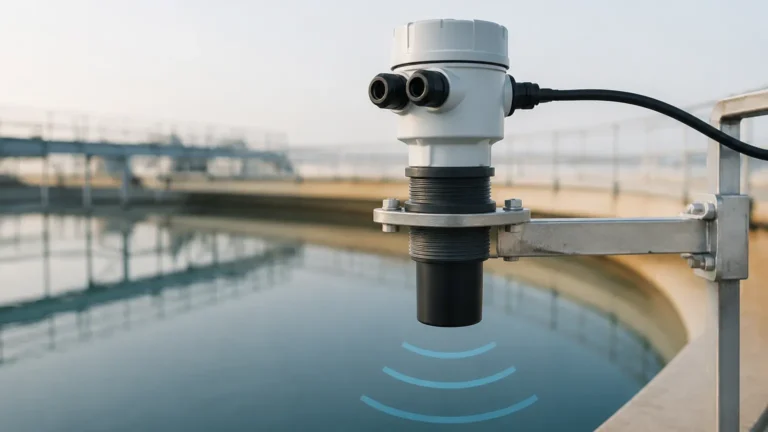
Ultrasonic sensors also operate on the ToF principle but use sound waves instead of electromagnetic waves. These sensors emit ultrasonic pulses that reflect off the surface of the medium. While highly cost-effective for water and wastewater applications, they are sensitive to air temperature fluctuations, heavy vapors, and vacuum conditions, as sound requires a medium (air) to travel.
Hydrostatic Pressure Measurement
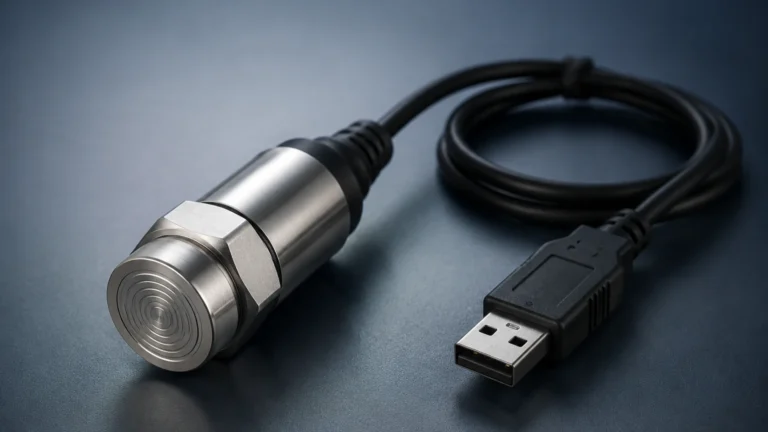
Hydrostatic level transmitters measure the pressure exerted by a liquid column. Based on the formula $P = \rho gh$ (where $P$ is pressure, $\rho$ is density, $g$ is gravity, and $h$ is height), the sensor can determine the level of the liquid if the density remains constant. This method is exceptionally reliable for vented tanks and deep wells.
Magnetic Level Gauges and Switches
Magnetic level gauges provide a visual indication of level via a float containing a magnet that actuates a series of flags or a transmitter outside the chamber. This is a mechanical solution that offers high reliability in high-pressure and high-temperature environments where electronic sensors might fail.
Comparative Selection Criteria
When evaluating instrumentation, engineers must balance technical performance with total cost of ownership. The following table provides a comparison of common technologies used in the industry, reflecting the standards often associated with e&h and similar high-tier manufacturers.
| Technology | Accuracy | Max Temperature | Pressure Range | Ideal Media |
| :— | :— | :— | :— | :— |
| 80 GHz Radar | ±1 mm | -40°C to +250°C | Up to 160 bar | Corrosive liquids, solids, narrow tanks |
| Guided Wave Radar | ±2 mm | -50°C to +400°C | Up to 400 bar | Low dk liquids, interface measurement |
| Ultrasonic | ±0.2% of range | -40°C to +80°C | Up to 3 bar | Water, wastewater, chemical storage |
| Hydrostatic | ±0.1% to 0.5% | -20°C to +100°C | N/A (Submersible) | Deep wells, fuel tanks, water reservoirs |
| Magnetic Gauge | ±5 mm (visual) | Up to +450°C | Up to 320 bar | Oil/water interface, high-pressure steam |
Technical Considerations for e&h Equivalent Solutions
When seeking alternatives to established brands like e&h, it is vital to ensure that the replacement hardware meets or exceeds the original specifications. For many organizations, the goal is to find a Main Page that offers equivalent technical specifications—such as HART communication protocols, ATEX/SIL2 certifications, and robust housing materials—at a more competitive price point.
1. Process Connection and Wetted Materials
In chemical applications, the compatibility of wetted parts is non-negotiable. While e&h often uses high-grade PTFE or Hastelloy, equivalent solutions must provide the same material certifications to prevent corrosion and premature sensor failure. Standard 316L stainless steel is sufficient for water, but aggressive acids require specialized coatings.
2. Signal Processing and False Echo Suppression
One of the reasons e&h is highly regarded is its advanced signal processing algorithms that can filter out "noise" from agitators or tank walls. Modern radar level meters now incorporate similar "Auto-False Echo Suppression" technology, allowing them to map out internal tank obstructions and focus solely on the true level signal.
3. Integration with Control Systems
Industrial 4.0 requires seamless data integration. Most high-quality level instruments now support 4-20mA current loops with HART, Modbus RS485, or Foundation Fieldbus. When transitioning between brands, verifying that the DTM (Device Type Manager) or EDD (Electronic Device Description) files are available is crucial for PLC/SCADA integration.
Installation Best Practices for Accuracy
Even the most advanced e&h or Welk sensor will provide inaccurate data if installed incorrectly. Engineering teams should adhere to the following guidelines:
* Avoid the Dead Zone: Every sensor has a "blocking distance" or "dead zone" near the antenna where measurement is impossible. Ensure the maximum liquid level never enters this zone.
* Nozzle Geometry: For radar and ultrasonic sensors, the nozzle height and diameter must be optimized. If the nozzle is too long or narrow, it can create parasitic reflections that interfere with the signal.
* Positioning: Sensors should generally be installed at 1/6th to 1/4th of the tank diameter from the wall. Never install a sensor directly over the center of a tank (to avoid multiple reflections) or directly over an inflow stream (to avoid turbulence interference).
* Stilling Wells: In tanks with heavy agitation or surface boiling, installing the sensor inside a stilling well or bypass chamber can provide a calm surface for more accurate readings.

Common Risks and Mitigation Strategies
In B2B procurement, the risk of downtime often outweighs the initial savings of a cheaper instrument. To mitigate these risks, consider the following:
* Environmental Factors: Condensation on the sensor face can attenuate ultrasonic signals. In such cases, switching to a radar sensor with a drip-off lens design is recommended.
* Vapor and Dust: High concentrations of dust in silos can scatter radar signals. Using a high-frequency (80 GHz) radar with a high sensitivity helps penetrate dust clouds more effectively than lower frequency models.
* Power Supply Stability: Ensure that the 24V DC loop power is stable. Voltage drops in long cable runs can lead to intermittent signal loss, a common issue in large-scale water treatment plants.
Frequently Asked Questions (FAQs)
Q: Can I replace an e&h radar meter with another brand without changing my PLC programming?
A: Yes, provided the new instrument supports the same communication protocol (usually 4-20mA HART). You will only need to update the range settings (4mA = 0%, 20mA = 100%) and potentially the DTM for configuration.
Q: How does 80 GHz radar compare to 26 GHz radar in practical applications?
A: 80 GHz radar has a much narrower beam angle (typically 3° to 6° compared to 10° to 15° for 26 GHz). This allows it to avoid internal obstructions like pipes or ladders and makes it much easier to install in small nozzles.
Q: Is hydrostatic level measurement suitable for pressurized tanks?
A: Standard hydrostatic sensors are designed for vented (atmospheric) tanks. For pressurized tanks, you must use a differential pressure (DP) transmitter to subtract the head pressure from the total pressure to find the liquid level.
Q: What is the typical lifespan of an industrial level sensor?
A: In non-corrosive environments, high-quality instruments often last 10 to 15 years. However, in aggressive chemical or high-vibration environments, sensors should be inspected every 2 to 3 years as part of a preventative maintenance program.
Conclusion
Choosing the right level measurement solution requires a deep understanding of both the process environment and the technological capabilities of the instrument. While e&h remains a leading choice for many, the gap between traditional premium brands and specialized manufacturers like Welk has narrowed significantly. By focusing on fundamental engineering principles—such as signal-to-noise ratios, material compatibility, and proper installation—industrial operators can achieve high-precision results while optimizing their instrumentation budget.
For those looking to explore a wide range of industrial level measurement options, including radar, ultrasonic, and hydrostatic solutions tailored to specific process needs, visiting the Main Page provides access to detailed product specifications and application support to ensure the right fit for your facility.