Endress Hauser Cerabar Pmp51b
Endress Hauser Cerabar Pmp51b
In the field of industrial process automation, pressure and level measurement are fundamental requirements for ensuring safety, efficiency, and quality. The Endress Hauser Cerabar PMP51B represents a significant advancement in digital pressure transmitter technology. As a part of the new generation of Cerabar instruments, it is designed to meet the rigorous demands of Industry 4.0 while maintaining the high reliability required for critical process applications. This article provides a technical overview of the PMP51B, its measurement principles, application engineering considerations, and how it compares to broader industrial level measurement solutions.
Understanding the Hydrostatic Measurement Principle
Before evaluating the specific features of the Endress Hauser Cerabar PMP51B, it is essential to understand the underlying physics it employs for level measurement. While the PMP51B is a pressure transmitter, it is frequently used in hydrostatic level applications.
The Physics of Hydrostatic Pressure
Hydrostatic level measurement is based on the principle that the pressure at a specific point in a static liquid is proportional to the height of the liquid column above that point, provided the density of the liquid and the force of gravity remain constant. The relationship is defined by the formula:
P = ρ · g · h
Where:
* P is the hydrostatic pressure (measured in Pascals or bar).
* ρ (rho) is the density of the medium (kg/m³).
* g is the acceleration due to gravity (approximately 9.81 m/s²).
* h is the height of the liquid column (meters).
In practical industrial applications, the transmitter is mounted at the bottom of a tank or vessel. As the liquid level rises, the pressure exerted on the transmitter's diaphragm increases linearly. By calibrating the transmitter to the specific gravity of the fluid, the pressure signal is converted into an accurate level reading.
Gauge vs. Absolute Pressure
The PMP51B is available in both gauge and absolute pressure configurations. Gauge pressure sensors measure pressure relative to the local atmospheric pressure, utilizing a vented cable or a vent element in the housing to compensate for changes in barometric pressure. Absolute pressure sensors measure pressure relative to a perfect vacuum, which is critical in vacuum distillation columns or applications where atmospheric fluctuations would introduce unacceptable errors.
Technical Specifications of the Cerabar PMP51B
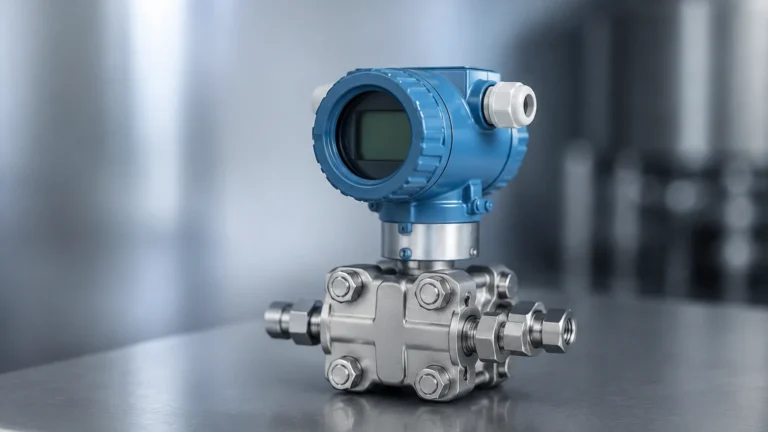
The Endress Hauser Cerabar PMP51B is a digital pressure transmitter equipped with a metallic measuring cell. Unlike its sibling, the PMC51B, which uses a ceramic cell, the PMP51B is optimized for high-pressure environments and applications where metallic diaphragms are preferred for chemical compatibility or mechanical robustness.
Sensor Construction
The PMP51B utilizes a piezoresistive sensor. This technology involves a bridge circuit etched onto a silicon or metallic substrate. When pressure is applied to the process diaphragm, it is transmitted via a fill fluid (typically silicone oil or inert oil) to the internal sensing element. The resulting mechanical deformation changes the electrical resistance of the bridge, which is then converted into a digital signal.
Key Performance Metrics
* Accuracy: The standard reference accuracy is ±0.075%, with a "platinum" version available that offers up to ±0.05%. This high precision is vital for inventory control and custody transfer applications.
* Long-term Stability: The device is designed for minimal drift, typically less than 0.05% of the URL (Upper Range Limit) per year.
* Pressure Ranges: The PMP51B can handle pressures from as low as 400 mbar (40 kPa) up to 400 bar (40 MPa), making it suitable for both shallow tank level measurement and high-pressure pipeline monitoring.
* Process Temperature: The standard operating range for the sensor is -40°C to +125°C. For higher temperatures, remote diaphragm seals are required to protect the electronics.
Digital Integration and Industry 4.0 Features
One of the defining characteristics of the PMP51B is its focus on connectivity and ease of use. In modern B2B industrial environments, reducing commissioning time and improving diagnostic capabilities are key drivers for ROI.
Bluetooth Connectivity and SmartBlue App
The PMP51B features integrated Bluetooth technology, allowing technicians to configure and diagnose the device from a distance of up to 15 meters. Using the SmartBlue app on a smartphone or tablet, users can access the device without opening the housing or using a physical handheld terminal. This is particularly beneficial for transmitters installed in hard-to-reach or hazardous areas.
HistoROM Data Management
The HistoROM concept involves an integrated memory module that stores the device configuration and event logs. If a transmitter electronics module needs replacement, the configuration can be automatically uploaded to the new module, ensuring zero-reconfiguration maintenance. This significantly reduces downtime in continuous process industries.
Safety and Compliance
The PMP51B is developed according to IEC 61508 and is suitable for use in SIL 2 (Safety Integrity Level) applications, or SIL 3 in homogeneous redundancy configurations. It also features a "Check-sum" function to ensure that the safety-related parameters have not been inadvertently changed.
Application Engineering and Selection Criteria
Selecting the right pressure transmitter requires a thorough analysis of the process conditions. While the Endress Hauser Cerabar PMP51B is a premium solution, engineers must weigh its features against the specific needs of the application.
When to Choose the PMP51B
1. High-Pressure Applications: When the process pressure exceeds the limits of ceramic sensors.
2. Hydrogen Permeation Risks: For applications involving hydrogen, the PMP51B can be equipped with gold-plated diaphragms to prevent hydrogen atoms from diffusing through the metal and damaging the sensor.
3. Vacuum Applications: Metallic cells are generally more resistant to the mechanical stresses of vacuum cycles than some ceramic designs.
4. Hygienic Requirements: With a wide range of flush-mounted process connections and 3-A or EHEDG certifications, it is suitable for food and beverage or pharmaceutical applications.
Comparative Selection Table
| Feature | PMP51B (Metallic) | PMC51B (Ceramic) | Standard Hydrostatic (e.g., Welk) |
| :— | :— | :— | :— |
| Overload Resistance | Moderate | Very High | Application Dependent |
| Abrasion Resistance | Low | High | Moderate |
| Vacuum Resistance | Excellent | Good | Good |
| Max Pressure | Up to 400 bar | Up to 40 bar | Up to 100 bar |
| Primary Use Case | High pressure, Hydrogen | Corrosive, Abrasive media | General Water/Oil/Gas |
For many standard industrial applications, such as water treatment or general chemical storage, a high-end digital transmitter like the PMP51B may offer more features than required. In these instances, exploring a broader range of industrial level measurement instruments can lead to more cost-effective solutions. You can Review product options and application support on the Welk Main Page to compare different technologies including radar, ultrasonic, and hydrostatic transmitters.

Installation and Commissioning Best Practices
Proper installation is critical to the accuracy and longevity of the PMP51B. Even the most advanced sensor will provide inaccurate data if installed incorrectly.
Mounting Position
For liquid level measurement, the transmitter should always be mounted below the minimum level. If the medium contains solids or sediment, the transmitter should be mounted slightly above the bottom of the tank or on the side to prevent the diaphragm from being covered by deposits.
Impulse Lines and Manifolds
When measuring pressure in pipelines, impulse lines should be as short as possible. For the PMP51B, using a manifold valve is highly recommended. This allows the transmitter to be isolated from the process for zero-point calibration or maintenance without shutting down the entire line.
Environmental Considerations
* Condensation: In humid environments, ensure the cable gland is pointing downwards to prevent water from entering the housing via the cable.
* Temperature Gradients: If the transmitter is exposed to direct sunlight, a sunshade should be used to prevent thermal fluctuations from affecting the electronics, even though the PMP51B has internal temperature compensation.
Limitations and Potential Risks
While the PMP51B is a robust instrument, it is not universal. Engineers should be aware of the following limitations:
1. Diaphragm Fragility: The metallic diaphragm on the PMP51B is very thin (often less than 0.1 mm). Any physical contact or abrasive particles in high-velocity flows can cause permanent damage or offset.
2. Fill Fluid Expansion: In applications with extreme temperature swings, the expansion and contraction of the internal fill fluid can introduce small measurement errors, particularly at very low pressure ranges.
3. Chemical Compatibility: While 316L stainless steel is standard, it is not suitable for all media. For highly corrosive acids (like hydrochloric acid), exotic materials like Tantalum or Monel must be specified, which significantly increases the cost.
Frequently Asked Questions (FAQ)
Q: Can the PMP51B be used for steam applications?
A: Yes, but a siphon or a remote seal must be used to ensure the steam temperature does not exceed the maximum allowable temperature at the sensor diaphragm.
Q: What is the difference between the PMP51B and the older PMP51?
A: The "B" generation introduces Bluetooth connectivity, an improved HistoROM, a more user-friendly display, and enhanced safety features (SIL by design).
Q: How often should the PMP51B be calibrated?
A: While the PMP51B has excellent long-term stability, industrial standards typically recommend an annual check. In stable, non-corrosive environments, this interval can often be extended to 2 or 3 years based on historical performance data.
Q: Does the PMP51B support Foundation Fieldbus or Profibus?
A: The PMP51B primarily supports HART 7, but integration into other bus systems is possible through gateways or by selecting specific electronic modules designed for those protocols.
Conclusion
The Endress Hauser Cerabar PMP51B is a sophisticated tool for modern process industries, offering high precision, safety compliance, and advanced digital diagnostics. Its metallic measuring cell makes it a preferred choice for high-pressure and vacuum applications where data integrity is paramount. However, successful implementation depends on careful selection of materials, correct installation, and an understanding of the hydrostatic principles involved. For engineers seeking a wide array of measurement technologies tailored to specific industrial needs, visiting the Main Page of a specialized manufacturer like Welk can provide additional insights into radar, ultrasonic, and other hydrostatic solutions that complement or provide alternatives to the Cerabar series.