Hands-on Instrumentation & Controls Course
Hands-on Instrumentation & Controls Course
In the modern industrial landscape, the gap between theoretical engineering knowledge and field-level application can be significant. For professionals working in water treatment, chemical processing, and oil and gas sectors, mastering the nuances of level measurement and process control is not merely an academic exercise but a requirement for operational safety and efficiency. A hands-on instrumentation & controls course provides the essential bridge, allowing engineers and technicians to interact with physical hardware, simulate process upsets, and calibrate instruments under realistic conditions.
Industrial automation relies heavily on the accurate feedback provided by level sensors and transmitters. Whether managing a volatile chemical reactor or a municipal wastewater tank, the ability to select, install, and troubleshoot these devices is a core competency. This guide explores the fundamental technologies involved in such training and provides a framework for evaluating professional development in the field of instrumentation and control (I&C).
Fundamental Principles of Industrial Level Measurement
Before engaging in a hands-on instrumentation & controls course, it is vital to understand the physics governing the most common measurement technologies. Level instruments generally fall into two categories: contact and non-contact. Each relies on specific physical properties of the media and the environment.
Radar Level Measurement (ToF)
Radar level meters utilize electromagnetic waves, typically in the microwave frequency range. The instrument emits a signal toward the material surface, which reflects back to the sensor. By measuring the Time of Flight (ToF), the device calculates the distance. Because electromagnetic waves are not affected by air temperature, pressure, or vacuum, radar is highly versatile.
Ultrasonic Level Sensors
Similar to radar, ultrasonic sensors use ToF but rely on sound waves. A transducer emits an ultrasonic pulse that bounces off the liquid or solid surface. The time taken for the echo to return is proportional to the distance. However, because the speed of sound is affected by air temperature and density, these sensors often require temperature compensation and are less suitable for high-pressure or vacuum environments.
Hydrostatic Level Transmitters
Hydrostatic measurement is based on the principle that the pressure at the bottom of a liquid column is directly proportional to the height of that column. The formula used is $P = \rho \times g \times h$, where $P$ is pressure, $\rho$ is the density of the fluid, $g$ is gravity, and $h$ is the height. This contact-based method is highly reliable for vented tanks but requires precise knowledge of the fluid's specific gravity.
Magnetic Level Gauges
These mechanical instruments use a float containing an internal magnet that moves with the liquid level. As the float rises or falls, it actuates magnetic flags or a transmitter outside the chamber. This provides a clear visual indication and a secondary electronic signal without the need for the electronics to come into contact with the process media.
Why a Hands-on Instrumentation & Controls Course is Essential
While digital simulations and textbooks provide a foundation, they cannot replicate the complexities of a physical plant. A hands-on instrumentation & controls course allows participants to experience the "noise" of a real-world environment. This includes electrical interference, mechanical vibration, and the physical constraints of vessel geometry.
Calibration and Loop Testing
In a laboratory setting, a sensor might work perfectly. However, in the field, the 4-20mA signal must travel through hundreds of meters of cable, potentially passing through junction boxes and marshalling panels. Hands-on training teaches technicians how to perform loop checks, verify signal integrity, and use HART (Highway Addressable Remote Transducer) communicators to calibrate devices like those found on the Main Page of leading equipment manufacturers.
Troubleshooting Under Pressure
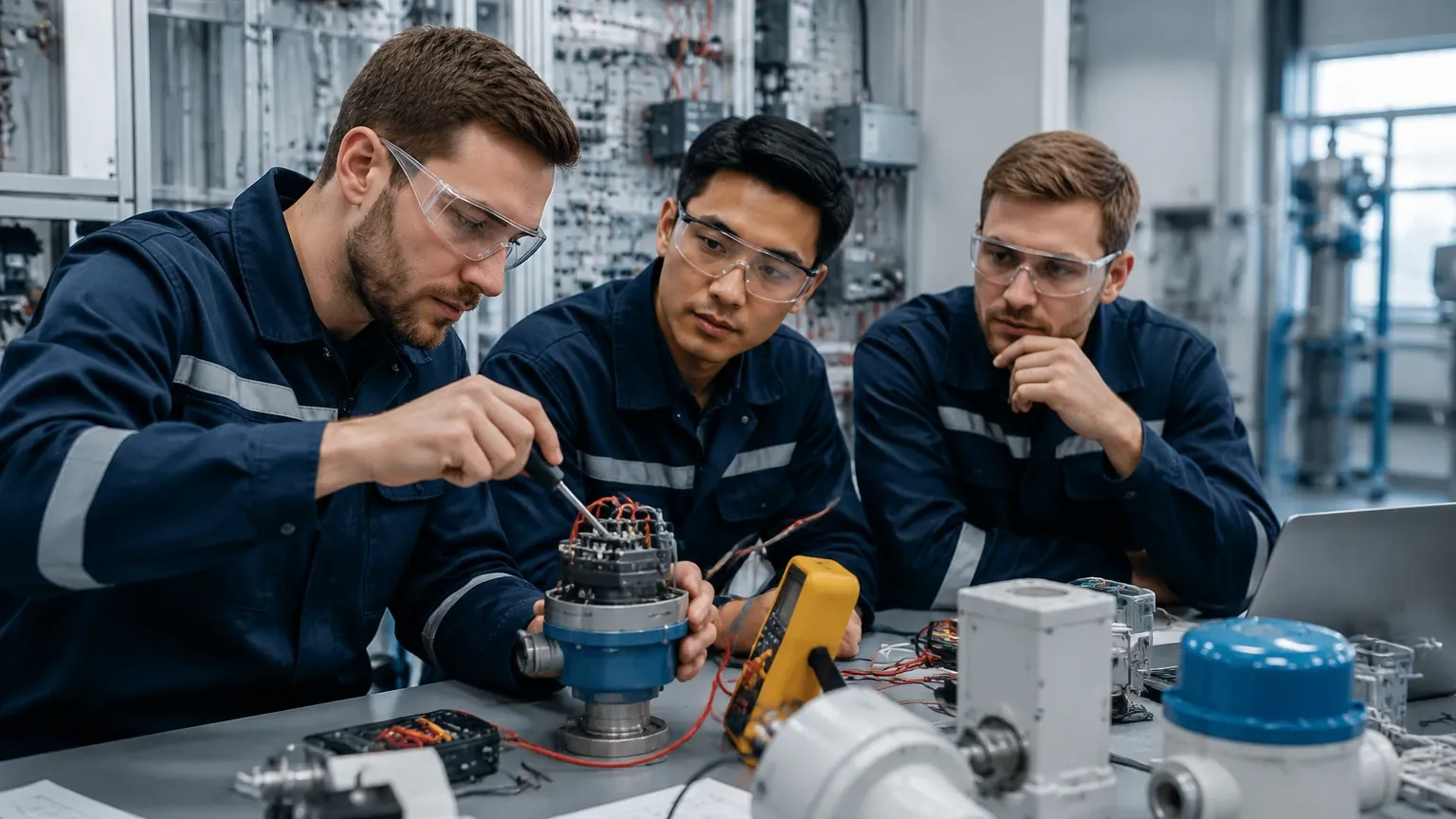
When a level switch fails or a radar signal is lost due to foam or turbulence, the financial and safety implications are immediate. Practical courses simulate these failures, forcing students to use multimeters, oscilloscopes, and diagnostic software to identify the root cause—whether it is a hardware failure, a configuration error, or an environmental factor like condensation on the sensor lens.
Technical Criteria for Evaluating I&C Training Programs
Not all training programs are created equal. When selecting a hands-on instrumentation & controls course for professional development, several technical criteria should be confirmed:
1. Equipment Diversity: Does the course use modern hardware from recognized brands like Welk? Training on obsolete equipment provides little value for current industrial applications.
2. Protocol Coverage: Does the curriculum include digital communication protocols such as Modbus, Profibus, and Foundation Fieldbus, in addition to standard 4-20mA analog loops?
3. Process Simulation: Are there actual fluid loops where students can observe the effects of agitation, foam, and varying density on sensor performance?
4. Safety Standards: Does the course cover hazardous area classifications (ATEX/IECEx) and the proper installation of intrinsically safe barriers?
Practical Selection Guide for Level Instrumentation
Choosing the right technology is the first step in any control strategy. The following table provides a comparison of common level measurement technologies taught in advanced I&C courses.
| Technology | Contact Type | Best Suited For | Limitations | Typical Accuracy |
| :— | :— | :— | :— | :— |
| Radar (80GHz) | Non-contact | Corrosive liquids, solids, high temp | High initial cost | ±1 mm |
| Ultrasonic | Non-contact | Water treatment, open channels | Affected by foam and vapor | ±0.25% of range |
| Hydrostatic | Contact | Deep wells, vented tanks | Requires constant density | ±0.1% to 0.5% |
| Magnetic Gauge | Contact | High-pressure boilers, oil tanks | Moving parts can wear | ±5 mm |
| Level Switch | Contact | Overfill protection, pump control | Point level only | N/A |
Installation Best Practices and Field Considerations
A critical module in any hands-on instrumentation & controls course is the physical installation of the instruments. Even the most accurate radar level meter will fail if installed incorrectly.
Nozzle and Dead Zone Management
Every non-contact sensor has a "dead zone" or "blocking distance" directly beneath the transducer where measurement is impossible. Technicians must learn to calculate nozzle heights to ensure the maximum liquid level never enters this zone. Furthermore, the internal diameter of the nozzle must be sufficient to prevent signal interference from the nozzle walls.
Avoiding Obstructions
In tanks with agitators, heating coils, or ladders, the signal beam of a radar or ultrasonic sensor can be reflected by these internal structures, leading to false readings. Practical training involves learning how to use "false echo suppression" or "echo masking" software to tell the instrument to ignore these static reflections.
Environmental Protection
Instruments in the field are subject to rain, sun, and extreme temperatures. Training should cover the use of sunshades, weather shields, and the importance of proper cable gland sealing to prevent moisture ingress into the electronics housing.
Common Risks and Troubleshooting in Level Control Systems
Implementing a control system involves more than just mounting a sensor. Several risks can compromise the system's integrity:
* Signal Noise: Electromagnetic interference (EMI) from large motors or variable frequency drives (VFDs) can corrupt the signal from a level transmitter. A hands-on course teaches the importance of shielded twisted-pair cabling and proper grounding techniques.
* Media Buildup: In applications involving wastewater or viscous chemicals, material can build up on the sensor face. Understanding which sensors (like high-frequency radar) are resistant to buildup is a key learning outcome.
* Power Supply Issues: Many loop-powered devices require a stable 24V DC supply. Voltage drops over long cable runs can cause intermittent device resets, a common issue that is difficult to diagnose without hands-on experience.
Frequently Asked Questions (FAQ)
Q: Can I transition from electrical work to instrumentation through a hands-on course?
A: Yes. Many electricians take these courses to specialize in process control. The transition requires learning about signal loops, P&ID (Piping and Instrumentation Diagram) reading, and specific measurement physics.
Q: Are metric units standard in these courses?
A: Most international courses use metric units (meters, millimeters, Celsius, bars) as they are the standard in global engineering. However, many also cover imperial equivalents (feet, inches, PSI) for the North American market.
Q: How long does a typical hands-on instrumentation & controls course last?
A: Intensive professional courses usually range from three days to two weeks, depending on the depth of the curriculum and the number of technologies covered.
Q: Does the course cover PLC integration?
A: Most comprehensive courses include a module on how to integrate instrument signals into a Programmable Logic Controller (PLC) or Distributed Control System (DCS) for automated logic.
Conclusion
Mastering industrial level measurement requires a combination of theoretical understanding and practical, tactile experience. By participating in a hands-on instrumentation & controls course, professionals gain the confidence to manage complex systems and ensure operational reliability. For those looking to explore the latest in measurement hardware, including radar, ultrasonic, and hydrostatic solutions, you can Review product options and application support to see how modern technology is applied in the field. Continuous education, paired with high-quality instrumentation, remains the most effective strategy for maintaining safety and efficiency in the process industries.
Download Hands-on Instrumentation & Controls Course as a PDF