Hygienic Weighing Sensor
Hygienic Weighing Sensor
In the processing of food, beverages, and pharmaceuticals, the ability to accurately measure the contents of a vessel is critical for both quality control and inventory management. While many industrial applications rely on non-contact level measurement technologies—such as those detailed on our Main Page—certain processes require the precision and density-independence that only a hygienic weighing sensor can provide. These sensors, often integrated into the support structure of a tank or hopper, measure the actual mass of the product, providing a direct measurement that is unaffected by foam, turbulence, or changes in dielectric constants.
Measurement Principles of Weighing Sensors
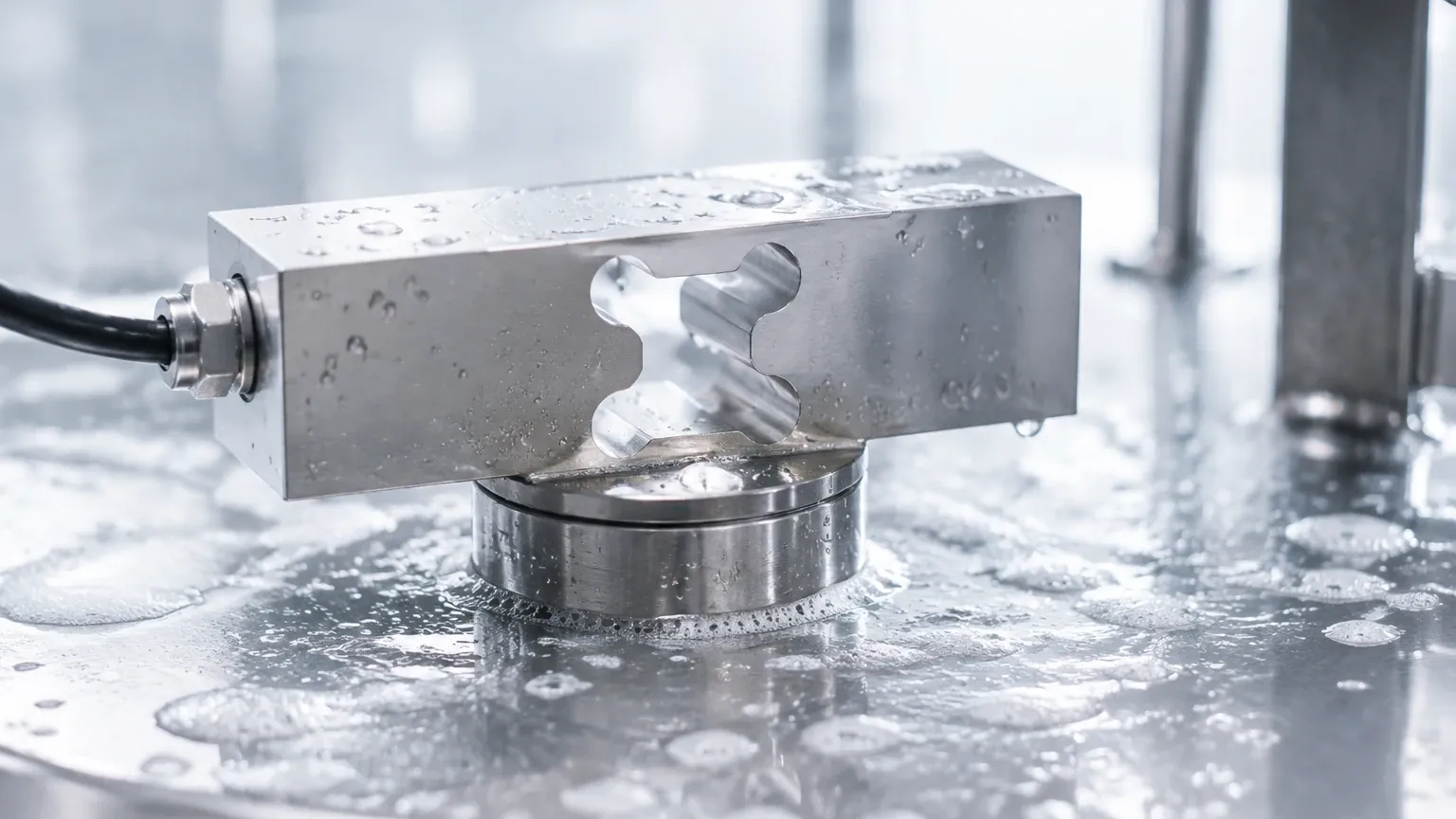
A hygienic weighing sensor, commonly referred to as a load cell, operates on the principle of converting mechanical force into a measurable electrical signal. In industrial environments, the most prevalent technology is the strain gauge load cell.
Strain Gauge Technology
When a load is applied to the sensor body (the spring element), the material undergoes minute elastic deformation. Strain gauges, which are thin electrical conductors bonded to the surface of the spring element, deform along with it. This deformation changes the electrical resistance of the gauges. By arranging these gauges in a Wheatstone bridge circuit, the change in resistance is converted into a differential voltage proportional to the applied mass.
Hydraulic Weighing
In some specialized hygienic applications, hydraulic load cells are used. These operate by measuring the pressure change in a thin film of fluid when a load is applied. Because they contain no internal electronics, they are exceptionally robust against lightning strikes and high-pressure washdowns, though they are less common in modern automated systems than strain gauge versions.
Why Choose Weighing Over Level Measurement?
Engineers often face a choice between measuring the level of a liquid or measuring its weight. While radar or ultrasonic sensors are ideal for many scenarios, a hygienic weighing sensor is preferred when:
1. Density Fluctuations: The product density changes due to temperature or concentration variations.
2. Foaming and Agitation: The surface of the liquid is unstable or covered in a thick layer of foam that might interfere with acoustic or electromagnetic signals.
3. High Precision Batching: The process requires adding ingredients by weight to meet strict recipe tolerances.
4. Internal Obstructions: The vessel contains complex agitators, baffles, or heating coils that create "dead zones" for top-down level sensors.
Hygienic Design Requirements
For a weighing sensor to be classified as "hygienic," it must meet stringent design criteria to ensure it does not become a source of contamination. In the B2B sector, compliance with standards such as EHEDG (European Hygienic Engineering & Design Group) and 3-A Sanitary Standards is often mandatory.
Material Selection
The primary material for hygienic sensors is 316L (1.4404) stainless steel. This grade offers superior corrosion resistance against the aggressive chemicals used in Clean-in-Place (CIP) and Sterilization-in-Place (SIP) cycles.
Surface Finish
Bacteria can thrive in microscopic pits and scratches. Therefore, the surface of a hygienic weighing sensor must be polished to a specific Roughness Average (Ra). A typical requirement is Ra < 0.8 μm. Some high-end pharmaceutical applications may require electro-polishing to achieve even smoother finishes.
Hermetic Sealing
To survive daily high-pressure washdowns, the internal electronics must be protected. Hygienic sensors are typically laser-welded to achieve an IP68 or IP69K rating. This ensures that moisture cannot ingress into the strain gauge cavity, which would otherwise cause signal drift or total failure.
Practical Selection Table
When selecting a hygienic weighing sensor for a project, engineers must balance capacity, accuracy, and environmental factors. The following table provides a comparison of common configurations:
| Sensor Type | Typical Capacity Range | Accuracy Class (OIML) | Primary Application |
| :— | :— | :— | :— |
| Bending Beam | 5 kg – 500 kg | C3 to C6 | Small hoppers, filling machines, and bench scales. |
| Shear Beam | 500 kg – 10 t | C3 | Medium-sized process tanks and platforms. |
| Compression (Canister) | 10 t – 100 t+ | C3 | Large silos and heavy reactors. |
| Tension (S-Type) | 50 kg – 5 t | C3 | Suspended vessels and mechanical scale conversions. |
Installation Considerations for Hygienic Environments
The accuracy of a hygienic weighing sensor is highly dependent on the quality of its installation. In a B2B engineering context, several factors must be addressed during the design phase:
1. Thermal Expansion
Process tanks often undergo significant temperature changes during SIP cycles. As the metal tank expands, it can exert lateral forces on the load cells. Using specialized mounting kits with integrated expansion compensation (such as rocker pins or sliding plates) is essential to prevent measurement errors and mechanical damage.
2. Piping Connections
Any rigid pipe connected to a weighed vessel will act as a "shunt," carrying part of the load and causing inaccuracies. In hygienic systems, flexible bellows or hose connections must be used. These connectors should be installed horizontally to minimize their influence on the vertical weight measurement.
3. Stay Rods and Safety
In areas with high wind loads (for outdoor silos) or seismic activity, stay rods are used to prevent the vessel from tipping or rotating. These rods must be adjusted so they do not exert vertical force on the weighing sensor during normal operation.
4. Drainage and Cleaning
The mounting assembly for the sensor should be designed to avoid "dead legs" or areas where water and product can pool. Self-draining surfaces and open designs that allow for easy visual inspection during cleaning are hallmarks of a well-engineered hygienic weighing station.
Limitations and Challenges
While highly accurate, hygienic weighing sensors are not without their limitations:
* Structural Requirements: The vessel support structure must be rigid. If the floor or the tank legs deflect significantly under load, the weighing accuracy will suffer.
* Vibration Sensitivity: High-speed agitators or nearby heavy machinery can introduce "noise" into the weight signal. While digital filtering can mitigate some of this, extreme vibration may require mechanical isolation.
* Cost of Implementation: Installing a weighing system is generally more expensive and labor-intensive than installing a top-down level meter, as it requires lifting the vessel and potentially modifying the piping and support structure.
* Environmental Factors: For outdoor silos, wind force can be interpreted by the sensor as weight. In these cases, the weighing system must be calibrated to account for aerodynamic lift or downforce.
Maintenance and Calibration
To maintain the integrity of a hygienic weighing system, regular calibration is required. In the food and pharma industries, this is often performed annually or bi-annually.
* Zeroing: The system should be checked frequently for "zero drift," which can occur if product builds up on the outside of the tank or if the sensor's mounting bolts loosen.
* Calibration Weights: The most accurate method involves applying certified test weights to the vessel. For very large silos where this is impractical, flow-meter-based calibration (measuring a known volume of water) is sometimes used as a secondary method.
Frequently Asked Questions (FAQs)
Q: Can I use a standard industrial load cell in a food processing plant?
A: It is not recommended. Standard load cells often have crevices, non-food-grade coatings, or cables that cannot withstand CIP chemicals. A dedicated hygienic weighing sensor is necessary to ensure food safety and equipment longevity.
Q: What is the difference between IP68 and IP69K?
A: IP68 rates the sensor for long-term immersion in water. IP69K is a more rigorous standard that tests the sensor’s ability to withstand high-pressure (up to 100 bar) and high-temperature (80°C) water jets, which are common in hygienic washdown procedures.
Q: How many sensors do I need for one tank?
A: Most vertical tanks use three sensors (arranged at 120-degree intervals) to provide a stable tripod base. For rectangular hoppers, four sensors are typical. Using fewer sensors with "dummy" mounts is possible for non-critical applications but significantly reduces accuracy if the center of gravity shifts.
Q: How does the sensor handle the weight of the tank itself (tare weight)?
A: The weighing electronics (indicators or transmitters) allow you to "tare" the system, effectively subtracting the weight of the empty vessel and its attachments so that only the weight of the product is displayed.
For engineers looking to integrate mass measurement into their process control systems, selecting the right hygienic weighing sensor is a balance of mechanical integration and environmental resilience. While level measurement remains a staple for many applications, the precision of a weighing system offers unparalleled reliability for high-value batching and inventory tasks. For further technical specifications on level and weight measurement solutions, please refer to our Main Page.