Level Sensor for Liquid
Level Sensor for Liquid
In industrial process control, the ability to accurately monitor and manage fluids is fundamental to operational efficiency, safety, and quality assurance. A level sensor for liquid is a device designed to determine the position of a liquid surface relative to a reference point, typically the bottom or top of a tank, vessel, or open channel. These instruments are ubiquitous in industries ranging from municipal water treatment and chemical processing to oil and gas production and food manufacturing.
Selecting the appropriate technology requires a deep understanding of the physical principles governing different measurement methods. This guide explores the primary technologies used in modern liquid level sensing, providing the technical context necessary for engineers to make informed decisions.
Core Measurement Principles
Before selecting a specific instrument, it is essential to understand the two primary categories of measurement: point level detection and continuous level measurement.
Point Level Detection
Point level sensors are used to detect the presence or absence of liquid at a specific height. These are often used as high-level alarms to prevent overfilling or low-level alarms to protect pumps from running dry. Common technologies include float switches, tuning forks (vibratory), and optical sensors.
Continuous Level Measurement
Continuous sensors provide a constant signal representing the exact level of the liquid throughout the entire measurement range (e.g., 0% to 100%). This is critical for inventory management and precise process control. The most common continuous technologies include radar, ultrasonic, hydrostatic, and magnetic gauges.
Detailed Technology Breakdown
1. Radar Level Measurement (Non-Contact and Guided)
Radar technology uses electromagnetic waves to measure distance.
* Principle: The sensor emits a high-frequency signal (typically in the GHz range) toward the liquid surface. The signal reflects off the surface and returns to the sensor. By measuring the Time-of-Flight (ToF) or the frequency shift (in FMCW radar), the device calculates the distance.
* Advantages: Radar is unaffected by temperature fluctuations, pressure changes, or the presence of dust and vapors. It is highly accurate, often within ±2 mm (0.08 inches).
* Limitations: The effectiveness of radar depends on the dielectric constant (εr) of the liquid. Liquids with very low dielectric constants, such as certain hydrocarbons, may reflect weak signals, requiring specialized high-sensitivity antennas or guided wave radar (GWR).
2. Ultrasonic Level Sensors
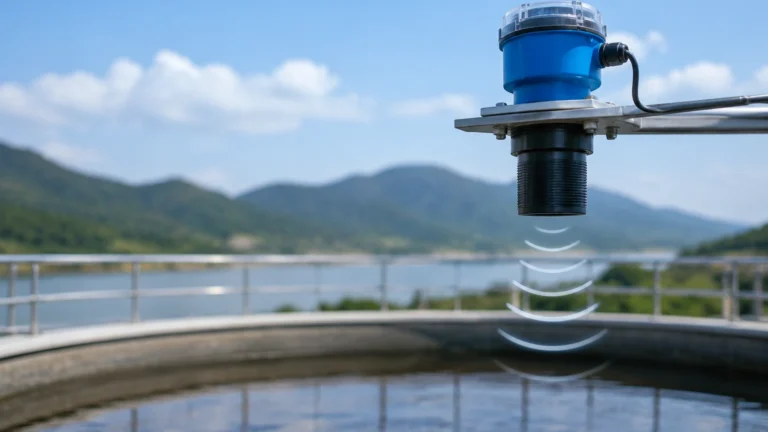
Ultrasonic sensors are a cost-effective solution for many non-contact applications.
* Principle: The sensor transmits a pulse of sound waves at a frequency above the human hearing range. The waves travel through the air, hit the liquid surface, and echo back. The distance is calculated based on the speed of sound.
* Advantages: No contact with the media makes them ideal for corrosive or dirty liquids. They are easy to install and maintain.
* Limitations: Because sound requires a medium (air) to travel, ultrasonic sensors are sensitive to air temperature, heavy foam, and vacuum conditions. Significant steam or turbulence can also disperse the sound waves, leading to signal loss.
3. Hydrostatic Level Transmitters
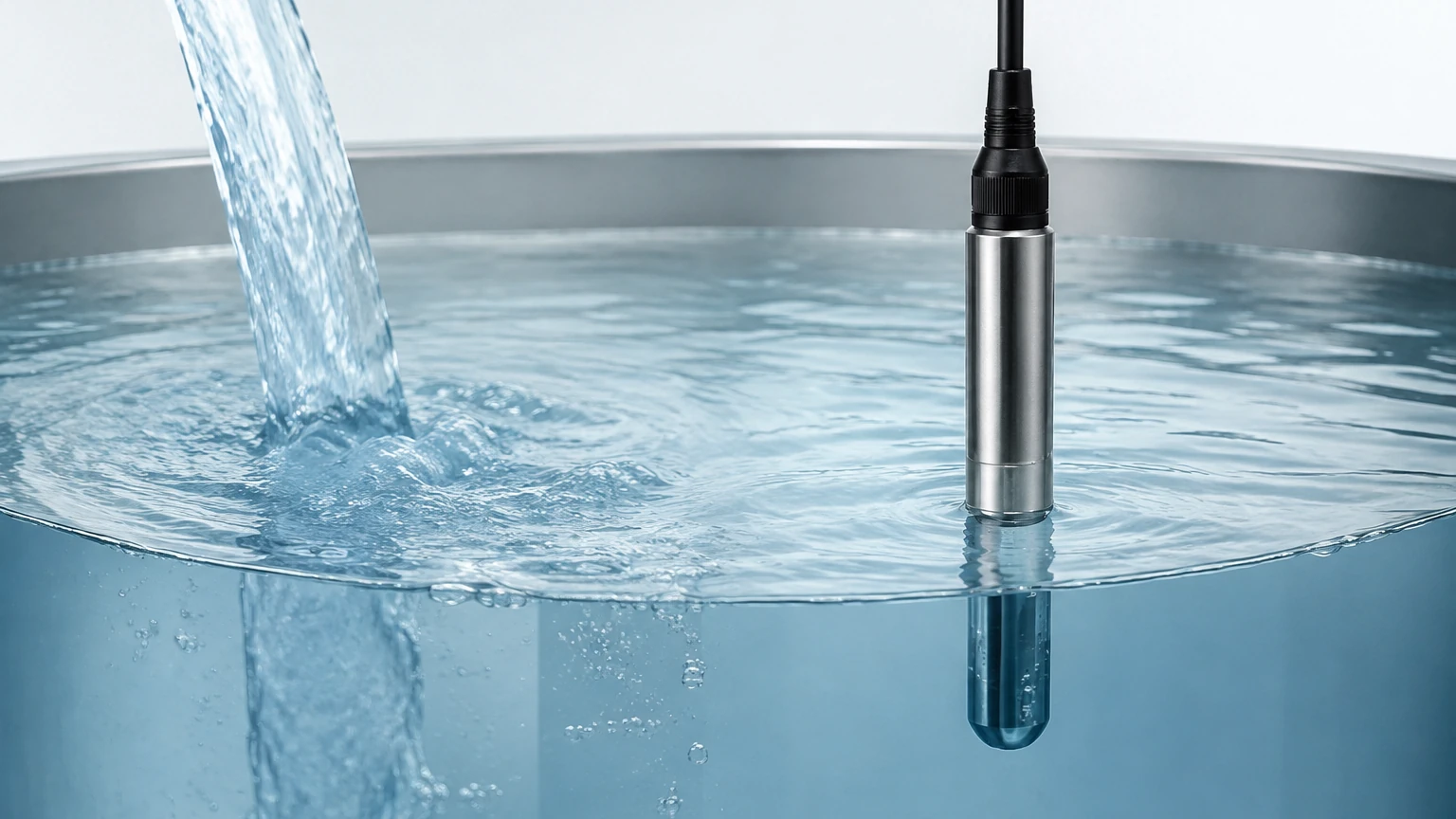
Hydrostatic measurement is a contact-based method relying on the weight of the liquid column.
* Principle: The pressure at the bottom of a vessel is directly proportional to the height of the liquid above it, following the formula $P = \rho \cdot g \cdot h$ (where $P$ is pressure, $\rho$ is density, $g$ is gravity, and $h$ is height).
* Advantages: These sensors are robust and simple to install, often submerged directly into the liquid or mounted to a flange at the tank bottom.
* Limitations: Accuracy depends on a constant liquid density. If the temperature changes significantly or if different liquids are mixed, the density shift will cause measurement errors unless compensated for by the control system.
4. Magnetic Level Gauges
Magnetic gauges provide both a visual indication and an electronic output.
* Principle: A float containing a permanent magnet moves up and down a bypass chamber connected to the tank. Outside the chamber, a series of magnetic flags or a sensing reed-chain tracks the position of the float.
* Advantages: They provide a clear visual reference without requiring power and are excellent for high-pressure and high-temperature environments where electronic displays might fail.
* Limitations: They are contact-based and involve moving parts, which may become stuck if the liquid is highly viscous or contains large particulates.
Selection Criteria for Liquid Level Sensors
Choosing the right level sensor for liquid requires evaluating the chemical properties of the fluid, the physical environment of the tank, and the required precision. The following table provides a general comparison of common technologies.
| Technology | Accuracy | Media Contact | Max Range (Typical) | Key Limitation |
| :— | :— | :— | :— | :— |
| Radar | Excellent (±2mm) | No | Up to 30m – 100m | Low dielectric liquids |
| Ultrasonic | Good (±0.25%) | No | Up to 15m – 30m | Foam, vapor, vacuum |
| Hydrostatic | Moderate (±0.5%) | Yes | Up to 200m+ | Density variations |
| Magnetic | Moderate (±5mm) | Yes | Up to 6m (Modular) | Viscous/sticky media |
| Capacitance | Good (±1%) | Yes | Up to 10m | Coating/buildup |
Installation Considerations
Proper installation is as critical as selecting the right technology. Even the most advanced sensor will fail if placed incorrectly.
1. Dead Zones (Blocking Distance): Both ultrasonic and radar sensors have a "dead zone" directly beneath the sensor face where measurements cannot be taken. Ensure the sensor is mounted high enough so the maximum liquid level never enters this zone.
2. Obstructions: Internal tank structures such as ladders, agitators, or heating coils can create false echoes. Sensors should be positioned to have a clear line of sight to the liquid surface. Many modern radar units offer "false echo suppression" software to ignore these fixed reflections.
3. Turbulence and Foam: If the liquid surface is turbulent due to an inlet pipe or agitator, consider using a stilling well or a guided wave radar to stabilize the surface area being measured. Foam can absorb ultrasonic signals but is often penetrated by high-frequency radar.
4. Nozzle Geometry: For non-contact sensors, the mounting nozzle should be short and wide enough to prevent the signal from reflecting off the nozzle walls before it reaches the tank interior.
Practical Limitations and Common Risks
Engineers must be aware of potential failure points in liquid level sensing applications:
* Chemical Compatibility: Ensure that the wetted materials of the sensor (e.g., Stainless Steel 316L, PTFE, PVDF) are compatible with the process liquid to prevent corrosion or sensor failure.
* Environmental Interference: In outdoor installations, heavy rain or condensation on the sensor face can interfere with ultrasonic pulses. Radar is generally more resilient to these conditions.
* Power Supply and Signal Integrity: In industrial environments, electromagnetic interference (EMI) from large motors can disrupt 4-20mA signals. Utilizing shielded cables and proper grounding is essential.
For those seeking specific hardware configurations or technical support for complex applications, it is advisable to Review product options and application support to ensure the selected instrument meets the specific safety and regulatory standards of the industry.
Frequently Asked Questions (FAQ)
Q: Can I use an ultrasonic sensor in a pressurized tank?
A: Generally, no. Ultrasonic sensors rely on the speed of sound, which changes with air density. Changes in pressure significantly affect the accuracy and signal strength. Radar or hydrostatic sensors are better suited for pressurized vessels.
Q: How do I measure the level of a liquid that is highly corrosive, like sulfuric acid?
A: Non-contact methods like radar or ultrasonic sensors with PTFE-coated faces are ideal. Alternatively, a hydrostatic transmitter made from specialized materials like Tantalum or Ceramic can be used.
Q: What is the difference between Pulse Radar and FMCW Radar?
A: Pulse radar sends a short burst and measures the time it takes to return. Frequency Modulated Continuous Wave (FMCW) radar sends a continuous signal with a changing frequency; the distance is calculated by the difference in frequency between the sent and received signals. FMCW is typically more accurate and provides a better signal-to-noise ratio in difficult conditions.
Q: Does the color of the liquid affect the sensor?
A: No. Radar, ultrasonic, and hydrostatic sensors are independent of the liquid's color or transparency. Only optical sensors are affected by the clarity or color of the media.
Conclusion
Identifying the right level sensor for liquid involves balancing technical requirements with budget constraints. While radar offers the highest versatility and precision, hydrostatic and ultrasonic sensors provide reliable performance for more straightforward applications. By understanding the underlying physics and accounting for installation variables like dead zones and chemical compatibility, facilities can ensure long-term reliability in their level measurement systems. For comprehensive technical data and product specifications, engineers should consult the Main Page of the manufacturer's reference guide.