Na20
Na20
In the landscape of industrial chemical processing and material storage, the accurate monitoring of sodium-based compounds, such as sodium oxide (Na2O), presents unique engineering challenges. Whether dealing with the raw powdered form of Na2O used in glass and ceramic manufacturing or the liquid caustic solutions derived from sodium-rich processes, selecting the correct level measurement technology is critical for operational safety, inventory management, and process efficiency.
This guide examines the technical requirements for measuring levels in environments involving Na2O and related sodium compounds. By understanding the physical properties of the media and the measurement principles of various instruments, engineers can specify solutions that withstand corrosive environments and provide high-precision data.
Understanding Measurement Principles for Sodium Compounds
Before selecting an instrument, it is essential to understand the physics behind the primary measurement technologies used in modern industrial automation. For sodium oxide (Na20) applications, the choice often fluctuates between non-contact radar, ultrasonic sensors, and contact-based hydrostatic transmitters.
Radar Level Measurement (FMCW and Pulse)
Radar level meters are the preferred choice for both solid Na2O powder and concentrated sodium solutions. They operate on the principle of electromagnetic wave reflection. The sensor emits a high-frequency signal (typically 26GHz or 80GHz) that travels to the material surface and reflects back to the antenna.
For solid Na20, which is often stored in silos, 80GHz Frequency Modulated Continuous Wave (FMCW) radar offers significant advantages. The higher frequency allows for a narrower beam angle, which is crucial for avoiding interference from silo walls or internal structural reinforcements. Furthermore, Na2O in its solid state has a specific dielectric constant (εr) that affects the strength of the reflected signal. Modern radar processors can filter out noise caused by dust clouds during filling operations, ensuring a stable level reading.
Ultrasonic Level Sensors
Ultrasonic sensors utilize sound waves to determine the distance to the media surface. The transmitter emits an ultrasonic pulse that reflects off the surface and returns to the transducer. The time-of-flight (ToF) is then converted into a level measurement.
While cost-effective, ultrasonic technology is generally reserved for liquid sodium solutions at moderate temperatures. Because sound waves require a medium (air) to travel, their accuracy can be affected by significant temperature fluctuations, heavy vapors, or high-pressure environments. In applications involving Na2O derivatives like liquid caustic soda, ultrasonic sensors must be equipped with chemical-resistant faces (such as PVDF or PTFE) to prevent corrosion.
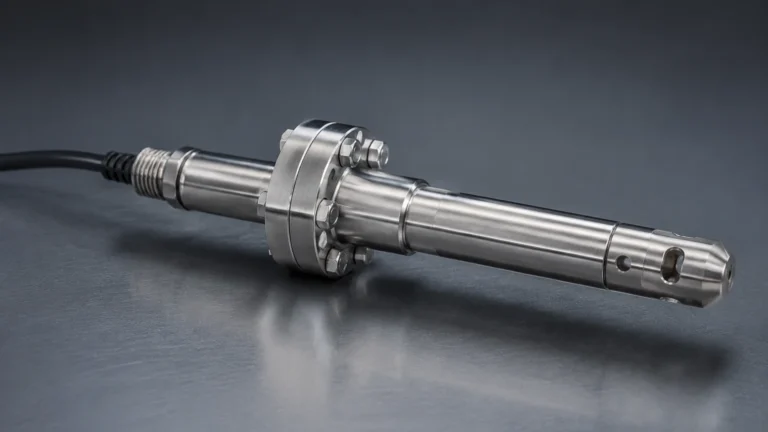
Hydrostatic Level Transmitters
Hydrostatic measurement relies on the relationship between the height of a liquid column and the pressure it exerts at the base of a tank. The formula $P = \rho \cdot g \cdot h$ (where P is pressure, $\rho$ is density, g is gravity, and h is height) allows the transmitter to calculate the level based on the weight of the fluid.
For sodium-based liquids, hydrostatic transmitters are highly reliable in vented tanks. However, because sodium solutions can be highly corrosive, the sensing diaphragm must be made of compatible materials like 316L stainless steel, Hastelloy, or coated with tantalum. This method is less suitable for solid Na20 powder due to the non-uniform pressure distribution of bulk solids.
Technical Selection Criteria for Na20 Applications
Choosing the right instrument requires a detailed analysis of the process conditions. The following table provides a comparison of technologies based on typical industrial parameters for sodium oxide and its derivatives.
| Feature | Radar (80GHz) | Ultrasonic | Hydrostatic |
| :— | :— | :— | :— |
| Media State | Solids & Liquids | Liquids (Primarily) | Liquids Only |
| Measurement Range | Up to 120m (393 ft) | Up to 15m (49 ft) | Up to 200m (656 ft) |
| Accuracy | ±1mm to ±5mm | ±0.25% of range | ±0.1% to ±0.5% |
| Temperature Limit | -40°C to +250°C | -40°C to +80°C | -40°C to +120°C |
| Pressure Limit | Up to 4.0 MPa | Atmospheric | Up to 10 MPa |
| Dust/Vapor Resistance | Excellent | Poor to Fair | Excellent (Submerged) |
| Corrosion Resistance | High (PTFE Flanges) | High (PVDF/PTFE) | Depends on Diaphragm |
Application Engineering: Solids vs. Liquids
Measuring Bulk Solid Na20
In glass manufacturing, Na2O is often handled as a fine powder. The primary challenges here are dust and the angle of repose. During pneumatic filling, the air inside the silo becomes saturated with particles. Standard ultrasonic sensors will fail in these conditions as the sound waves are absorbed or scattered by the dust.
Radar instruments, particularly those with a self-cleaning lens or an air purge connection, are the industrial standard. The 80GHz radar beam can penetrate dust clouds effectively. Additionally, when the powder forms a cone (angle of repose), the radar's sophisticated algorithms can process multiple echoes to determine the average level or the peak of the pile.
Measuring Sodium-Rich Liquid Solutions
When Na2O is dissolved or used in chemical synthesis, it often forms highly alkaline solutions. These liquids can be agitated by mixers or produce surface foam.
* Agitation: If the tank has an agitator, a non-contact radar with a fast response time and false-echo suppression is necessary to ignore the moving blades.
* Foam: Heavy foam can absorb radar signals. In these specific cases, a guided wave radar (GWR) or a hydrostatic transmitter might be more appropriate, as they are less affected by surface turbulence and foam layers.
Installation Considerations and Best Practices
Proper installation is as critical as instrument selection. For any level measurement project involving Na20, follow these engineering guidelines:
1. Nozzle Height and Diameter: For radar and ultrasonic units, the nozzle should be as short as possible. If the nozzle is too long, it can create internal reflections that interfere with the near-zone measurement.
2. Obstruction Clearance: Ensure the signal beam does not intersect with ladders, heating coils, or inflow streams. For a radar with a 3° beam angle, a clear path must be maintained throughout the entire measurement range.
3. Mounting Position: Sensors should generally be mounted at 1/2 to 1/3 of the tank radius. Avoid mounting the sensor in the exact center of a domed tank, as this can concentrate reflected signals and cause "ghost" echoes.
4. Chemical Compatibility: Ensure all wetted parts, including gaskets and O-rings, are compatible with the specific concentration of sodium compounds present. EPDM or Viton are common choices, but PTFE is preferred for maximum chemical inertness.

Limitations and Environmental Factors
While modern instrumentation is robust, certain limitations must be acknowledged:
* Dielectric Constant: If the dielectric constant of the Na2O powder is extremely low (less than 1.5), standard pulse radar may struggle. In such cases, specialized high-sensitivity FMCW radar or guided wave radar is required.
* Condensation: In liquid tanks, steam or chemical vapors can condense on the sensor face. While radar can typically see through thin films, heavy droplets can attenuate the signal. Using a sensor with a convex (drip-off) lens design helps mitigate this issue.
* Vacuum Conditions: Ultrasonic sensors cannot operate in a vacuum because sound requires a medium. Radar is unaffected by vacuum or high-pressure gas blankets.
Maintenance and Troubleshooting
For systems monitoring Na20, a proactive maintenance schedule prevents unplanned downtime.
* Visual Inspection: Periodically check for material buildup on the sensor face or antenna. Even though many radar units can tolerate some buildup, excessive crusting can degrade accuracy.
* Calibration Verification: Use a manual tape measure or a reference point to verify the electronic reading once every six months.
* Signal Strength Monitoring: Modern digital transmitters provide a "signal-to-noise" ratio. A declining ratio often indicates that the sensor face needs cleaning or that the internal electronics are being affected by extreme heat.
Frequently Asked Questions (FAQ)
Q: Can I use a standard pressure transmitter for Na20 liquid level?
A: Only if the tank is vented to the atmosphere and the transmitter's diaphragm is chemically compatible. For pressurized tanks, a differential pressure (DP) transmitter is required to compensate for the head pressure.
Q: How does temperature affect Na2O level measurement?
A: For radar, temperature has negligible effect on the signal speed. However, the housing must be kept within its rated operating temperature (usually up to 80°C (176°F)) using cooling fins or remote electronics if the process is significantly hotter.
Q: Is 80GHz always better than 26GHz for sodium oxide silos?
A: Generally, yes. The smaller antenna size and narrower beam of 80GHz make it easier to install and more reliable in avoiding internal silo obstructions.
Conclusion
Reliable level measurement of Na20 and its derivatives is a cornerstone of modern industrial safety and efficiency. By matching the measurement principle—whether radar, ultrasonic, or hydrostatic—to the specific physical state and environmental conditions of the process, engineers can ensure long-term accuracy.
Welk provides a comprehensive range of industrial level measurement instruments designed to meet these rigorous demands. From high-frequency radar for bulk solids to corrosion-resistant sensors for chemical processing, our solutions are engineered for precision and durability. For detailed technical specifications and to explore our full range of measurement technologies, please visit our Main Page. Our team of application engineers is available to help you select the optimal configuration for your specific Na20 monitoring requirements.