Rotary Paddle Level Switch
Rotary Paddle Level Switch
In the landscape of industrial automation and bulk solids management, the rotary paddle level switch remains one of the most reliable and widely utilized instruments for point level detection. Designed specifically for powders, granules, and other dry bulk materials, these devices prevent silo overfills, manage hopper replenishment, and protect downstream equipment from dry-running or blockages. As a professional manufacturer of industrial level measurement instruments, Welk provides these robust solutions alongside a comprehensive range of radar, ultrasonic, and hydrostatic sensors, which can be explored on our Main Page.
Understanding the mechanical nature and application boundaries of the rotary paddle level switch is essential for engineers and plant managers seeking to maintain operational efficiency in sectors ranging from food processing to heavy mining.
Measurement Principle and Mechanics
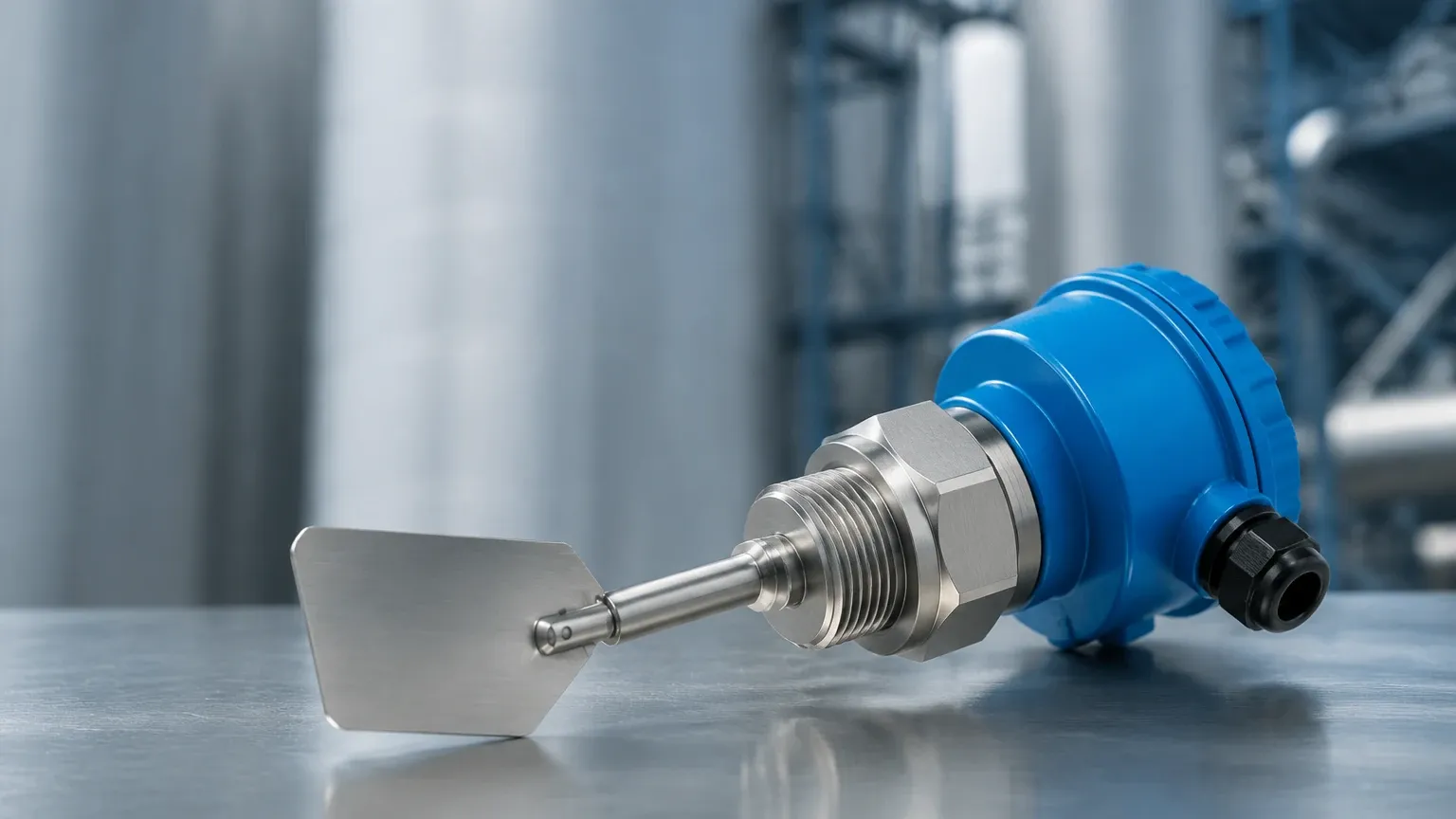
The operation of a rotary paddle level switch is purely mechanical, which contributes to its durability in harsh environments. The core components include a low-speed synchronous motor, a mechanical clutch, a shaft, and a paddle (or vane) extending into the process vessel.
The Detection Cycle
1. Free Rotation: When the material level is below the paddle, the motor drives the shaft at a steady speed—typically 1 to 5 revolutions per minute (RPM).
2. Material Resistance: As the bulk material rises and reaches the paddle, it creates mechanical resistance. This resistance overcomes the motor's torque.
3. Switching Action: Once the paddle is stalled, the motor rotates within the housing against a spring-loaded mechanism. This movement triggers one or two internal microswitches. The first switch usually cuts power to the motor to prevent overheating and premature wear, while the second switch changes the output state (e.g., from Normally Open to Normally Closed) to signal an alarm or control a pump/conveyor.
4. Reset: When the material level drops, the paddle is no longer obstructed. The internal spring pulls the motor back to its original position, the microswitches reset, and the motor restarts the rotation.
This principle is highly effective because it is unaffected by the dielectric constant, conductivity, or moisture content of the material, which often interfere with electronic sensors like capacitive probes.
Key Evaluation and Selection Criteria
Selecting the correct rotary paddle level switch requires an analysis of the material's physical properties and the vessel's environmental conditions. The most critical factor is the bulk density of the medium.
Material Density and Paddle Size
Lightweight materials exert less force on the paddle. To compensate, a larger paddle surface area or a more sensitive spring setting is required. Conversely, heavy materials like gravel or cement require smaller, reinforced paddles to prevent mechanical damage to the shaft.
| Material Type | Typical Bulk Density (kg/m³) | Recommended Paddle Type |
| :— | :— | :— |
| Plastic Pellets / Grain | 400 – 800 | Standard Scimitar or Cross Paddle |
| Wood Chips / Sawdust | 150 – 300 | Large Vaned or Folding Paddle |
| Cement / Sand | 1,200 – 1,600 | Small Stainless Steel Scimitar |
| Fly Ash / Fine Powder | 500 – 900 | Standard Scimitar with Dust Seal |
| Heavy Ore / Crushed Stone | >2,000 | Heavy-duty Reinforced Paddle |
Process Temperature and Pressure
Standard models typically handle process temperatures up to 80°C (176°F). For high-temperature applications, such as fly ash handling in power plants, specialized models with ceramic extensions and heat sinks can withstand temperatures exceeding 250°C (482°F). Pressure ratings must also be verified, especially in pneumatic conveying systems where pressures might reach 10 bar (145 psi).
Practical Installation Considerations
Proper placement and orientation are vital to the longevity of a rotary paddle level switch. Improper installation is the leading cause of premature mechanical failure.
Mounting Position
* Top Mounting (High Level): The switch is installed vertically through the roof of the silo. A flexible shaft or protective pipe extension is often used if the paddle needs to reach deep into the vessel. This prevents the shaft from bending under the lateral force of moving material.
* Side Mounting (High/Low Level): The switch is installed horizontally through the vessel wall. For low-level detection, the switch must be positioned so that the paddle is not directly in the path of the falling material during filling.
Protection from Material Flow
If the switch must be placed in a high-flow area, a protective baffle or "shield" should be installed above the paddle. This angled metal plate diverts the weight and impact of falling bulk solids, allowing the paddle to detect the presence of the material without being crushed or sheared off.
Cable Entry and Sealing
Always install the unit with the cable entries facing downward to prevent moisture from entering the housing via capillary action along the power cables. In outdoor silos, using a drip loop in the wiring is a standard best practice.
Common Risks and Limitations
While the rotary paddle level switch is a "workhorse" of industry, it is not a universal solution. Engineers should be aware of the following limitations:
1. Sticky or Caking Materials: If the material is prone to significant buildup (e.g., wet clay or certain food starches), the paddle may become "bridged" or coated. If the buildup is heavy enough to stall the motor even when the silo is empty, a false high-level signal will occur. In these cases, a vibrating level switch or a non-contact radar may be more appropriate.
2. Mechanical Wear: Because it has moving parts, the motor and seals will eventually wear out. High-cycling applications (where the level changes many times per hour) will shorten the lifespan compared to static storage applications.
3. Very Low Density: For extremely light materials (less than 100 kg/m³), the mechanical resistance may be insufficient to trigger the switch. Ultrasonic or high-sensitivity tuning fork sensors are preferred for these ultra-light powders.
Comparison with Alternative Technologies
When evaluating a rotary paddle level switch against other point level technologies, consider the following trade-offs:
* Vs. Vibrating Level Switches (Tuning Forks): Vibrating switches have no moving parts and are more compact, making them easier to install in small hoppers. However, they can be more sensitive to material coating and are generally more expensive than rotary paddles.
* Vs. Capacitive Probes: Capacitive sensors are excellent for liquids and some solids but require calibration based on the material's dielectric constant. The rotary paddle requires no calibration; it simply reacts to physical presence.
* Vs. Non-Contact Radar: Radar is ideal for continuous level measurement but is often overkill for simple high/low point detection. For a cost-effective point-level solution in solids, the rotary paddle remains the primary choice.
Maintenance and Troubleshooting
A proactive maintenance schedule can extend the life of a rotary paddle level switch to several years of continuous operation.
* Seal Inspection: Periodically check the shaft seal, especially in abrasive powder applications. If dust enters the motor housing, it can cause the gears to grind or the microswitch to fail.
* Paddle Integrity: During silo cleanouts, inspect the paddle for bending or erosion. A worn paddle has a reduced surface area and may fail to trigger in lower-density materials.
* Motor Function: If the unit fails to rotate, check the power supply and the internal clutch. Most modern units allow for easy motor replacement without removing the entire mounting flange from the vessel.
Frequently Asked Questions (FAQ)
Q: Can a rotary paddle level switch be used for liquids?
A: No. The mechanical resistance provided by most liquids is insufficient to stall the motor. For liquid level detection, hydrostatic transmitters or ultrasonic sensors are recommended.
Q: How do I adjust the sensitivity of the switch?
A: Most units feature an internal spring that can be hooked into different tension slots. Increasing the spring tension makes the unit less sensitive (for heavy materials), while decreasing it makes it more sensitive (for light materials).
Q: What is the purpose of the mechanical clutch?
A: The clutch protects the motor and gear train from sudden shocks or manual rotation of the paddle during installation, preventing internal gear stripping.
Q: Are there explosion-proof versions available?
A: Yes. Since these are often used in grain elevators or chemical plants where combustible dust is a concern, ATEX or IECEx certified explosion-proof housings are standard options for hazardous zones.
Conclusion
The rotary paddle level switch remains a foundational tool in bulk solids handling due to its simplicity, lack of calibration requirements, and cost-effectiveness. By accurately matching the paddle design to the material density and ensuring proper physical protection during installation, industrial facilities can achieve reliable point level control for years. For more complex measurement challenges, including continuous level monitoring or liquid applications, Welk offers a diverse portfolio of advanced instrumentation. Explore our full range of solutions on our Main Page to find the right fit for your specific process requirements.