Transmitter Temperature
Transmitter Temperature
In industrial process automation, transmitter temperature is a critical parameter that influences the accuracy, reliability, and lifespan of level measurement instruments. Whether dealing with the ambient temperature surrounding the housing or the process temperature at the point of contact, thermal management is essential for maintaining operational integrity. For engineers and plant managers, understanding how temperature affects electronic components and sensor physics is the first step in selecting the correct instrumentation for a specific application.
Welk, as a professional manufacturer of industrial level measurement instruments, provides a range of solutions designed to operate across diverse thermal profiles. To explore the full catalog of sensors designed for extreme environments, professionals can visit the Main Page to review product options and application support.
The Role of Transmitter Temperature in Industrial Instrumentation
Transmitter temperature generally refers to two distinct but related thermal conditions: the ambient temperature of the environment where the transmitter electronics are located and the process temperature of the medium being measured. Most industrial transmitters are rated for an ambient operating range, typically between -40°C and +80°C (-40°F to +176°F). Exceeding these limits can lead to electronic component failure, display drift, or complete signal loss.
Process temperature, on the other hand, can range from cryogenic levels (-196°C) to extreme heat exceeding 450°C in power generation or chemical processing. The challenge for a level transmitter is to isolate the sensitive electronics from these process extremes while maintaining a clear and accurate signal path. This is often achieved through specialized cooling fins, thermal stand-offs, or remote mounting configurations.
Measurement Principles and Temperature Sensitivity
Different level measurement technologies react to temperature variations in unique ways. Understanding these principles is vital before making a hardware recommendation.
Radar Level Measurement
Radar level meters utilize electromagnetic pulses. Because the speed of light is essentially constant regardless of air temperature, pressure, or vapor composition, radar is inherently robust against temperature fluctuations in the headspace of a tank. However, the transmitter temperature at the flange and within the electronics housing must still be managed. High-frequency electronics generate their own internal heat, which, when combined with high ambient or process temperatures, can accelerate the degradation of the microwave oscillator.
Ultrasonic Level Measurement
Unlike radar, ultrasonic sensors are highly sensitive to transmitter temperature and the temperature of the transmission medium (usually air or gas). The speed of sound is directly proportional to the square root of the absolute temperature. For example, a change of 1°C can result in an error of approximately 0.17% in the distance measurement. To counteract this, most ultrasonic transmitters include an integrated temperature sensor to provide real-time compensation. However, if there is a significant temperature gradient between the sensor face and the liquid surface, the compensation may be inaccurate.
Hydrostatic Level Measurement
Hydrostatic pressure transmitters measure level based on the weight of the liquid column. Temperature affects the density of the liquid; as the transmitter temperature or process temperature rises, the liquid expands and its density decreases. If the transmitter is calibrated for a specific density at 20°C, but the process operates at 80°C, the level reading will be lower than the actual height unless the control system or the transmitter itself accounts for this density shift. Additionally, the sensing diaphragm can experience "thermal drift," where the zero point of the sensor shifts due to the physical expansion of the internal fill fluid.
Selection Criteria for Temperature-Critical Applications
When selecting a level transmitter, engineers must evaluate the thermal limits of both the wetted parts (the parts in contact with the process) and the non-wetted parts (the electronics housing).
Selection Table: Technology vs. Temperature Limits
| Technology | Typical Max Process Temp | Typical Max Ambient Temp | Primary Temperature Concern |
| :— | :— | :— | :— |
| Ultrasonic | +80°C | +70°C | Speed of sound compensation |
| Radar (Standard) | +150°C | +80°C | Electronic component protection |
| Radar (High-Temp) | +450°C | +80°C | Material selection (Ceramic/Graphite) |
| Hydrostatic | +120°C | +85°C | Liquid density and diaphragm drift |
| Magnetic Gauge | +400°C | +80°C | Float buoyancy and chamber expansion |
Material Selection
For high transmitter temperature applications, the choice of gaskets and seals is paramount. While Viton is common, it may fail at temperatures exceeding 200°C. For extreme heat, Kalrez or graphite seals are required. The antenna or sensor face material must also be considered; PTFE is excellent for chemical resistance but has a lower thermal threshold compared to PEEK or ceramic materials.
Practical Installation Guidelines for Thermal Protection
Proper installation can significantly extend the life of a transmitter by mitigating the effects of extreme temperatures.
1. Use of Heat Sinks and Cooling Fins: For process temperatures above 150°C, radar transmitters often utilize integrated cooling fins between the flange and the electronics housing. These fins increase the surface area for convective cooling, ensuring the transmitter temperature at the circuit board remains within safe limits.
2. Remote Mounting: In hydrostatic applications, a capillary system with a remote seal can be used. This allows the sensitive transmitter electronics to be mounted several meters away from the hot process vessel, connected only by a fluid-filled capillary tube.
3. Sunshades: In outdoor installations, direct solar radiation can raise the internal transmitter temperature by 20°C or more above the ambient air temperature. Installing a simple stainless steel or plastic sunshade can prevent overheating and UV degradation of the display window.
4. Heat Tracing and Insulation: In cold climates, liquid in the sensing lines of a hydrostatic transmitter or within a magnetic level gauge chamber may freeze or become too viscous. While insulation is necessary, installers must ensure that the transmitter head itself is *not* insulated, as it needs to dissipate heat generated by its own electronics.
Limitations and Operational Risks
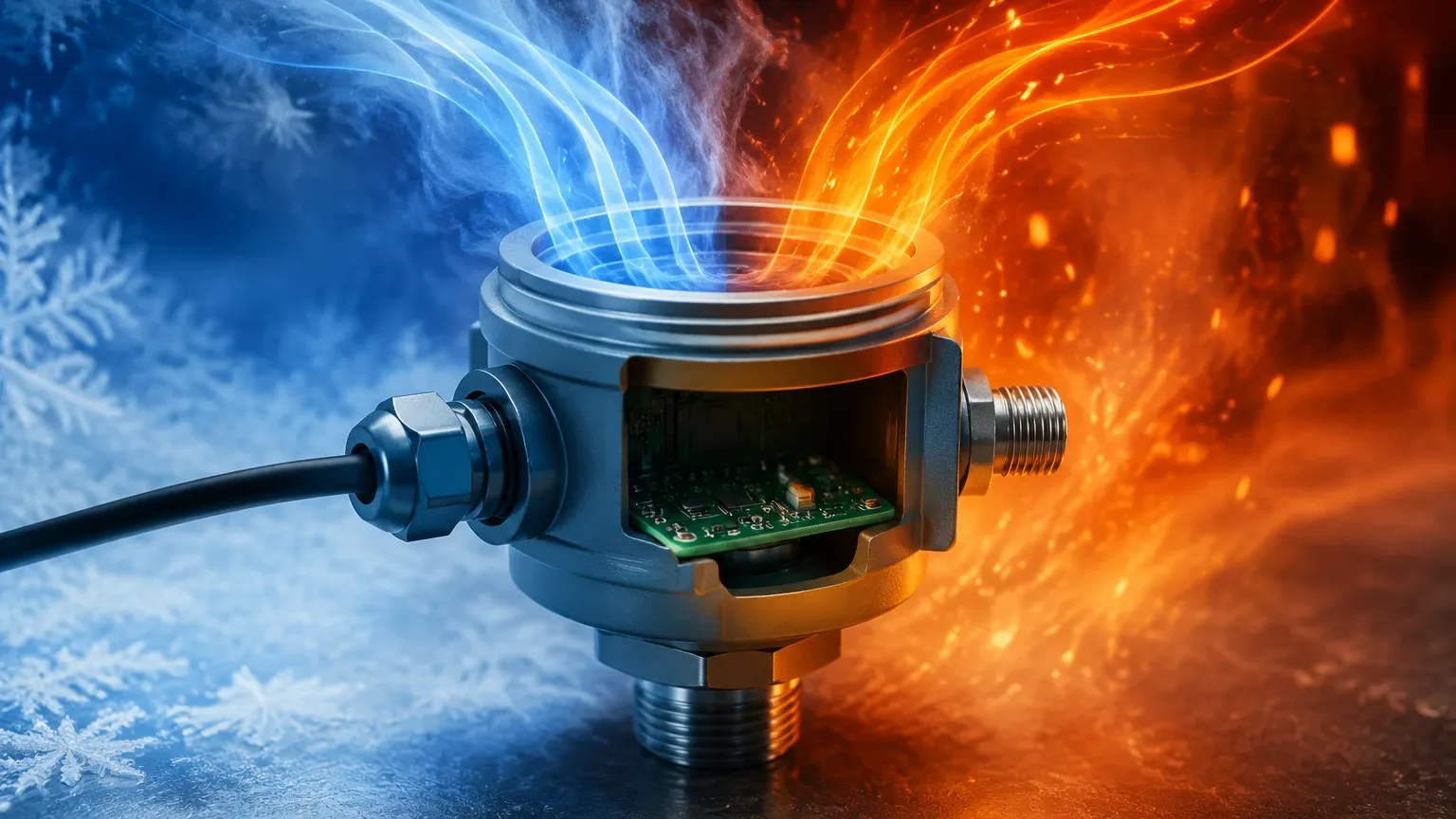
Ignoring transmitter temperature limits can lead to several failure modes:
* Thermal Drift: This is a common phenomenon in pressure-based sensors where the zero and span settings shift as the temperature changes. While high-end transmitters are factory-compensated for this, cheaper sensors may exhibit significant inaccuracy in fluctuating environments.
* Condensation: If the transmitter temperature drops below the dew point of the surrounding air or the process vapors, condensation can form on the sensor face or inside the housing. In ultrasonic sensors, droplets on the transducer can cause a "loss of echo." In electronics, moisture leads to corrosion and short circuits.
* Component Fatigue: Frequent thermal cycling (moving from hot to cold) causes mechanical stress due to the different expansion coefficients of the materials used in the transmitter. This can eventually lead to cracked solder joints or seal failure.
* T-Class Compliance: In hazardous areas, the surface temperature of the transmitter must not exceed the ignition temperature of the surrounding explosive atmosphere. This is known as the T-rating (e.g., T4, T6). High process temperatures can heat the transmitter body, potentially violating its safety certification.
Frequently Asked Questions regarding Transmitter Temperature
Q: Can I use an ultrasonic transmitter on a boiling liquid?
A: Generally, no. While the temperature might be within the sensor's range, the heavy steam and turbulence associated with boiling interfere with the sound waves. Furthermore, the rapid temperature fluctuations in the headspace make accurate speed-of-sound compensation nearly impossible. Radar is a better choice for such applications.
Q: How does cold transmitter temperature affect LCD displays?
A: Most industrial LCDs begin to lag or become unreadable at temperatures below -20°C. If the transmitter must be used in colder environments, look for models with integrated heaters or use an external heated enclosure.
Q: Does the transmitter temperature affect the 4-20mA signal?
A: Modern digital transmitters use temperature-compensated D/A converters, so the 4-20mA loop is generally stable. However, extreme heat can increase the resistance of the copper wiring in the loop, which may become an issue if the power supply voltage is marginal for the total loop impedance.
Q: What is the difference between an active and passive temperature compensation?
A: Passive compensation uses the physical properties of materials (like a bimetallic strip) to offset changes. Active compensation, found in modern Welk transmitters, uses a dedicated thermistor to measure the transmitter temperature and applies a mathematical algorithm to the output signal to maintain accuracy.
Conclusion
Managing transmitter temperature is a fundamental aspect of industrial process design. By understanding the measurement principles of radar, ultrasonic, and hydrostatic technologies, and by applying rigorous selection and installation standards, engineers can ensure long-term reliability. Whether protecting electronics from the desert sun or isolating a sensor from molten bitumen, the correct thermal strategy is essential for precise level control. For more technical specifications and to consult with application engineers, visit the Main Page to find the ideal solution for your specific temperature requirements.