Tank Level Switch
Tank Level Switch
In industrial process control, the tank level switch serves as a critical component for point-level detection. Unlike continuous level transmitters that provide a constant stream of data regarding the exact volume or height of a substance, a tank level switch is designed to trigger a response when a specific level is reached. These devices act as the primary line of defense for overfill protection, pump control, and low-level dry-run prevention in storage tanks and process vessels.
Selecting the appropriate technology requires a deep understanding of the physical properties of the media, the environmental conditions of the tank, and the specific requirements of the automation system. This guide explores the fundamental principles, selection criteria, and installation best practices for industrial tank level switches.
Measurement Principles of Tank Level Switches
Before selecting a device, it is essential to understand how different sensing technologies interact with the stored material. Each principle offers distinct advantages depending on whether the media is liquid, slurry, or granular solid.
Float-Operated Switches
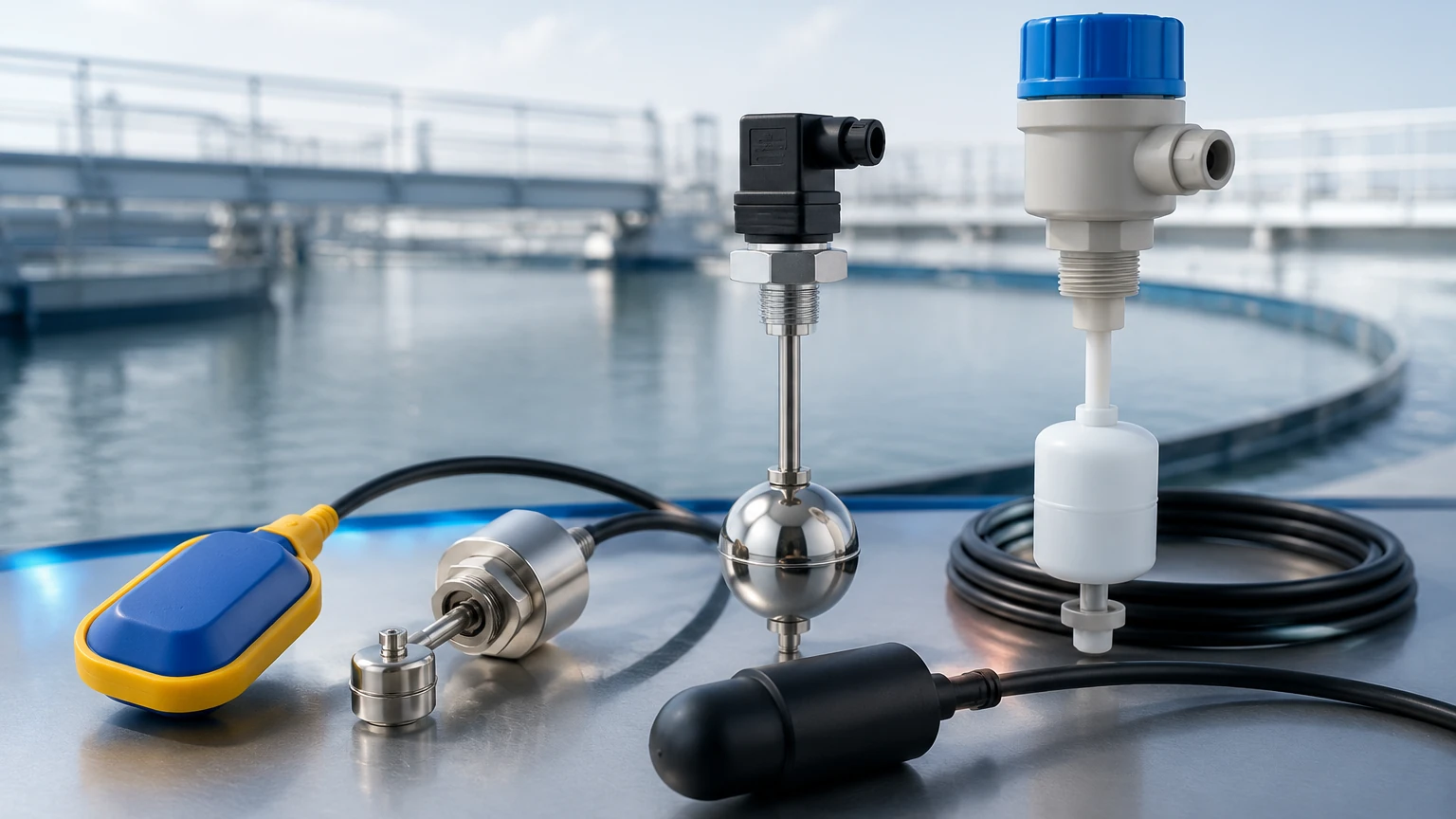
Float switches operate on the principle of buoyancy. A float, typically made of stainless steel or plastic, moves with the liquid level. As the float reaches a predetermined point, it mechanically or magnetically actuates a switch.
* Magnetic Reed Switches: A magnet inside the float passes a reed switch located within a stationary stem, closing or opening the electrical circuit.
* Cable-Suspended Floats: Often used in wastewater, these tilt when the liquid rises, moving an internal ball to trigger a microswitch.
Vibrating Tuning Fork Switches
Vibrating switches utilize a tuning fork-shaped sensor that is excited by a piezoelectric crystal to its natural resonant frequency in air. When the fork is submerged in liquid or covered by solids, the frequency changes or the vibration is damped. This shift is detected by the electronics and converted into a switching signal. This technology is highly reliable as it is largely unaffected by flow, turbulence, bubbles, or foam.
Capacitance Level Switches
Capacitance switches measure the change in electrical capacitance between the sensor probe and the tank wall (or a reference probe). Since different materials have different dielectric constants, the presence of the media at the probe level changes the capacitance. These are ideal for detecting the interface between two different liquids, such as oil and water, but may require calibration if the material properties change significantly.
Ultrasonic Level Switches
Ultrasonic switches use high-frequency sound waves. A common configuration involves a gap in the sensor head; when liquid fills this gap, the ultrasonic signal is transmitted across it, triggering the switch. Because they have no moving parts, they are suitable for corrosive or high-viscosity fluids where mechanical floats might stick.
Conductive Level Switches
Limited to conductive liquids (such as water or acids), these switches use electrodes to complete an electrical circuit through the liquid itself. When the liquid touches the electrode, a low-voltage current flows, signaling that the level has been reached. These are cost-effective but cannot be used with oils or non-conductive hydrocarbons.
Practical Selection Table
Choosing the right tank level switch involves balancing performance requirements with budget constraints. The following table provides a comparison of common technologies used in industrial applications.
| Technology | Suitable Media | Primary Advantage | Main Limitation |
| :— | :— | :— | :— |
| Float Switch | Clean liquids, oils | Low cost, no power required (passive) | Prone to mechanical jamming; sensitive to build-up |
| Tuning Fork | Liquids, powders, granules | Robust, maintenance-free, ignores foam | Not suitable for very high-viscosity coatings |
| Capacitance | Liquids, solids, interfaces | High temperature/pressure capability | Requires calibration; sensitive to dielectric changes |
| Ultrasonic | Corrosive liquids, slurries | Non-contact (gap type), no moving parts | Sensitive to heavy aeration or dense foam |
| Conductive | Conductive liquids (water-based) | Simple, inexpensive, multi-point | Only works with conductive media; probe corrosion |
Key Evaluation Criteria for Tank Level Switches
When specifying a tank level switch for a project, several engineering factors must be confirmed to ensure long-term reliability.
1. Media Characteristics
* Viscosity: High-viscosity liquids can cause float switches to stick or create "bridging" on tuning forks.
* Corrosiveness: Ensure the wetted parts (e.g., 316L Stainless Steel, PTFE, or PP) are compatible with the chemical composition of the fluid.
* Density: Float switches must be rated for a specific gravity lower than the liquid they are intended to measure.
2. Process Conditions
* Temperature: Standard switches often handle up to 80°C (176°F), but high-temperature versions with cooling fins or ceramic insulators are required for steam or furnace applications reaching 250°C (482°F) or higher.
* Pressure: The switch housing and process connection must withstand the maximum tank pressure, which can exceed 40 bar (580 psi) in some chemical reactors.
3. Output Requirements
Decide whether the system requires a simple SPDT (Single Pole Double Throw) relay, a PNP/NPN transistor output for PLC integration, or a two-wire loop-powered signal. For safety-critical applications, look for units with SIL (Safety Integrity Level) ratings.
For a comprehensive overview of available technologies and specific model specifications, engineers should consult the Main Page of the manufacturer’s technical catalog to compare performance data.
Installation Considerations and Best Practices
Proper installation is as important as selecting the right technology. Poor placement can lead to false alarms or premature device failure.
* Avoid the Fill Stream: Never install a level switch directly under the tank's inlet pipe. The turbulence and force of the falling material can cause mechanical damage or trigger false high-level alarms.
* Nozzle Length: For tuning fork and ultrasonic switches, ensure the "dead zone" or the active sensing element extends past the mounting nozzle into the tank. If the sensor is recessed inside a narrow nozzle, material build-up can occur, causing the switch to stay in the "covered" state.
* Side vs. Top Mounting: Float switches are often side-mounted for high/low alarms, while ultrasonic and capacitance probes are typically top-mounted. Ensure there is enough clearance for the probe length or float swing radius.
* Agitators and Baffles: In tanks with mixers, ensure the switch is positioned away from the blades and consider using a stilling well for float switches to prevent excessive movement caused by turbulence.
* Orientation: Vibrating forks should be oriented so that material can easily flow off the blades. In horizontal installations, the forks should be oriented vertically (side-by-side) so that the media does not rest on top of the blades.
Limitations and Common Risks
While highly effective, tank level switches are not universal solutions. Engineers must be aware of the following risks:
1. Material Build-up: In applications involving sticky resins or wastewater, material can accumulate on the sensor. While tuning forks are designed to shed some build-up, heavy coating will eventually lead to failure. In these cases, non-contact radar or flush-mounted capacitance sensors may be preferred.
2. Turbulence and Foam: Mechanical floats and ultrasonic gap switches can struggle in highly agitated liquids or tanks with thick foam layers. Foam might be detected as a liquid level by a tuning fork but ignored by a float, depending on the foam's density.
3. Electromagnetic Interference (EMI): Electronic switches (capacitance and ultrasonic) require shielded cabling when installed near high-power motors or frequency drives to prevent signal noise from triggering false switches.
Frequently Asked Questions (FAQ)
Q: Can a tank level switch be used for continuous monitoring?
A: No. A level switch only provides a binary (on/off) signal at a specific point. For continuous tracking (0-100%), a radar, ultrasonic, or hydrostatic level transmitter is required.
Q: How do I test a level switch without filling the tank?
A: Many modern electronic switches, such as those from Welk, include a manual test button or a magnetic test point that simulates a "covered" state. For mechanical floats, the float must be manually moved if the tank is empty.
Q: What is the difference between a "Normally Open" (NO) and "Normally Closed" (NC) configuration?
A: This refers to the state of the electrical switch when the level is not touching the sensor. For fail-safe overfill protection, a "Normally Closed" circuit is often preferred because if a wire breaks, the system will perceive it as a high-level alarm, stopping the fill process.
Q: Are there switches suitable for explosive environments?
A: Yes. For oil and gas or chemical applications, switches must be certified as Intrinsically Safe (Ex ia) or Explosion-Proof (Ex d) to prevent the electrical components from igniting flammable vapors.
Conclusion
The tank level switch remains a cornerstone of industrial safety and process efficiency. By understanding the physical principles of detection—whether buoyancy, vibration, or capacitance—and accounting for the specific challenges of the media and environment, engineers can implement reliable point-level control. For detailed technical specifications, OEM/ODM customization options, and specific application support, visiting the Main Page provides access to a full range of industrial level measurement solutions designed for accuracy and durability in demanding conditions.