Ultrasonic Tank Level Sensor
Ultrasonic Tank Level Sensor
In modern industrial process control, the accurate monitoring of liquid levels is fundamental to operational safety, inventory management, and efficiency. Among the various technologies available, the ultrasonic tank level sensor has emerged as a preferred non-contact solution for a wide range of applications. By utilizing high-frequency sound waves to determine the distance to a liquid surface, these instruments provide reliable data without physical contact with the medium, making them ideal for corrosive, coating, or high-purity liquids.
As a professional manufacturer of industrial measurement instruments, Welk provides a comprehensive range of level solutions. Understanding the underlying physics, installation requirements, and environmental limitations of ultrasonic technology is essential for engineers and plant managers to ensure optimal performance in their specific process environments.
Understanding the Measurement Principle
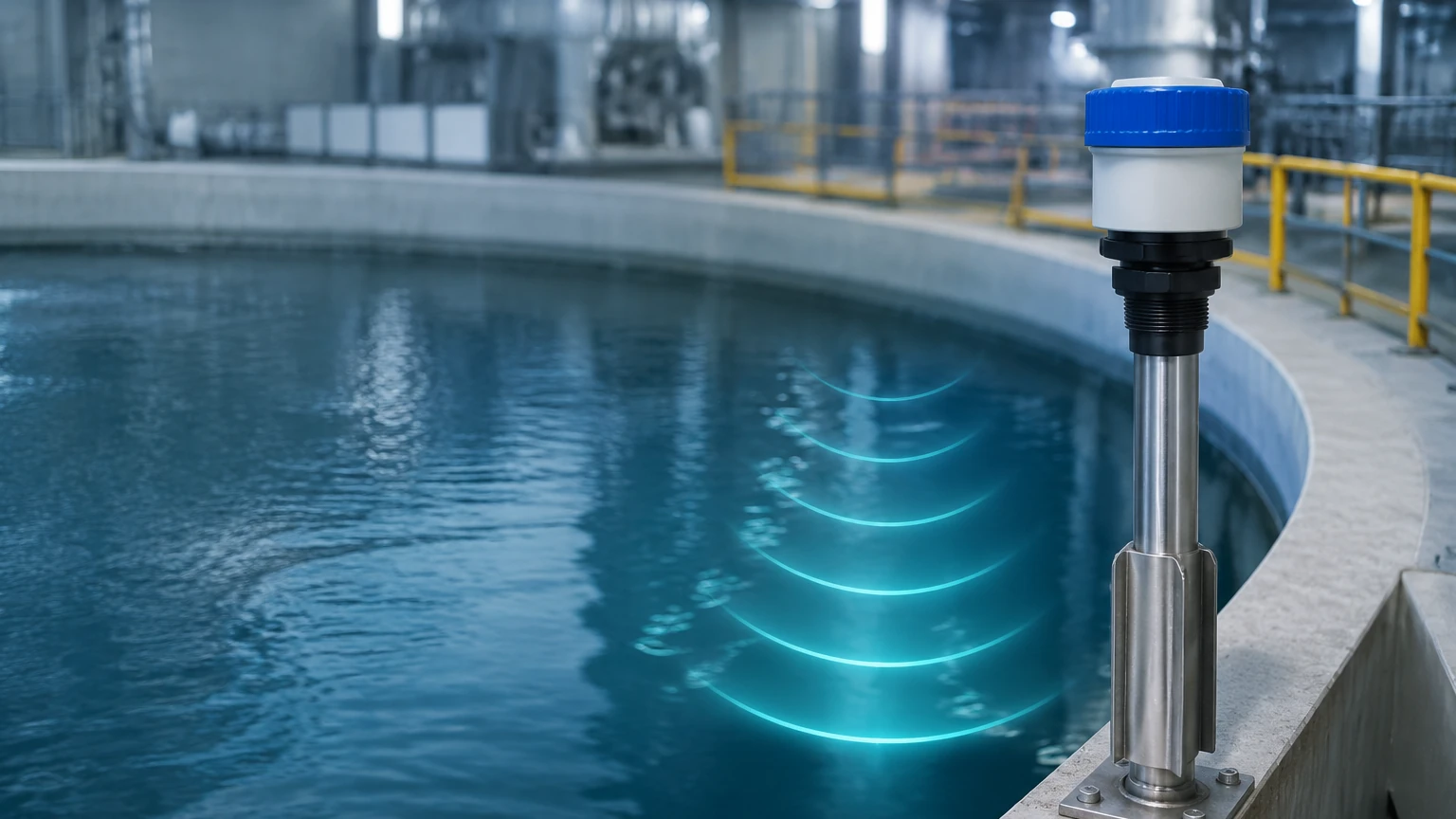
The operation of an ultrasonic tank level sensor is based on the "Time of Flight" (ToF) principle. The sensor’s transducer contains a piezoelectric crystal that converts electrical energy into mechanical pulses. These pulses are emitted as high-frequency sound waves—typically ranging from 20 kHz to 200 kHz—directed toward the surface of the medium.
The Calculation Formula
When the sound wave hits the surface of the liquid, it is reflected back to the sensor. The transducer then acts as a receiver, converting the returning acoustic energy back into an electrical signal. The internal electronics measure the time elapsed between the emission of the pulse and the reception of the echo. The distance ($D$) is calculated using the following formula:
$$D = \frac{c \times t}{2}$$
Where:
* $c$ is the speed of sound in the air (approximately 344 m/s at 20°C).
* $t$ is the total travel time (transit time) of the pulse.
Since the sensor knows the total height of the tank ($H$), it subtracts the measured distance ($D$) from the tank height to determine the actual liquid level ($L$):
$$L = H – D$$
The Role of Temperature Compensation
The speed of sound is not constant; it varies significantly with the temperature of the medium through which it travels (usually air or a gas buffer). For example, the speed of sound increases by approximately 0.6 m/s for every degree Celsius increase in temperature. To maintain accuracy, high-quality ultrasonic tank level sensors include an integrated temperature sensor to automatically adjust the calculation based on ambient conditions. For applications involving high-precision requirements, users can often find advanced calibration options on the Main Page of the manufacturer’s technical portal.
Advantages of Non-Contact Measurement
Choosing an ultrasonic tank level sensor offers several distinct advantages over contact-based methods like float switches or pressure transmitters:
1. Zero Maintenance for Moving Parts: Because there are no mechanical floats, linkages, or seals in contact with the liquid, there is no risk of mechanical wear, clogging, or corrosion of the sensing element.
2. Chemical Compatibility: Since the sensor is mounted at the top of the tank and does not touch the liquid, it is highly resistant to aggressive chemicals, acids, and alkalis. Standard housing materials like PVDF or PTFE-faced transducers further enhance this resistance.
3. Hygiene and Purity: In food, beverage, and pharmaceutical industries, non-contact measurement prevents cross-contamination and simplifies the Clean-in-Place (CIP) process.
4. Versatility: These sensors can measure both liquids and, in some cases, coarse solids (though with reduced range and accuracy) across various tank shapes and sizes.
Technical Selection Criteria
Selecting the right ultrasonic tank level sensor requires a detailed analysis of the application’s physical and chemical parameters. The following factors are critical:
Measuring Range
Ultrasonic sensors are available in various ranges, typically from 0.25 meters up to 30 meters. It is important to select a sensor where the maximum range exceeds the tank height by at least 10-20% to account for potential signal attenuation. Conversely, the "Dead Zone" (discussed below) must be smaller than the distance between the sensor and the maximum expected liquid level.
Process Temperature and Pressure
Standard ultrasonic sensors are designed for atmospheric pressure and temperatures between -20°C and +60°C. While some specialized models can handle higher temperatures, extreme heat or pressure can alter the density of the air, significantly affecting the speed of sound and the reliability of the echo. For high-pressure or high-temperature environments, radar level meters are often a more suitable alternative.
Output and Communication
Most industrial sensors provide a standard 4-20mA analog output proportional to the level. However, modern integration often requires digital protocols such as:
* HART: Allows for digital communication over the analog loop for remote configuration.
* Modbus RTU (RS485): Ideal for multi-drop installations where multiple sensors are connected to a single PLC or SCADA system.
* Switch Outputs: Integrated relays for high-level or low-level alarms.
Installation Best Practices
Proper installation is the most significant factor in the success of an ultrasonic tank level sensor application. Failure to follow geometric guidelines often leads to "lost echoes" or false readings.
1. Managing the Dead Zone (Blocking Distance)
The Dead Zone is a small area directly below the transducer face where the sensor cannot accurately measure. This occurs because the transducer must stop vibrating from the transmission pulse before it can listen for the reflection. If the liquid enters this zone, the sensor may report an error or a fixed, incorrect value. Always mount the sensor high enough so the maximum liquid level remains below the dead zone (typically 0.2m to 0.5m depending on the model).
2. Positioning and Beam Angle
Ultrasonic pulses spread out in a cone shape, known as the beam angle (usually 5° to 12°). The sensor must be positioned such that this cone does not intersect with tank walls, ladders, pipes, or agitators. If the sound wave hits an internal obstruction, it will create a "false echo," which the sensor might mistake for the liquid level.
* Perpendicular Mounting: The sensor face must be perfectly parallel to the liquid surface. A tilt of even a few degrees can cause the reflected signal to bounce away from the receiver.
* Distance from Walls: As a rule of thumb, the sensor should be mounted at least 200mm away from the tank wall for every meter of depth to avoid wall interference.
3. Avoiding Turbulence and Foam
In tanks with heavy agitation or filling pipes that create splashing, the liquid surface may become turbulent. This scatters the ultrasonic signal. In such cases, a stilling well (a vertical pipe) can be installed to provide a calm surface for the sensor to measure. However, stilling wells must be vented and have a smooth internal surface to prevent the pulse from catching on joints.
Selection Table for Industrial Applications
The following table provides a general guideline for selecting sensor specifications based on common industrial scenarios:
| Application Type | Recommended Range | Housing Material | Key Consideration |
| :— | :— | :— | :— |
| Water Storage Tank | 0-10m | ABS / PVC | Standard cost-effective solution. |
| Chemical Day Tank | 0-5m | PVDF / PTFE | Resistance to corrosive vapors. |
| Wastewater Sump | 0-8m | IP68 Rated | Protection against flooding and humidity. |
| Open Channel Flow | 0-3m | UV Resistant | Requires built-in flow calculation software. |
| Grain Silo (Small) | 0-15m | Dust-Ignition Proof | High power pulse needed for solids. |
Application Limitations and Environmental Factors
While the ultrasonic tank level sensor is a robust tool, it is not a "one-size-fits-all" solution. Engineers should be aware of the following limitations:
* Foam: Heavy, thick foam on the liquid surface absorbs the ultrasonic pulse rather than reflecting it. If the foam is dense enough, the sensor will lose the signal entirely. For foamy applications, radar or hydrostatic transmitters are preferred.
* Vacuum: Sound waves require a medium (air or gas) to travel. In a vacuum, ultrasonic sensors cannot function.
* Vapor and Dust: Heavy steam, chemical vapors (like concentrated nitric acid), or thick dust can change the composition of the air in the tank, leading to inaccuracies or signal attenuation.
* Surface Turbulence: Rapidly moving or boiling liquids can scatter the pulse. This can often be mitigated through software filtering (damping) or the use of stilling wells.
Frequently Asked Questions (FAQ)
Q: Can an ultrasonic sensor measure through a closed plastic tank lid?
A: Generally, no. The pulse will reflect off the lid itself. The sensor requires a hole or a flange to "see" into the tank. However, some very low-power sensors can measure through thin plastic walls, but with significant loss of accuracy and range.
Q: How do I handle a tank with an internal agitator?
A: If the agitator is within the beam path, you should use a sensor with "False Echo Suppression" software. This allows you to "teach" the sensor to ignore reflections from fixed objects at specific distances. Alternatively, move the sensor to a position where the beam avoids the agitator blades.
Q: Is the sensor affected by the color or transparency of the liquid?
A: No. Unlike optical or laser sensors, ultrasonic technology is entirely independent of the liquid’s color, transparency, or dielectric constant. It only requires a surface that can reflect sound.
Q: What is the typical lifespan of an ultrasonic level sensor?
A: In a well-specified environment (within temperature and pressure limits), a high-quality sensor like those found on the Welk Main Page can last 7 to 10 years or more, as there are no wearing parts.
Conclusion
The ultrasonic tank level sensor remains a cornerstone of industrial instrumentation due to its balance of cost, ease of installation, and reliable non-contact performance. By carefully considering the tank geometry, the nature of the liquid, and environmental factors like temperature and foam, engineers can implement a maintenance-free leveling solution that enhances process safety and accuracy. For complex applications involving high pressure or extreme vapors, consulting with a manufacturer to compare ultrasonic technology against radar or hydrostatic options is always recommended to ensure the long-term success of the installation.