Ultrasonic Level Sensor Types
Ultrasonic Level Sensor Types: A Comprehensive Engineering Guide
In the landscape of industrial process control, non-contact level measurement has become the preferred standard for reliability and low maintenance. Among the various technologies available, Ultrasonic Level Meters stand out as versatile, cost-effective solutions for monitoring liquids and solids. Understanding the various ultrasonic level sensor types is essential for engineers and procurement specialists to ensure the selected instrument matches the specific physical and chemical demands of their application.
This guide examines the fundamental principles of ultrasonic technology, categorizes the primary sensor types used in modern industry, and provides practical selection criteria for successful deployment.
The Principle of Ultrasonic Level Measurement
Before diving into specific sensor types, it is critical to understand how these instruments function. Ultrasonic level measurement is based on the "Time-of-Flight" (ToF) principle.
The sensor, often referred to as a transducer, contains a piezoelectric crystal. When energized, this crystal vibrates at a high frequency (typically between 20 kHz and 200 kHz), emitting a pulse of ultrasonic sound waves. These waves travel through the air or gas space in a tank, strike the surface of the medium (liquid or solid), and reflect back toward the sensor.
The instrument calculates the distance ($D$) between the sensor and the material surface using the formula:
$$D = \frac{c \times t}{2}$$
Where:
* c is the speed of sound in the medium (usually air).
* t is the elapsed time between the emission and the reception of the pulse.
Because the height of the vessel ($H$) is known, the actual level ($L$) is determined by subtracting the distance from the total height ($L = H – D$).
The Importance of Temperature Compensation
The speed of sound ($c$) is not constant; it fluctuates based on the temperature of the air through which it travels. For instance, at 0°C (32°F), the speed of sound is approximately 331.5 m/s, while at 20°C (68°F), it increases to about 343 m/s. To maintain accuracy, most industrial-grade Ultrasonic Level Meters include an integrated temperature sensor to automatically compensate for these variations in real-time.
Categorizing Ultrasonic Level Sensor Types
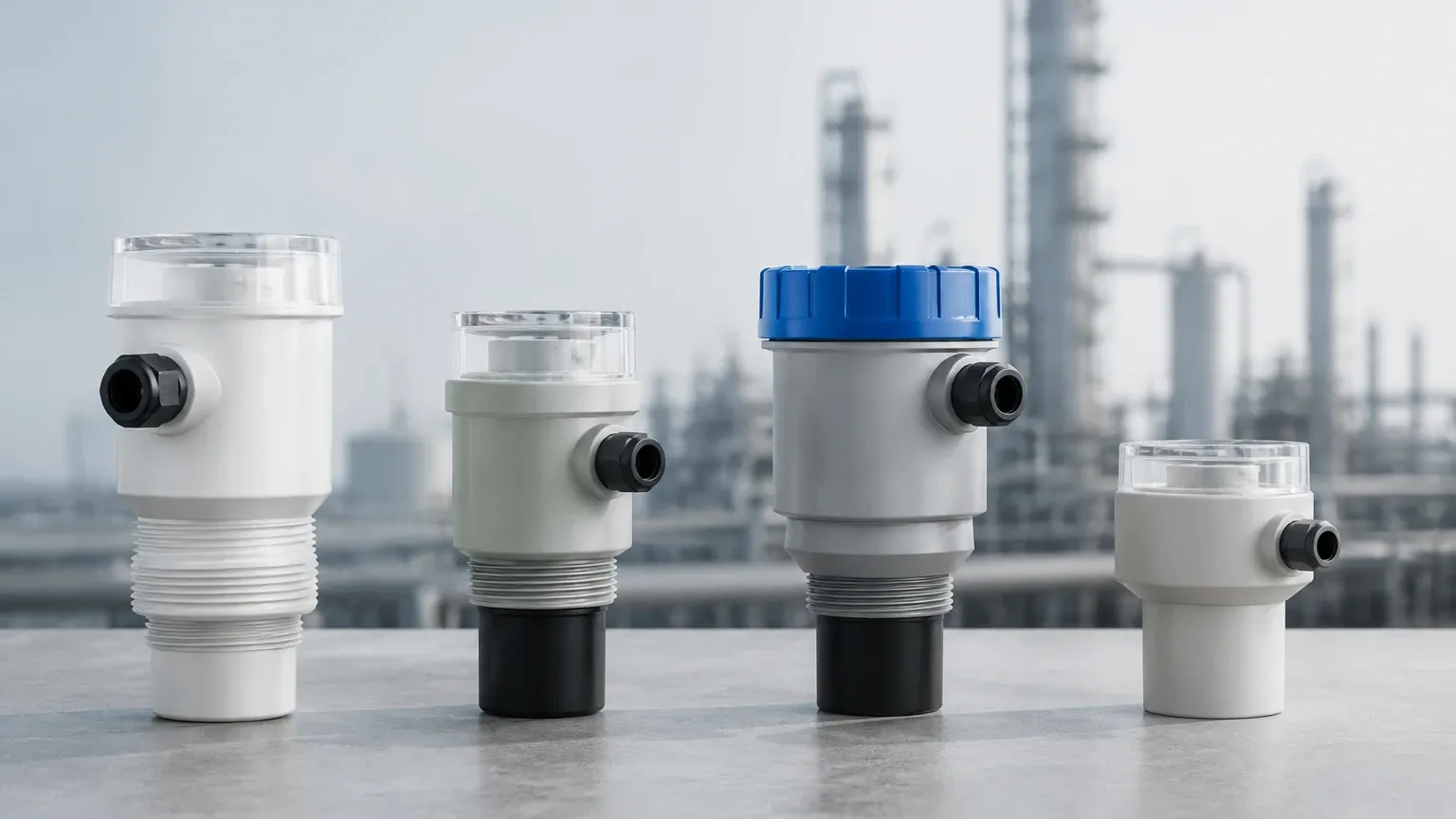
Industrial applications vary from simple water storage to complex chemical processing. Consequently, manufacturers like Welk offer several configurations of ultrasonic sensors to meet these diverse needs.
1. Integrated (Compact) vs. Split (Remote) Types
One of the most fundamental distinctions in ultrasonic level sensor types is the physical arrangement of the transducer and the electronics.
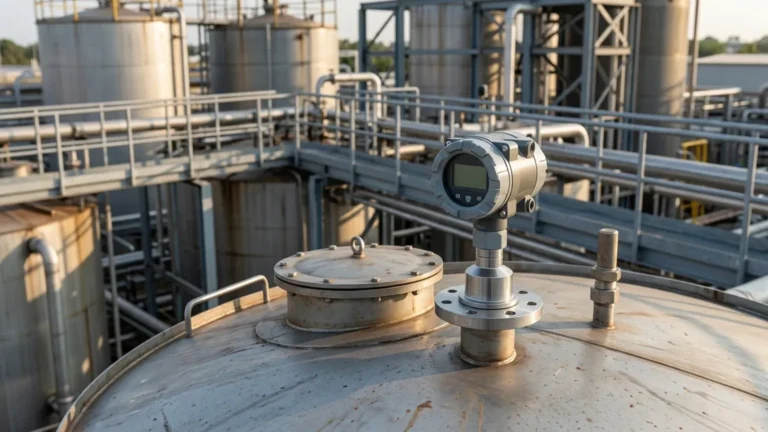
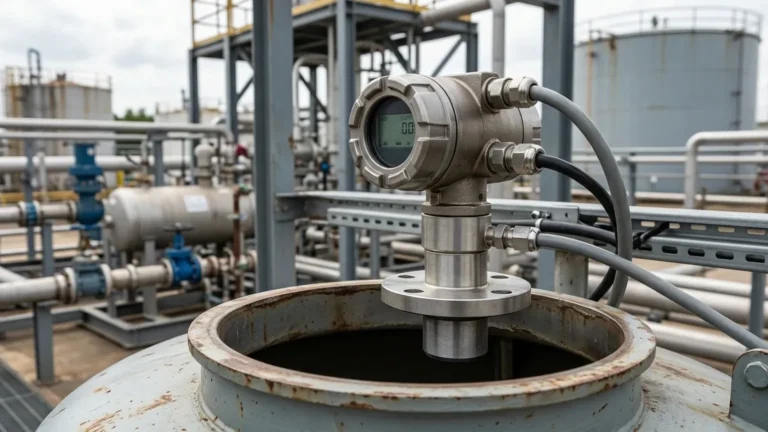
* Integrated (Compact) Type: In this configuration, the transducer and the electronic transmitter/display are housed in a single unit. This is the most common type for standard industrial applications. It is easy to install, requires less wiring, and is generally more cost-effective. It is ideal for outdoor tanks or sumps where the display can be read directly at the measurement point.
* Split (Remote) Type: The transducer is installed at the measurement point, while the electronic display and control unit are mounted at a distance (often in a control room or at eye level on a nearby wall). This type is preferred when the measurement point is difficult to access, or when the environment at the tank top is extreme (e.g., high vibration or excessive heat) and could damage the sensitive electronics of a compact unit.
2. Two-Wire vs. Four-Wire Systems
This classification refers to the power supply and signal output configuration.
* Two-Wire (Loop Powered): The sensor is powered by the 4-20mA signal loop itself. This simplifies installation and reduces cabling costs. However, because the power available is limited, two-wire sensors are generally used for shorter ranges and less demanding environments.
* Four-Wire (Line Powered): These units have separate pairs of wires for the power supply (usually 24V DC or 110/220V AC) and the signal output. Because they have access to more power, four-wire sensors can emit stronger ultrasonic pulses, making them better suited for long-range measurements (up to 30 or 40 meters) and for penetrating dust or light foam.
3. Material-Specific Sensors: Liquids vs. Solids
While the basic principle remains the same, the physical properties of the medium significantly affect sensor choice.
* Liquid Level Sensors: These typically operate at higher frequencies. Liquids provide a flat, reflective surface that returns a strong echo. These are used in water treatment, chemical storage, and oil tanks.
* Solid Level Sensors: Measuring grains, powders, or ores is more challenging. Solids often form irregular piles (cones) that scatter the ultrasonic signal rather than reflecting it directly back. Sensors designed for solids often operate at lower frequencies to penetrate dust and feature specialized software algorithms to process "weak" or "noisy" echoes.
4. Specialized and Hazardous Area Types
For environments with specific safety or chemical requirements, specialized ultrasonic level sensor types are required:
* Explosion-Proof Types: Designed with flameproof or intrinsically safe enclosures for use in oil refineries, gas plants, and chemical facilities where flammable vapors are present.
* Corrosion-Resistant Types: These feature transducers made from or coated with materials like PTFE (Teflon) or PVDF to withstand aggressive acids and bases.
Practical Selection Table
The following table provides a comparison to assist in the initial selection process:
| Feature | Integrated Compact | Split / Remote | High-Power Four-Wire | Corrosion-Resistant |
| :— | :— | :— | :— | :— |
| Primary Use | General liquid storage | Hard-to-reach tanks | Deep silos / Solids | Acids, bases, chemicals |
| Installation | Simple, single point | Requires cable run | Requires separate power | Threaded or Flanged |
| Max Range | Up to 15m (49ft) | Up to 30m (98ft) | Up to 40m+ (131ft) | Up to 10-15m (33-49ft) |
| Cost | Low to Moderate | Moderate | High | Moderate to High |
| Maintenance | Low | Low (Transducer only) | Moderate | Low |
Installation Considerations and Best Practices
Even the most advanced ultrasonic level meter will fail if installed incorrectly. To ensure reliable performance, engineers must consider the following factors:
The Dead Zone (Blanking Distance)
Every ultrasonic sensor has a "dead zone" immediately below the transducer face (typically 0.2m to 0.6m depending on the frequency). The sensor cannot measure any level that enters this zone because the transducer cannot switch from "transmit" to "receive" mode fast enough. Always mount the sensor high enough so that the maximum expected liquid level never enters the dead zone.
Mounting Position and Angle
* Avoid the Center: In cylindrical tanks, do not mount the sensor in the exact center, as this can lead to multiple reflections (parabolic effect) that confuse the instrument.
* The 1/6 Rule: A common rule of thumb is to mount the sensor at a distance of 1/6th the diameter of the tank from the wall.
* Perpendicularity: The transducer face must be perfectly parallel to the liquid surface. A tilt of even a few degrees can cause the reflected signal to miss the sensor entirely, especially at longer distances.
* Obstructions: The ultrasonic beam spreads out in a cone (usually 5° to 10°). Ensure there are no ladders, pipes, or agitators within this cone, as they will create "false echoes."
Environmental Factors
* Foam: Heavy, thick foam absorbs ultrasonic waves, often resulting in a "lost signal" error. If foam is present, a radar level meter or a hydrostatic transmitter may be a better choice.
* Turbulence: Rapidly moving or boiling surfaces can scatter the signal. This can often be mitigated by using a "stilling well" (a vertical pipe) to provide a calm surface for measurement.
* Vacuum: Ultrasonic waves require a medium (air/gas) to travel. They cannot function in a vacuum.
Limitations and Common Risks
While highly effective, ultrasonic technology has boundaries that should not be ignored:
1. Pressure Limits: Most ultrasonic level sensor types are designed for atmospheric pressure. High pressure changes the density of the air, significantly altering the speed of sound and causing measurement errors.
2. Vapor and Condensation: Heavy steam or chemical vapors can attenuate the signal. Furthermore, condensation forming on the transducer face can cause the sensor to "see" the water droplets as the tank level, leading to a permanent high-level reading. Many Welk sensors feature a self-cleaning transducer face to minimize this risk.
3. Temperature Gradients: If there is a significant temperature difference between the liquid and the air space (e.g., hot liquid in a cold tank), the resulting air currents can distort the ultrasonic beam.
Frequently Asked Questions (FAQs)
Q: Can I use an ultrasonic sensor to measure the level of sulfuric acid?
A: Yes, provided you select a corrosion-resistant type with a PTFE or PVDF wetted part. Ensure the vapors are not so dense that they block the signal.
Q: My tank has an agitator. Can I still use an ultrasonic meter?
A: Yes, but you must use a sensor with "false echo suppression" software. This allows you to tell the meter to ignore the fixed reflection from the agitator blades. Alternatively, install the sensor in a stilling well.
Q: What is the typical accuracy of these sensors?
A: Most industrial ultrasonic level meters offer an accuracy of ±0.25% to ±0.5% of the measured range, which is sufficient for the vast majority of process applications.
Q: How do I choose between ultrasonic and radar?
A: Ultrasonic is generally more cost-effective and suitable for most water-based liquids. Radar is preferred for high-pressure, high-temperature, vacuum, or heavy foam applications where sound waves cannot reliably travel.
Conclusion
Selecting the right ultrasonic level sensor types requires a balance of environmental awareness and technical specification. By understanding the measurement principle and accounting for factors like dead zones, material properties, and physical obstructions, engineers can implement a measurement solution that provides years of maintenance-free service. For complex applications, consulting with a specialized manufacturer like Welk ensures that the selected instrument is optimized for the specific challenges of the site.