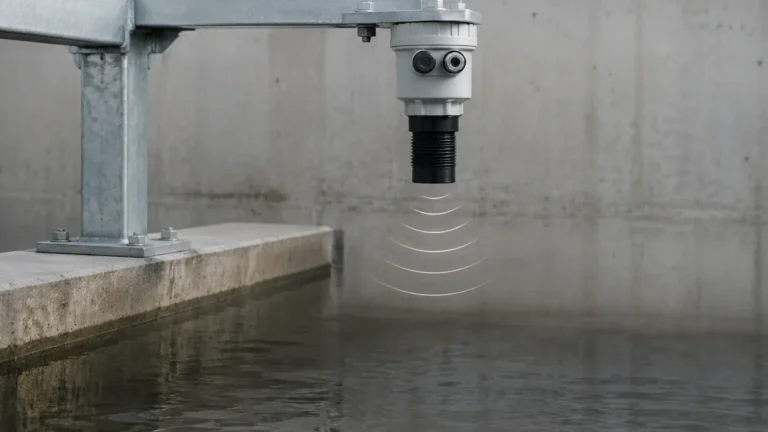
Ultrasonic Water Level Meter
Ultrasonic Water Level Meter: A Comprehensive Engineering Guide to Non-Contact Measurement
In industrial water management and wastewater treatment, the ability to monitor liquid levels accurately without physical contact is a significant operational advantage. The ultrasonic water level meter has emerged as a primary solution for these applications, offering a balance of precision, ease of installation, and cost-effectiveness. As a professional manufacturer, Welk provides these instruments to address the rigorous demands of industrial automation, chemical processing, and environmental monitoring.
This guide explores the technical principles, selection criteria, and installation best practices for Ultrasonic Level Meters, providing engineers and project managers with the factual foundation needed to integrate these sensors into their systems.
Understanding the Measurement Principle
The operation of an ultrasonic water level meter is based on the "Time-of-Flight" (ToF) principle. The instrument consists of a transducer and an electronic processing unit. The transducer acts as both a transmitter and a receiver of high-frequency acoustic waves.
1. Emission: The transducer emits a series of ultrasonic pulses (typically in the range of 20 kHz to 200 kHz) directed toward the surface of the water.
2. Reflection: These sound waves travel through the air, hit the water surface, and are reflected back toward the sensor.
3. Reception: The transducer detects the returning echo.
4. Calculation: The internal electronics measure the time interval ($t$) between the emission and the reception. Since the speed of sound in air ($c$) is known, the distance ($D$) from the sensor to the water surface is calculated using the formula:
$$D = \frac{c \times t}{2}$$
To determine the actual level of the water in a tank or channel, the device subtracts the measured distance ($D$) from the total height of the vessel ($H$), which is programmed during commissioning ($Level = H – D$).
The Role of Temperature Compensation
The speed of sound in air is not constant; it varies with temperature (approximately 0.6 m/s per degree Celsius). To maintain accuracy, modern ultrasonic level meters include an integrated temperature sensor. The electronics automatically adjust the calculation based on the ambient temperature near the transducer, ensuring that fluctuations in the environment do not lead to measurement errors.
Key Advantages in Water Applications
Compared to contact-based methods like float switches or hydrostatic transmitters, the ultrasonic water level meter offers several distinct benefits:
* Non-Contact Nature: Because the sensor never touches the liquid, it is immune to corrosion, scaling, or fouling from debris in the water. This is particularly critical in wastewater or chemical-laden fluids.
* Low Maintenance: With no moving parts to wear out or clog, the long-term maintenance requirements are minimal.
* Versatility: These meters can be used in various environments, including open channels, sumps, and storage tanks.
* Integrated Control: Most units provide not just a level reading, but also 4-20mA analog outputs, RS485 Modbus communication, and programmable relay outputs for pump control or alarms.
Technical Selection Criteria
Selecting the correct ultrasonic water level meter requires an analysis of the specific process conditions. Use the following table as a reference for standard industrial specifications:
| Feature | Standard Specification | High-Performance Specification |
| :— | :— | :— |
| Measuring Range | 0.3m to 5m (1ft to 16.4ft) | Up to 30m (98.4ft) |
| Accuracy | ±0.5% of full scale | ±0.2% to ±0.25% of full scale |
| Resolution | 1mm to 3mm (0.04" to 0.12") | < 1mm (0.04") |
| Beam Angle | 10° to 12° | 5° to 9° (Narrow beam) |
| Output Signals | 4-20mA, RS485 | 4-20mA/HART, Modbus, Profibus |
| Power Supply | 24V DC | 24V DC or 220V AC |
| Operating Temp | -20°C to +60°C | -40°C to +80°C |
| Enclosure Rating | IP65 / NEMA 4 | IP67 / IP68 |
Defining the "Dead Zone"
One of the most critical factors in selection is the Dead Zone (also known as the blocking distance). This is a small area directly beneath the transducer where the sensor cannot measure. It exists because the transducer needs a fraction of a millisecond to stop vibrating after emitting a pulse before it can listen for the echo. Typical dead zones range from 0.2m to 0.5m (0.6ft to 1.6ft). When selecting a meter, ensure the maximum water level will never rise into this dead zone, or the reading will become erratic.
Installation Guidelines for Accuracy
Proper installation is the single most important factor in the performance of an ultrasonic water level meter. Poor placement can lead to "false echoes" or signal loss.
1. Positioning and Orientation
The transducer must be mounted perfectly perpendicular to the water surface. If the sensor is tilted, the ultrasonic pulse will reflect away from the transducer rather than back to it, resulting in a "Lost Echo" error.
2. Avoiding Obstructions
The ultrasonic pulse spreads out in a cone shape (defined by the beam angle). Any internal structures within this cone—such as pipes, ladders, or support beams—will create false reflections.
* Rule of Thumb: For every 1 meter of depth, the clear radius required increases based on the beam angle. For a 10° beam, ensure at least 0.1m of horizontal clearance for every 1m of vertical distance.
3. Wall Distance
Do not mount the sensor too close to the tank wall. Smooth walls can cause multipath interference, while rough walls can create unwanted reflections. Maintain a distance from the wall that is at least 10% to 15% of the total measuring height.
4. Turbulence and Inflow
Avoid mounting the sensor directly above an inflow pipe. The turbulence and bubbles created by falling water will scatter the ultrasonic signal. If the water surface is excessively turbulent, a stilling well (a vertical pipe that dampens surface movement) may be required to provide a stable surface for measurement.
Limitations and Environmental Considerations
While highly effective, ultrasonic technology has factual boundaries that must be respected to avoid project failure.
* Foam: Heavy, thick foam on the water surface acts as an acoustic absorber. It soaks up the ultrasonic pulse rather than reflecting it. If foam is present, a radar level meter or a hydrostatic transmitter is often a better choice.
* Vacuum and Pressure: Ultrasonic waves require a medium (air or gas) to travel. They cannot function in a vacuum. Furthermore, high-pressure environments change the density of the air, which can significantly affect the accuracy of the sound speed calculation.
* Steam and Vapors: In applications with hot water, steam can condense on the transducer face, forming droplets that attenuate the signal. Furthermore, heavy vapor layers can create temperature gradients that distort the sound wave.
* Wind: In outdoor open-channel applications, strong winds can "blow" the ultrasonic pulse away, leading to inconsistent readings over long distances.
Practical Applications in Industry
Wastewater Treatment
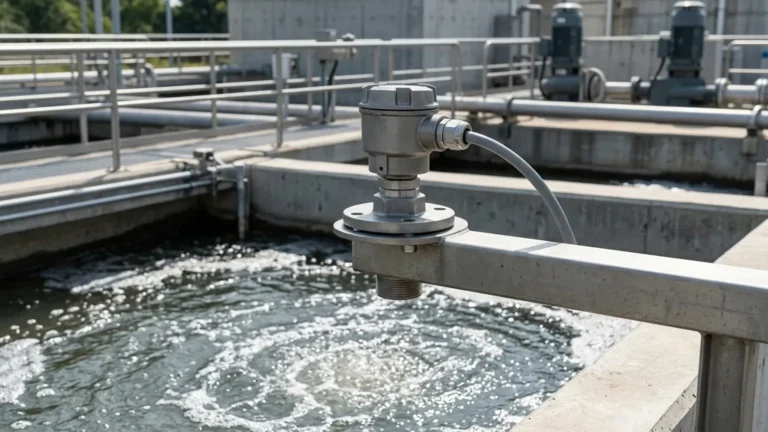
In sewage treatment plants, the ultrasonic water level meter is used for monitoring influent flow in Parshall flumes. By measuring the level and applying a programmed flow formula, the meter provides real-time flow rate data ($m^3/h$).
Chemical Storage
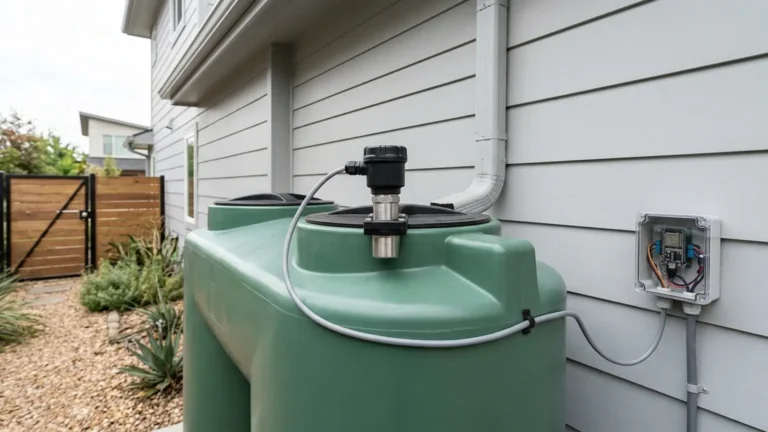
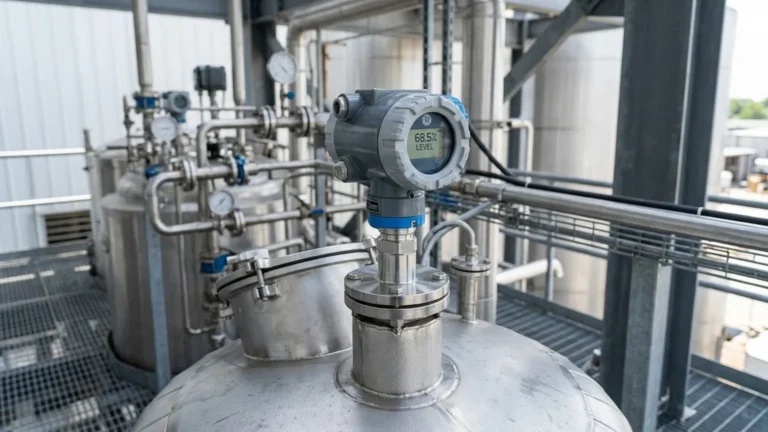
For plastic or fiberglass tanks containing acids or alkalis, the non-contact nature of the sensor prevents chemical attack. If the tank is sealed, the sensor can often be mounted through a flange or a threaded boss on the top of the vessel.
Pump Station Automation
Ultrasonic sensors are frequently used to automate sump pumps. The internal relays can be programmed to start a pump at a "High" level and stop it at a "Low" level, providing a reliable, solid-state alternative to mechanical float switches.
Frequently Asked Questions (FAQ)
Q: Can an ultrasonic water level meter measure through a tank lid?
A: Generally, no. The ultrasonic pulse cannot penetrate solid materials like metal or thick plastic. However, if the tank lid is made of a very thin, acoustic-transparent material, it might work, but this is not recommended for industrial accuracy. The sensor should always have a clear line of sight to the liquid.
Q: How do I handle a transducer that has condensation on it?
A: Many Welk ultrasonic sensors feature a self-cleaning function where the vibration of the transducer face helps shed small droplets. For high-humidity environments, choosing a sensor with a PTFE or specialized plastic face can reduce the surface tension that allows droplets to cling.
Q: What is the maximum distance an ultrasonic meter can measure?
A: For water, most industrial units max out at 15m to 30m (49ft to 98ft). Beyond this distance, the signal attenuation in the air becomes too great, and radar technology is typically recommended.
Q: Does the color or transparency of the water affect the measurement?
A: No. Unlike optical or laser sensors, ultrasonic waves reflect off the physical density interface of the liquid. Whether the water is clear, muddy, or colored does not impact the measurement.
Conclusion
The ultrasonic water level meter remains a cornerstone of modern process instrumentation due to its reliability and non-invasive design. By understanding the physics of sound propagation and adhering to strict installation geometry, engineers can achieve highly accurate level data for even the most demanding water management projects. When specifying a system, always account for the dead zone, potential foam, and the physical beam angle to ensure long-term operational success.
For technical assistance in selecting the specific frequency and mounting configuration for your application, you can Review product options and application support to find the optimal balance of range and precision.