Mobile Clarifier to Reduce Tss
Mobile Clarifier to Reduce Tss
In industrial wastewater management and process water treatment, the removal of suspended particles is a critical step for regulatory compliance and equipment protection. A mobile clarifier to reduce TSS (Total Suspended Solids) serves as a versatile, rapid-deployment solution for sites facing temporary capacity surges, emergency system failures, or remote construction requirements. To operate these systems efficiently, precise level and interface measurement is required to automate sludge removal and monitor throughput.
Effective TSS reduction relies on the principle of sedimentation, where solids heavier than water settle to the bottom of a vessel over time. In a mobile clarifier, this process is often accelerated using chemical flocculants and specialized internal geometries, such as inclined plates (lamella clarifiers). For engineers and site managers, understanding the instrumentation that governs these units is as important as the mechanical design of the clarifier itself.
Measurement Principles in Clarification Processes
Before selecting instrumentation for a mobile clarifier, it is essential to understand the two primary measurement challenges: liquid level monitoring and sludge blanket interface detection.
Liquid Level Measurement
Liquid level measurement ensures the clarifier does not overflow and helps regulate the flow rate of influent. This is typically achieved using non-contact methods to avoid fouling from the high TSS concentrations.
* Ultrasonic Principle: An ultrasonic sensor emits high-frequency sound pulses that travel through the air and reflect off the liquid surface. The time-of-flight is measured to determine the distance. This is cost-effective but can be affected by foam or significant temperature gradients.
* Radar (ToF) Principle: Radar level meters emit microwave pulses (often at 80GHz for high precision). These signals reflect off the surface and return to the sensor. Unlike ultrasonic waves, radar signals are unaffected by air temperature, pressure, or steam, making them ideal for outdoor mobile units.
Sludge Blanket Interface Measurement
The "interface" is the boundary between the clarified water (supernatant) and the settling solids (sludge). Measuring this level is vital for a mobile clarifier to reduce TSS effectively, as it tells the control system when to activate sludge pumps.
* Ultrasonic Sonar: A submerged ultrasonic transducer sends a pulse downward. The pulse reflects off the denser sludge layer. By analyzing the echo profile, the system calculates the depth of the sludge blanket. This allows for real-time optimization of solids concentration.
Technology Selection for Mobile Clarifiers
Choosing the right sensor depends on the specific characteristics of the wastewater and the physical constraints of the mobile unit. Mobile systems often experience more vibration and varying environmental conditions than permanent installations.
Comparison of Level Measurement Technologies
| Technology | Accuracy | Maintenance Needs | Best For | Limitations |
| :— | :— | :— | :— | :— |
| 80GHz Radar | ±2 mm | Very Low | Surface level in turbulent tanks | Higher initial cost |
| Ultrasonic | ±0.25% of range | Moderate | Open channels and steady tanks | Sensitive to foam/vapor |
| Hydrostatic | ±0.1% to 0.5% | Low to Moderate | Deep sumps or vented tanks | Affected by density changes |
| Submerged Sonar | ±10 mm | High (cleaning) | Sludge blanket interface | Requires frequent cleaning |
For a comprehensive look at sensor specifications and industrial applications, professionals can visit the Main Page of specialized instrument manufacturers to compare model-specific data.
Role of Mobile Clarifiers in TSS Reduction
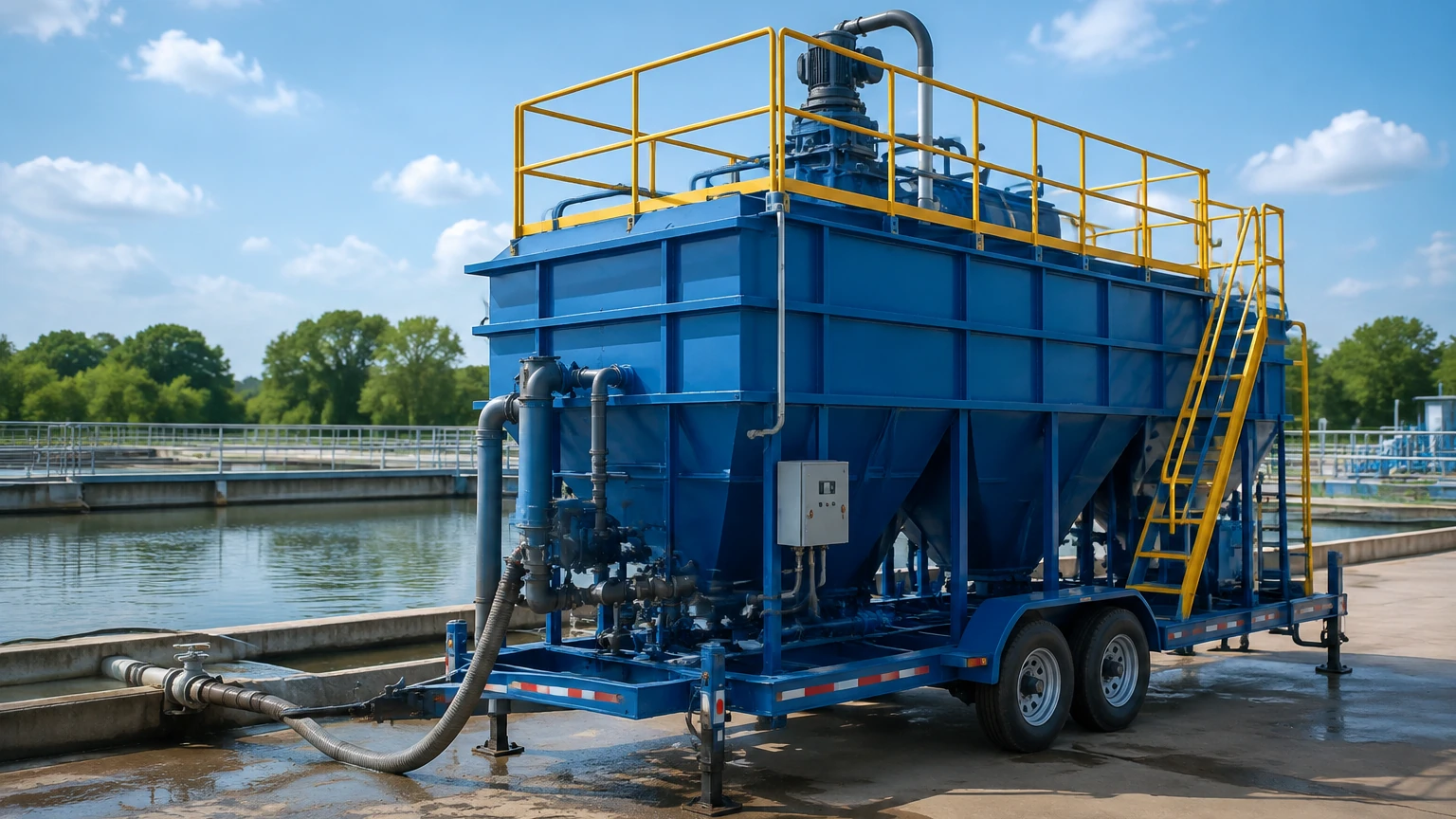
A mobile clarifier to reduce TSS is typically employed when a facility's permanent primary or secondary clarifier is offline for maintenance, or when a project generates a large volume of sediment-laden water, such as in tunneling or dredging.
The Clarification Mechanism
1. Coagulation and Flocculation: Chemicals are added to the influent to bind small particles into larger "flocs."
2. Sedimentation: The water enters the main chamber of the mobile clarifier. The velocity is reduced, allowing flocs to settle.
3. Collection: Clarified water exits through weirs at the top, while sludge collects in the bottom hopper.
To maintain a consistent effluent quality, the sludge blanket must be kept at an optimal height. If the blanket is too low, the sludge may be too thin (high water content), increasing disposal costs. If it is too high, solids may "carry over" into the effluent, defeating the purpose of using a mobile clarifier to reduce TSS.
Installation Considerations for Sensors
When integrating level meters into a mobile clarifier, several practical engineering factors must be addressed to ensure long-term reliability.
Positioning and Mounting
* Dead Zones: Every sensor has a "dead zone" or "blocking distance" near the face of the transducer where measurement is impossible. Ensure the sensor is mounted high enough that the maximum liquid level never enters this zone.
* Obstructions: Avoid mounting sensors directly above ladders, agitators, or inlet pipes. Internal structures can cause false echoes. Modern radar sensors utilize software to "mask" these fixed reflections, but physical clearance is always preferred.
* Angle of Incidence: For radar and ultrasonic sensors, the beam should be perpendicular to the liquid surface. In mobile units that may not be perfectly level on a job site, adjustable mounting brackets are recommended.
Environmental Protection
Mobile clarifiers are often exposed to the elements. Sensors should have an IP67 or IP68 rating to protect against rain and dust. Furthermore, if the wastewater contains corrosive chemicals (common in the mining or chemical industries), the wetted parts of the sensors—such as the radar antenna or hydrostatic diaphragm—should be constructed from PVDF, PTFE, or high-grade stainless steel.
Operational Limitations and Challenges
While a mobile clarifier to reduce TSS is a robust tool, certain conditions can interfere with both the clarification process and the instrumentation:
1. Entrained Air and Foam: Thick foam on the surface of the clarifier can absorb ultrasonic signals, leading to a "loss of echo." In these cases, high-frequency radar is a superior choice as it penetrates foam more effectively.
2. Rapid Density Changes: Hydrostatic level transmitters calculate level based on pressure ($P =
ho gh$). If the density ($
ho$) of the wastewater changes significantly due to varying solids loading, the level reading will drift unless recalibrated.
3. Temperature Fluctuations: Significant shifts in ambient temperature can change the speed of sound in air, affecting ultrasonic accuracy. Integrated temperature compensation in the sensor can mitigate this, but radar remains the more stable option for extreme climates.
Maintenance Guidance for Clarifier Instrumentation
To ensure the mobile clarifier continues to meet TSS discharge limits, a routine maintenance schedule for the level and interface sensors is required.
* Weekly Inspection: Check the face of ultrasonic or radar transducers for buildup of grease, condensation, or dried solids. Wipe with a soft cloth and mild detergent if necessary.
* Monthly Calibration: Verify the sensor output against a manual tape measure reading. For sludge blanket sonar, ensure the transducer head is free of biological growth or rags.
* Signal Analysis: Utilize the diagnostic features of modern digital transmitters (such as HART or Modbus protocols) to monitor signal strength. A declining signal-to-noise ratio often indicates that the sensor requires cleaning or that the process conditions have changed.
Frequently Asked Questions (FAQs)
Q: How accurate does the level measurement need to be in a mobile clarifier?
A: For most TSS reduction applications, an accuracy of ±10 mm to ±20 mm is sufficient for process control. However, if the level data is used for flow calculations in a flume or weir, higher precision (±2 mm) is often required by environmental regulations.
Q: Can I use a single sensor to measure both the liquid level and the sludge blanket?
A: Generally, no. Surface level sensors (radar/ultrasonic) look at the air-to-liquid interface. Sludge blanket sensors (sonar) are submerged and look at the liquid-to-solid interface. Both are necessary for full automation of a mobile clarifier to reduce TSS.
Q: What is the benefit of 80GHz radar over 26GHz radar for these units?
A: 80GHz radar has a much narrower beam angle (often as small as 3 degrees). This makes it easier to install in the narrow compartments or crowded tank tops common in mobile equipment, as it is less likely to hit the side walls or internal bracing.
Q: How do mobile clarifiers handle varying TSS loads?
A: The system relies on the interface sensor to detect an increase in settling solids. When the sludge blanket rises due to higher influent TSS, the sensor triggers the sludge pump to run more frequently, maintaining the balance of the system.
By integrating advanced level measurement technology with the mechanical efficiency of a mobile clarifier, industrial operators can achieve reliable TSS reduction even in challenging, temporary environments. Proper sensor selection and installation are the foundations of a successful water treatment strategy.