Ultrasonic Level Sensor Hs Code
Ultrasonic Level Sensor HS Code: A Comprehensive Guide for Industrial Procurement
In the landscape of industrial automation and process control, accurate level measurement is fundamental to operational efficiency and safety. Among the various technologies available, ultrasonic level meters have emerged as a preferred non-contact solution for a wide range of applications, from water treatment to chemical processing. However, for global procurement managers and engineers, understanding the technical specifications is only half the battle; navigating the regulatory and logistical requirements, such as the ultrasonic level sensor hs code, is equally vital for seamless international trade.
This guide provides a detailed technical overview of ultrasonic measurement principles, selection criteria, and the specific Harmonized System (HS) classifications used to categorize these instruments for customs and compliance.
Understanding Ultrasonic Level Measurement Principles
Before diving into the logistics of procurement and classification, it is essential to understand how these devices function. Ultrasonic level meters operate on the "Time-of-Flight" (ToF) principle.
The Measurement Cycle
The sensor, typically mounted at the top of a tank or vessel, contains a piezoelectric crystal that acts as a transducer. This transducer converts electrical energy into mechanical energy, emitting a high-frequency ultrasonic pulse (usually between 20 kHz and 200 kHz). The pulse travels through the air space in the tank, hits the surface of the medium (liquid or solid), and reflects back to the sensor.
The sensor then switches to "receive" mode to detect the returning echo. The distance ($D$) between the sensor and the material surface is calculated using the formula:
$$D = \frac{c \times t}{2}$$
Where:
* $c$ is the speed of sound in the medium (typically air).
* $t$ is the total time elapsed from emission to reception.
By knowing the total height of the tank ($H$), the electronics can calculate the actual level ($L$) of the material: $L = H – D$.
Temperature Compensation
The speed of sound ($c$) is not constant; it varies significantly with temperature. In air, the speed of sound increases by approximately 0.6 meters per second for every degree Celsius increase. To maintain accuracy, high-quality Ultrasonic Level Meters incorporate an integrated temperature sensor to provide real-time compensation for these fluctuations.
Navigating the Ultrasonic Level Sensor HS Code for International Trade
The Harmonized System (HS) is a standardized numerical method of classifying traded products. It is used by customs authorities around the world to identify products for the application of duties and taxes. For B2B buyers and exporters, using the correct ultrasonic level sensor hs code is critical to avoid delays, fines, or overpayment of tariffs.
Common HS Code Classifications
Industrial level measurement instruments generally fall under Chapter 90 of the HS system, which covers "Optical, photographic, cinematographic, measuring, checking, precision, medical or surgical instruments and apparatus."
Specifically, ultrasonic level sensors are usually classified under the following headings:
1. HS Code 9026.10: This is the most common classification for instruments and apparatus for measuring or checking the level of liquids. Since most ultrasonic sensors are used for liquid level monitoring, this is the primary code used globally.
2. HS Code 9026.90: This code is reserved for "Parts and accessories" of the instruments mentioned in heading 9026. If you are importing transducers or replacement electronic modules rather than a complete meter, this code may apply.
3. HS Code 9031.80: In some jurisdictions, if the ultrasonic sensor is categorized as a general measuring or checking instrument not specifically restricted to liquid levels (for example, distance measurement or solids level measurement), it might fall under this broader category.
Why Classification Accuracy Matters
* Duty Rates: Different codes carry different import duty percentages depending on the trade agreements between the exporting and importing countries.
* Regulatory Compliance: Certain codes may trigger requirements for specific certifications (such as CE, UL, or explosion-proof certifications like ATEX/IECEx).
* Statistical Tracking: Governments use these codes to track trade volumes, which can influence future trade policies.
Key Evaluation Criteria for Ultrasonic Level Meters
When selecting an ultrasonic level meter, engineers must look beyond the HS code and focus on the technical parameters that ensure reliability in a specific process environment.
1. Measurement Range
Ultrasonic sensors have both a maximum and a minimum range. The maximum range is determined by the power of the transducer and the frequency of the pulse. Lower frequencies travel further but require larger transducers. The minimum range, known as the "Blocking Distance" or "Dead Zone," is the area immediately below the sensor where measurement is impossible because the transducer is still vibrating from the emission phase when the echo returns.
2. Beam Angle
The ultrasonic pulse is emitted in a cone shape. The beam angle (typically between 5° and 12°) determines how much the pulse spreads over distance. A narrow beam angle is preferable in narrow tanks or vessels with internal obstructions like ladders or agitators to prevent false echoes.
3. Environmental Conditions
* Pressure: Standard ultrasonic sensors are designed for atmospheric pressure. High-pressure environments can change the density of the air, affecting the speed of sound and the efficiency of the transducer.
* Vapor and Steam: Dense vapors or steam can absorb the ultrasonic signal, significantly reducing the effective range or causing the signal to be lost entirely.
* Foam: Surface foam acts as an acoustic absorber. While light foam might be penetrable, heavy, thick foam often prevents the signal from reflecting back to the sensor.
Practical Selection Table for Industrial Applications
To assist in the procurement process, the following table outlines typical specifications for various industrial scenarios.
| Application Type | Recommended Range | Frequency | Key Feature Required |
| :— | :— | :— | :— |
| Small Chemical Tank | 0.25m – 5m | 50-70 kHz | Chemical resistance (PVDF/PTFE) |
| Water Reservoir | 0.5m – 15m | 30-40 kHz | High IP rating (IP68) |
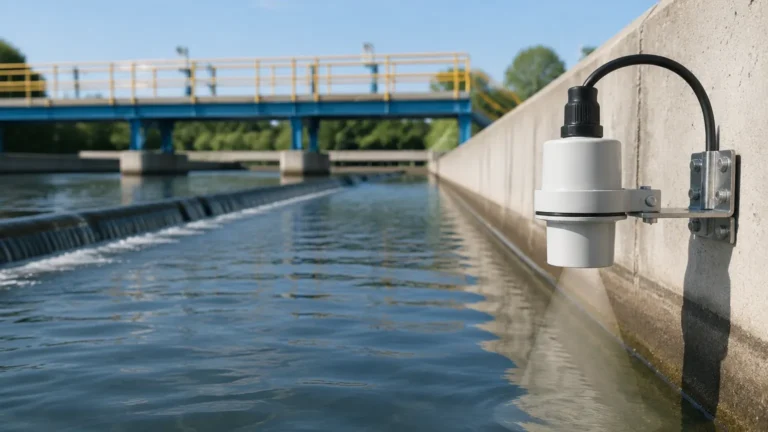
| Wastewater Channel | 0.3m – 8m | 40-50 kHz | Integrated flow calculation (Open Channel) |
| Large Silo (Solids) | 1m – 30m | 15-25 kHz | High power, dust penetration |
| Corrosive Acids | 0.25m – 10m | 40 kHz | Fully sealed, non-contact housing |

Installation Guidelines and Best Practices
Correct installation is as important as selecting the right ultrasonic level sensor hs code for your shipment. Most performance issues arise from improper mounting.
Mounting Position
* Avoid the Center: In cylindrical tanks with domed tops, do not mount the sensor in the exact center. This can create a "parabolic" effect where multiple echoes converge, leading to erratic readings.
* Avoid the Wall: Mount the sensor at a distance from the wall (typically at least 200mm) to prevent the beam from hitting the wall or being affected by buildup on the wall.
* Perpendicularity: The sensor face must be perfectly parallel to the surface of the liquid. Even a few degrees of tilt can cause the reflected signal to miss the transducer.
Overcoming Obstructions
If a tank has internal structures like pipes or cooling coils, the sensor should be positioned to avoid these. Many modern Ultrasonic Level Meters feature "False Echo Suppression" software, allowing the user to map out fixed obstructions so the sensor ignores them.
Stilling Wells
In applications with heavy surface turbulence or foam, a stilling well (a vertical pipe submerged in the liquid) can be used. The sensor is mounted at the top of the pipe, providing a calm, clean surface for the ultrasonic pulse to reflect from.
Limitations and Environmental Constraints
While ultrasonic technology is versatile, it is not a "one-size-fits-all" solution. Engineers should be aware of the following limitations:
1. Vacuum Conditions: Sound cannot travel in a vacuum. Therefore, ultrasonic sensors cannot be used in vacuum tanks.
2. High Temperature: Most standard ultrasonic transducers are limited to operating temperatures below 80°C (176°F). For higher temperatures, radar technology is usually preferred.
3. Acoustic Noise: High-frequency mechanical noise from nearby machinery can occasionally interfere with the sensor’s ability to detect the return echo.
4. Dust and Solids: While they can be used for solids, the angle of repose (the slope of the material pile) can reflect the signal away from the sensor. Furthermore, heavy dust can attenuate the signal.
Frequently Asked Questions (FAQs)
What is the universal ultrasonic level sensor hs code?
While codes can vary slightly by country, the 6-digit universal code is 9026.10. This covers instruments for measuring or checking the level of liquids. For specific national imports, extra digits are added (e.g., 9026.10.0000 in the USA or 9026.10.11 in parts of Europe).
Can I use an ultrasonic sensor for boiling liquids?
It is generally not recommended. Boiling liquids create heavy steam and surface turbulence, both of which interfere with the ultrasonic signal. In these cases, a guided wave radar or a hydrostatic pressure transmitter is a more reliable choice.
How do I maintain my ultrasonic level meter?
Because they are non-contact, maintenance is minimal. However, you should periodically check the transducer face for condensation, dust buildup, or chemical scaling. Wiping the face with a soft, damp cloth is usually sufficient.
Does the material being measured affect the accuracy?
Only if the material is a solid. For liquids, the density or conductivity does not affect the measurement, as the signal reflects off the surface. For solids, the surface texture and the angle of the pile can influence the signal strength.
What is the difference between a 2-wire and 4-wire sensor?
* 2-Wire: The power and the 4-20mA output signal share the same pair of wires. These are more energy-efficient and easier to install.
* 4-Wire: Separate pairs of wires are used for power and signal. These units can typically provide more power to the transducer, allowing for longer measurement ranges or better penetration through difficult environments.
Conclusion
Selecting the right industrial level measurement solution requires a balance of technical expertise and logistical awareness. By understanding the measurement principles of Ultrasonic Level Meters and ensuring the correct ultrasonic level sensor hs code is used during procurement, businesses can ensure both technical success and regulatory compliance. Whether you are managing water treatment facilities or complex chemical processes, these instruments provide a cost-effective, reliable, and low-maintenance solution for modern level control needs.