How to Level Switches Work
How to Level Switches Work
In industrial process control, level switches serve as the primary line of defense for overfill protection, pump control, and dry-run prevention. Unlike level transmitters that provide a continuous measurement of the fluid level, a level switch is a point-level detection device. It operates as a discrete sensor, triggering an electrical signal—typically a relay output or a transistor switch—when a specific level is reached. Understanding how to level switches work is essential for engineers and plant operators to ensure system safety and operational efficiency.
Level switches are integrated into automation systems to provide binary feedback (on/off). This guide explores the diverse physical principles behind these devices, their mechanical and electronic configurations, and the critical factors involved in selecting the right technology for specific industrial media.
Fundamental Principles of Level Detection
The operation of a level switch is based on the interaction between a sensing element and the process material. This material can be a liquid, a slurry, or a granular solid. When the material reaches the height of the sensor, it induces a physical or electrical change that the switch interprets as a "level-reached" state.
The most common technologies used in modern industrial environments include:
* Mechanical/Buoyancy: Utilizing the displacement of fluid.
* Vibratory: Utilizing changes in resonant frequency.
* Capacitive: Utilizing changes in electrical capacitance.
* Conductive: Utilizing the electrical conductivity of the liquid.
* Optical: Utilizing the refraction of light.
* Ultrasonic: Utilizing the transmission of sound waves.
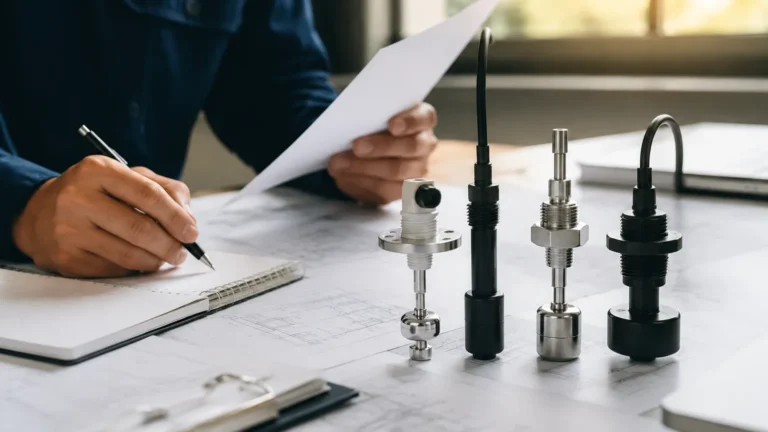
Each technology has distinct advantages depending on the viscosity, density, dielectric constant, and corrosiveness of the medium. For a comprehensive overview of available hardware, engineers can Review product options and application support to determine which Level Switches align with their specific process requirements.
Mechanical Level Switches: Buoyancy and Displacement
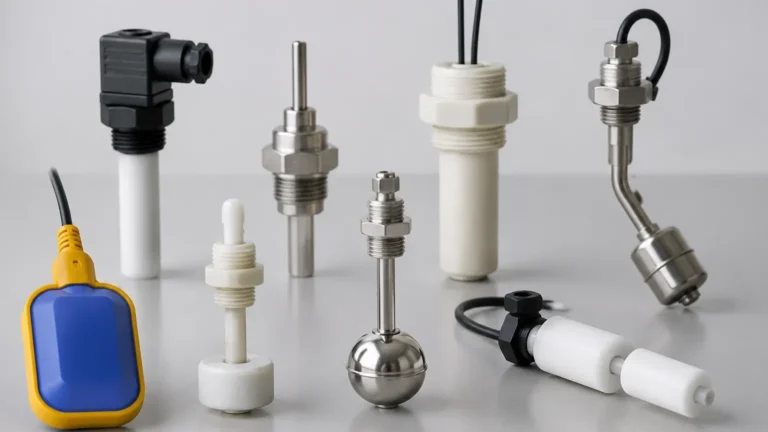
Float Level Switches
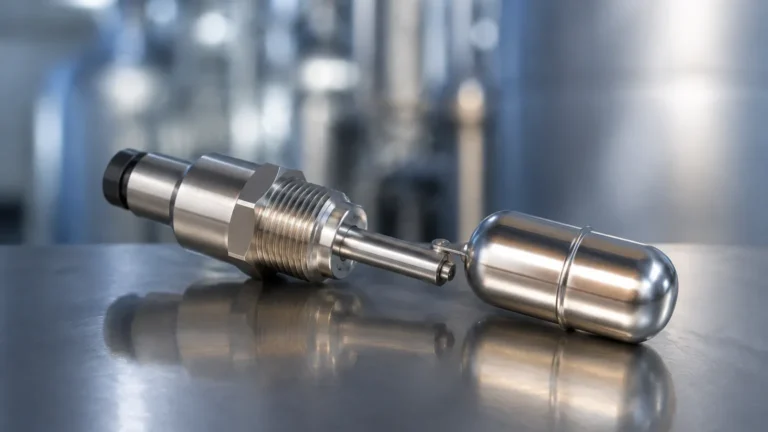
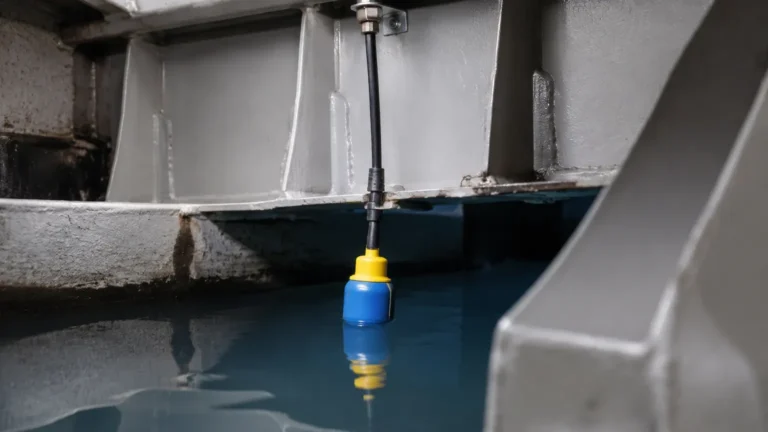
Float level switches are among the most established and cost-effective methods for liquid level detection. The principle is based on Archimedes' Law: a body immersed in a fluid is buoyed up by a force equal to the weight of the fluid displaced.
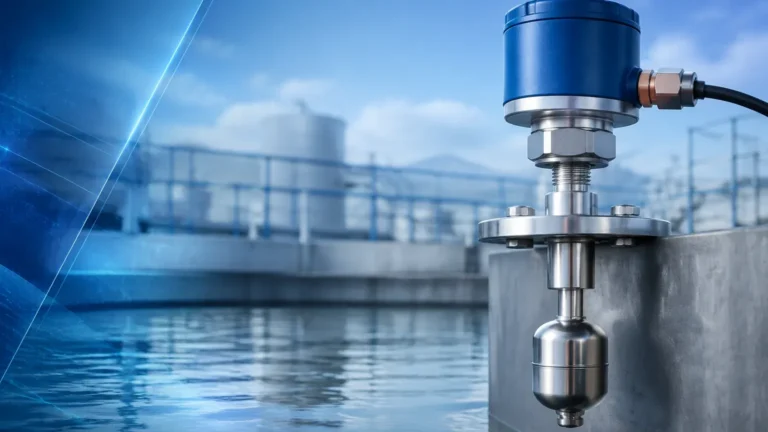
A typical float switch consists of a hollow float containing a magnet and a stationary stem containing a reed switch. As the liquid level rises, the float slides up the stem. When the magnet inside the float reaches the position of the reed switch, the magnetic field causes the reed contacts to close (or open), completing an electrical circuit.
Key Considerations:
* Density: The float must be less dense than the liquid to ensure it remains on the surface.
* Maintenance: Because they have moving parts, they are susceptible to mechanical wear and can be jammed by debris or high-viscosity liquids.
Displacement Level Switches
Unlike float switches, displacers do not float on the surface. Instead, they are weighted elements suspended by a spring. As the liquid rises and covers the displacer, the buoyant force reduces the apparent weight of the element. This change in tension on the spring triggers a microswitch. Displacers are often used in high-pressure applications or where heavy turbulence would cause a standard float to bounce excessively.
Vibrating Level Switches: The Tuning Fork Principle
Vibrating level switches, often referred to as tuning fork switches, are highly versatile and widely used for both liquids and fine-grained solids. These devices utilize a sensing element shaped like a fork that is driven to vibrate at its natural resonant frequency by a piezoelectric crystal.
How the Tuning Fork Works
1. In Air: The fork vibrates freely at its high resonant frequency (typically around 1,200 Hz to 1,400 Hz for liquids).
2. In Medium: When the liquid or solid covers the fork tines, the frequency of vibration drops due to the increased mass and damping effect of the surrounding medium.
3. Detection: An internal electronic circuit monitors this frequency shift. Once the frequency falls below a predefined threshold, the switch changes its output state.
This technology is favored because it is largely independent of the chemical properties of the fluid, such as density, conductivity, or dielectric constant. It is particularly effective for detecting the level of powders, grains, and aerated liquids.
Capacitance and Conductive Level Switches
Capacitance Level Switches
Capacitance switches operate based on the electrical property of capacitance, which is the ability of a system to store an electric charge. The sensor probe acts as one plate of a capacitor, and the vessel wall (if metallic) acts as the second plate. The medium between them acts as the dielectric.
The capacitance ($C$) is determined by the formula:
$C = \epsilon (A/d)$
Where $\epsilon$ is the dielectric constant of the material, $A$ is the area of the plates, and $d$ is the distance between them.
As the level rises and replaces air (dielectric constant $\approx 1$) with the process medium (e.g., water, dielectric constant $\approx 80$), the capacitance increases significantly. The electronics detect this change and trigger the switch. Capacitance switches are excellent for non-conductive liquids and solids, though they may require calibration for different materials.
Conductive Level Switches
Conductive switches are used exclusively with conductive liquids (e.g., water, acids, lye). They consist of two or more electrodes. When the liquid touches the electrodes, it completes a low-voltage electrical circuit. These are simple, have no moving parts, and are highly reliable for wastewater and chemical processing, provided the liquid is not prone to leaving insulating deposits on the probes.
Ultrasonic and Optical Level Switches
Ultrasonic Level Switches
Ultrasonic point-level switches use high-frequency sound waves. In a "gap" style ultrasonic switch, a pair of piezoelectric crystals is mounted across a small gap in the sensor head. One crystal transmits ultrasonic energy, and the other receives it.
* Dry State: Sound waves travel poorly through air, so the signal does not reach the receiver.
* Wet State: When liquid fills the gap, the sound waves are efficiently transmitted to the receiver, triggering the switch.
These are non-contact in terms of moving parts and are ideal for clean liquids where mechanical floats might fail.
Optical Level Switches
Optical switches utilize an infrared LED and a light receiver housed within a transparent prism.
* In Air: The infrared light is reflected internally within the prism back to the receiver.
* In Liquid: When the prism is submerged, the refractive index of the liquid allows the light to escape into the fluid rather than reflecting back. The receiver detects the loss of light and switches the output.
Optical switches are extremely compact and are often used in small tanks or laboratory equipment where space is limited.

Comparison and Selection Criteria for Industrial Applications
Selecting the correct level switch requires evaluating the physical environment and the characteristics of the media. The following table provides a general guide for technology selection:
| Technology | Media Type | Viscosity Limit | Pressure Range (Max) | Key Advantage |
| :— | :— | :— | :— | :— |
| Float | Clean Liquids | Low | 40 bar | Low cost, simple operation |
| Tuning Fork | Liquids/Solids | Medium | 64 bar | Immune to foam and bubbles |
| Capacitance | Liquids/Solids | High | 100 bar | High temperature/pressure resistance |
| Conductive | Conductive Liquids | Low | 25 bar | No moving parts, inexpensive |
| Ultrasonic | Clean Liquids | Low | 40 bar | No calibration required |
| Optical | Clean Liquids | Very Low | 50 bar | Extremely small footprint |
Critical Evaluation Factors
1. Media Density: Mechanical floats require a specific gravity (SG) difference. If the liquid density changes significantly, the float may fail to trigger.
2. Dielectric Constant: Capacitance switches require a minimum $\epsilon$ to distinguish between the "empty" and "full" states.
3. Coating and Build-up: In applications like wastewater or syrup, material may build up on the sensor. Tuning forks and capacitance switches with "active shield" technology are better suited for these environments.
4. Turbulence and Foam: Mechanical switches can be damaged by turbulence. Tuning forks are generally excellent at ignoring foam, whereas ultrasonic and optical switches may be triggered prematurely by it.
Installation Considerations and Best Practices
Correct installation is as vital as technology selection. Improper mounting can lead to false triggers or premature sensor failure.
Orientation and Positioning
* Top Mounting: Standard for float and ultrasonic switches. Ensure the probe length is correct for the desired trip point.
* Side Mounting: Common for tuning forks and optical switches. Ensure the switch is angled slightly downward if the medium is viscous to allow for drainage.
* Dead Zones: Many sensors have a "dead zone" near the mounting threads where they cannot accurately detect the level. Consult the manufacturer's technical datasheet for these dimensions.
Environmental Factors
* Agitation: If the tank has an agitator, the level switch should be installed behind a baffle or in a stilling well to prevent mechanical damage or erratic signals.
* Temperature Extremes: High-temperature processes (above 150°C) often require remote-mounted electronics or specialized cooling fins on the sensor body.
* Pressure: Ensure the process connection (NPT, BSP, or Flange) and the sensor housing are rated for the maximum possible vessel pressure, including surges.
Wiring and Safety
Most industrial level switches offer SPDT (Single Pole Double Throw) or DPDT (Double Pole Double Throw) relay outputs. In safety-critical applications, such as high-level alarms, the switch should be wired in a "normally closed" (NC) configuration. This ensures that if a wire breaks or power is lost, the system fails into an alarm state (fail-safe).
Limitations and Troubleshooting Common Issues
While level switches are robust, they are not infallible. Common issues include:
* False Alarms due to Foam: In chemical mixing tanks, foam can be thick enough to trigger ultrasonic or optical sensors. In such cases, a tuning fork or a displacer is a more reliable choice.
* Material Build-up: In cement silos or adhesive tanks, material can cake onto the sensor. For solids, a rotary paddle switch or a vibrating rod is often more effective than a standard tuning fork.
* Electromagnetic Interference (EMI): Electronic switches (capacitance and ultrasonic) can be affected by nearby heavy machinery or variable frequency drives (VFDs). Shielded cabling and proper grounding of the sensor housing are mandatory.
Troubleshooting Steps:
1. Check Power Supply: Ensure the voltage matches the sensor requirements (typically 24V DC or 110/220V AC).
2. Inspect for Coating: Clean the sensing element and observe if the switch returns to its normal state.
3. Verify Calibration: For capacitance switches, recalibrate the device with the tank empty and then full to set the sensitivity threshold.
Frequently Asked Questions
Q: Can a level switch be used for continuous level measurement?
A: No. A level switch only detects if a material has reached a specific point. For continuous measurement (e.g., 0% to 100% volume), a level transmitter (radar, ultrasonic, or hydrostatic) is required.
Q: What is the difference between a NPN and PNP output in electronic switches?
A: These refer to the type of transistor output. PNP switches provide a positive signal when triggered, while NPN switches provide a negative (ground) signal. The choice depends on the input requirements of your PLC (Programmable Logic Controller).
Q: Are there level switches suitable for explosive atmospheres?
A: Yes. Manufacturers like Welk provide explosion-proof (Ex d) or intrinsically safe (Ex i) versions of level switches designed for use in hazardous areas such as oil refineries or chemical plants.
Q: How do I handle high-viscosity liquids?
A: Avoid float switches as the liquid may prevent the float from moving. Vibrating tuning forks or heavy-duty capacitance probes are generally the best options for high-viscosity media.
By understanding the physical mechanics of how to level switches work and matching the technology to the specific environmental constraints, engineers can implement reliable level control solutions that minimize downtime and prevent costly overflows. For professional-grade instrumentation and customized OEM/ODM services, selecting a manufacturer with a proven track record in industrial automation is the final step in securing a robust measurement system.