5 Switches
5 Switches
In the landscape of industrial automation and process control, point-level detection remains a cornerstone of safety and efficiency. While continuous level measurement provides a real-time data stream of vessel contents, level switches provide the critical "on/off" signals required for overfill protection, pump control, and dry-run prevention. For engineers and facility managers, understanding the distinct operational principles of the most common technologies is essential for system reliability.
This guide examines the five most prevalent types of Level Switches used in modern industrial applications. By evaluating the mechanical and electronic principles of these five switches, stakeholders can better navigate the complexities of media characteristics, environmental constraints, and maintenance requirements.
1. Understanding the Role of Level Switches in Process Control
A level switch is a sensor designed to detect the presence or absence of a liquid, powder, or granulated solid at a specific height within a tank, silo, or pipe. Unlike continuous sensors that output a 4-20mA or digital signal representing 0-100% volume, a switch typically provides a relay output (SPDT/DPDT) or a transistor output (PNP/NPN).
The primary functions of these switches include:
* High-Level Alarm: Preventing overflows that could lead to environmental hazards or product loss.
* Low-Level Alarm: Protecting pumps from cavitation or ensuring a process does not run dry.
* Pump Control: Managing the start and stop points of a pump to maintain a specific range (often requiring at least two switching points).
* Interface Detection: Identifying the boundary between two immiscible liquids, such as oil and water.
Welk, as a professional manufacturer of industrial level measurement instruments, emphasizes that the choice between these technologies depends heavily on the physical properties of the medium, such as density, viscosity, and dielectric constant.
2. The 5 Essential Level Switch Technologies
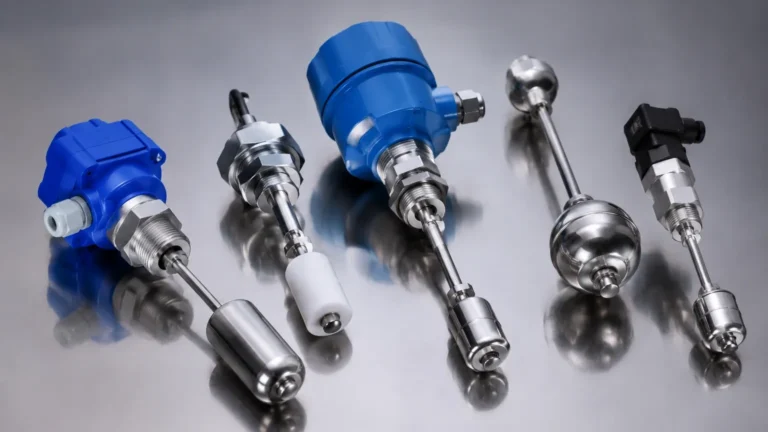
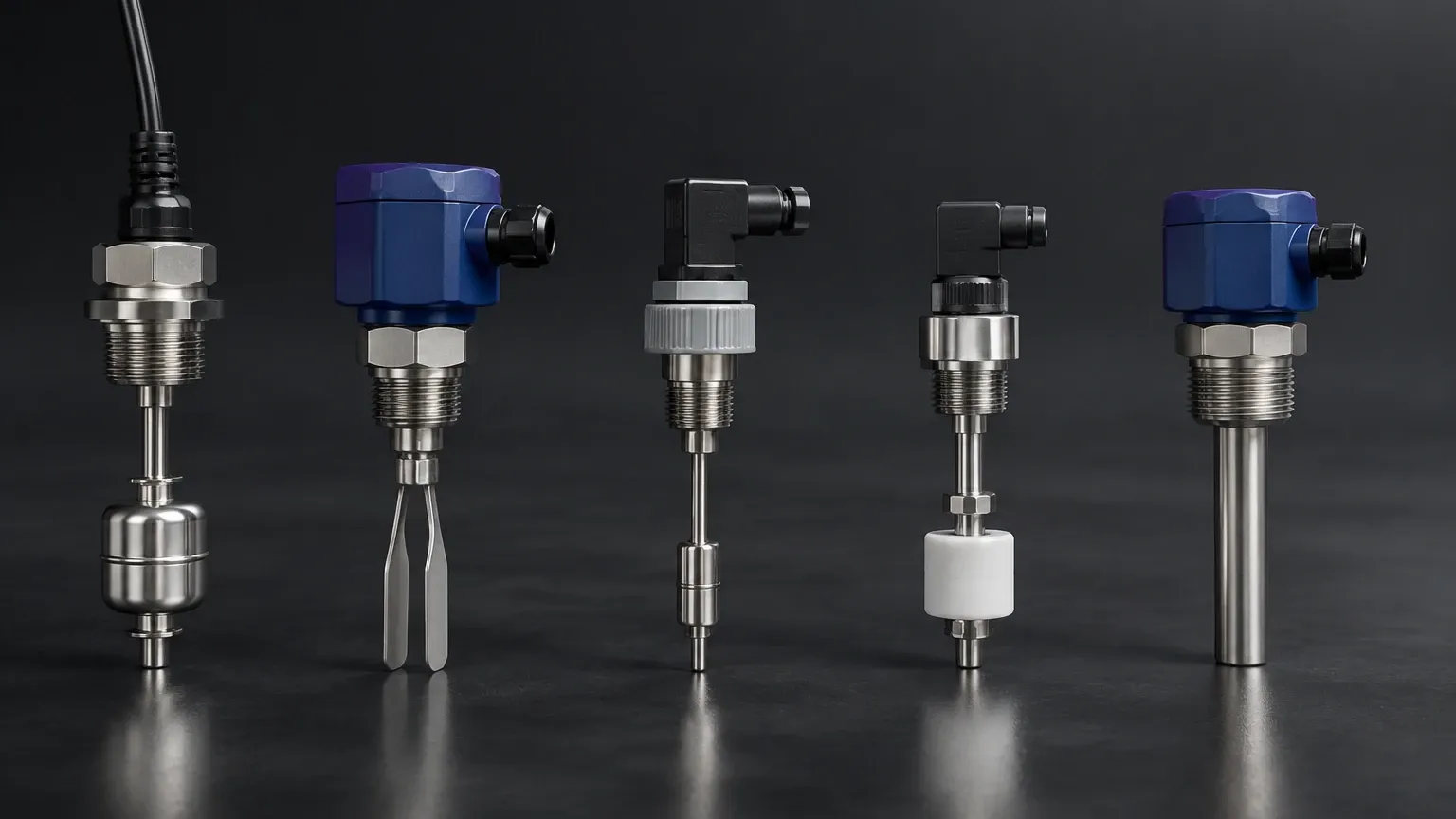
To effectively manage diverse industrial processes, engineers typically rely on five core technologies. Each has unique strengths and limitations based on its physical interaction with the material.
I. Float Level Switches
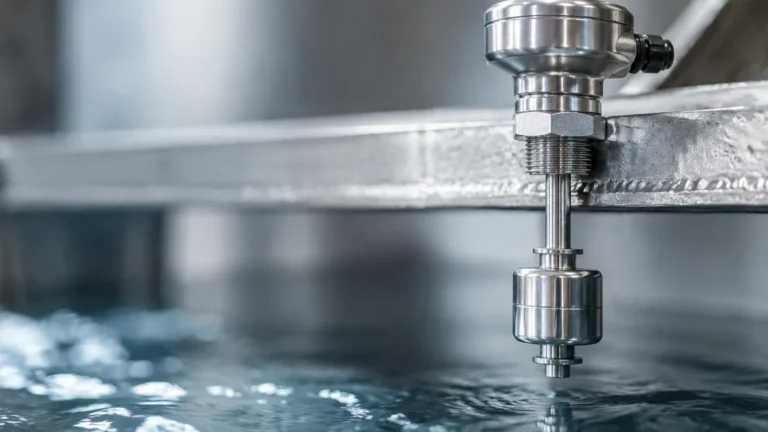
Float switches operate on the principle of buoyancy. A float containing a permanent magnet moves with the liquid level. When the float reaches a predetermined point, the magnetic field actuates a hermetically sealed reed switch located within the stationary stem.
* Best For: Clean liquids with low viscosity, such as water, oils, and chemicals.
* Advantages: Simple, low-cost, and requires no power to operate the switch itself (passive).
* Limitations: Susceptible to fouling if the liquid contains debris or is highly viscous. Mechanical movement means eventual wear over millions of cycles.
II. Tuning Fork (Vibrating) Level Switches
These switches utilize a fork-shaped sensing element that is vibrated at its natural resonant frequency by a piezoelectric crystal. When the fork is submerged in the medium, the frequency of vibration changes or stops. The internal electronics detect this shift and trigger the output.
* Best For: Both liquids and fine-grained solids (powders). They are highly effective in applications with foam or turbulence.
* Advantages: No moving parts to wear out; high reliability; unaffected by flow, bubbles, or small amounts of build-up.
* Limitations: Not suitable for extremely sticky media that can bridge the gap between the forks.
III. Capacitance Level Switches
Capacitance switches treat the sensor probe and the tank wall (or a reference probe) as two plates of a capacitor. The medium acts as the dielectric. As the level rises and covers the probe, the capacitance increases because the dielectric constant of the material is higher than that of air.
* Best For: High-temperature and high-pressure environments; powders, granules, and liquids.
* Advantages: Can be designed for non-contact measurement through non-metallic tank walls. Very robust with no moving parts.
* Limitations: Requires calibration based on the dielectric constant of the material. Performance can drift if the material composition changes significantly.
IV. Rotary Paddle Level Switches
Designed specifically for bulk solids, these switches use a low-speed motor that rotates a paddle. When the material reaches the paddle, it creates mechanical resistance (torque), which causes the motor to tilt and trigger a microswitch, simultaneously cutting power to the motor to prevent burnout.
* Best For: Silos containing grain, sand, plastic pellets, or cement.
* Advantages: Extremely robust for heavy materials; easy to install and maintain.
* Limitations: Mechanical parts are subject to wear; not suitable for liquids or very lightweight powders with low bulk density.
V. Ultrasonic Level Switches
Ultrasonic switches use a pair of piezoelectric crystals (a transmitter and a receiver) separated by a small gap. When the gap is filled with air, the ultrasonic signal is attenuated. When the gap fills with liquid, the signal is transmitted across the gap, triggering the switch.
* Best For: Highly corrosive or ultra-pure liquids where contact must be minimized.
* Advantages: No moving parts; high accuracy; works well with a wide range of liquid densities.
* Limitations: Can be affected by heavy aeration or high concentrations of suspended solids that block the ultrasonic signal.
3. Selection Criteria and Comparative Analysis
Choosing the correct switch among these 5 switches requires a systematic evaluation of the process conditions. The following table provides a quick reference for engineering selection.
| Technology | Medium Type | Max Temp (Approx.) | Max Pressure (Approx.) | Key Advantage |
| :— | :— | :— | :— | :— |
| Float | Clean Liquids | 150°C (302°F) | 40 bar (580 psi) | Cost-effective, simple |
| Tuning Fork | Liquids/Solids | 150°C (302°F) | 64 bar (928 psi) | Versatile, no calibration |
| Capacitance | Liquids/Solids | 250°C+ (482°F) | 100 bar (1450 psi) | High Temp/Pressure |
| Rotary Paddle | Bulk Solids | 80°C (176°F) | Atmospheric | Reliable for heavy solids |
| Ultrasonic | Liquids | 100°C (212°F) | 10 bar (145 psi) | Minimal maintenance |
4. Multi-Point Configuration: The Utility of 5-Switch Systems
In complex process vessels, a single switch is rarely sufficient. Many engineering designs specify a "5-switch" configuration to ensure comprehensive control and redundancy. In such a setup, five distinct switching points are established at varying heights:
1. Level 5 (High-High Alarm): The ultimate safety shut-off. This point triggers an emergency stop to prevent catastrophic overfill.
2. Level 4 (High Alarm/Pump Stop): Signals that the tank is nearly full. In a filling application, this stops the supply pump.
3. Level 3 (Mid-Level/Pump Start): Often used as a trigger to start a discharge pump or as a general process status indicator.
4. Level 2 (Low Alarm/Pump Start): Signals that the tank is nearly empty. In a filling application, this starts the supply pump.
5. Level 1 (Low-Low Alarm): The dry-run protection point. This shuts down discharge pumps to prevent mechanical damage due to lack of lubrication or cooling.
Using a combination of the technologies mentioned above—for instance, using tuning forks for the high/low alarms and float switches for the intermediate points—can provide a layered defense against sensor failure.
5. Installation and Maintenance Best Practices
To ensure the longevity of any level switch, proper installation is paramount. Engineers should consider the following factors:
* Orientation: Some switches, like rotary paddles, should be installed with a slight downward angle or protected by a baffle to prevent damage from falling material. Float switches must be installed vertically or horizontally depending on their specific design.
* Turbulence and Agitation: In tanks with mixers, switches should be installed in a stilling well or away from the direct path of the agitator to prevent mechanical stress or false triggers.
* Dead Zones: Ultrasonic switches have a "blocking distance" or dead zone near the sensor face where measurement is impossible. This must be accounted for in the vessel's top-level calculations.
* Electrical Considerations: Ensure that the contact ratings of the switch are compatible with the load (e.g., motor starter vs. PLC input). Using an intermediate relay is often recommended for high-current applications.
Maintenance should involve periodic cleaning of the sensing elements, especially in applications involving wastewater or viscous chemicals. For float switches, checking for scale build-up on the stem is critical to prevent the float from sticking.
6. Limitations and Troubleshooting
Despite their reliability, each of the 5 switches has specific failure modes:
* Build-up (Coating): Capacitance and tuning fork switches can sometimes be fooled by material build-up. Modern "active shield" capacitance probes and high-frequency tuning forks are designed to mitigate this, but heavy coating remains a challenge.
* Specific Gravity Changes: Float switches rely on the density of the liquid. If the process fluid changes from water to a light oil, the float may no longer have enough buoyancy to actuate the switch.
* Dielectric Constant: Capacitance switches may fail if the moisture content of a solid material changes drastically, as this alters the dielectric constant.
If a switch fails to trigger, the first step is to verify the supply voltage and then inspect the sensing element for physical obstruction or coating. For magnetic float switches, checking the continuity of the reed switch with a multimeter while manually moving the float is a standard diagnostic procedure.
7. Frequently Asked Questions (FAQs)
Q: Can I use a liquid tuning fork switch for solids?
A: Generally, no. Tuning forks for solids are designed with larger, more robust tines and operate at different frequencies to handle the higher damping effect of powders and granules. Always specify the medium type when ordering.
Q: What is the benefit of a non-contact capacitance switch?
A: Non-contact switches can detect levels through plastic or glass tank walls. This is ideal for highly corrosive acids or sterile environments where the sensor cannot touch the medium.
Q: How do I prevent false triggers from foam?
A: Tuning fork switches and certain ultrasonic switches are relatively immune to light foam. However, for thick, dense foam, a capacitance switch with an adjustable sensitivity or a displacement-type float switch may be more effective.
Q: Are these switches suitable for hazardous areas?
A: Yes, most of these technologies are available in explosion-proof (Ex d) or intrinsically safe (Ex i) versions. Ensure the switch carries the appropriate ATEX, IECEx, or UL certifications for your specific zone.
By carefully selecting from these five switch technologies and considering the specific needs of the application—from single-point detection to complex 5-switch safety arrays—operators can ensure a robust and reliable level control system. For detailed specifications and custom OEM/ODM solutions, professionals are encouraged to Review product options and application support to find the most cost-effective and accurate instrument for their needs.