Banjo Kazooie Water Level Switches
Banjo Kazooie Water Level Switches
In the field of industrial fluid management, the precision of point-level detection is the cornerstone of process safety and automation. While the phrase "banjo kazooie water level switches" is often associated with the interactive environmental mechanics of classic gaming—where players manipulate water heights to access new areas—the underlying logic mirrors a very real engineering challenge: sequential multi-stage level control. In industrial applications, managing water levels across distinct stages requires a robust array of sensors designed to withstand varying pressures, temperatures, and chemical compositions.
Whether managing a simple storage tank or a complex wastewater treatment facility, understanding the transition between different water elevations is critical. This guide explores the technical principles, selection criteria, and installation requirements for industrial water level switches used to achieve precise, multi-stage control.
The Logic of Sequential Level Control
In many process industries, a single high or low alarm is insufficient. Engineers often require a series of set-points to manage pumps, valves, and safety interlocks. This is where the conceptual framework of banjo kazooie water level switches translates into industrial practice. A typical multi-stage system might involve:
1. Low-Low Level (Dry Run Protection): Prevents pumps from operating when the tank is empty, avoiding cavitation and mechanical seal failure.
2. Low Level (Pump Start): Triggers the intake of water to replenish the reservoir.
3. High Level (Pump Stop): Signals that the tank has reached its optimal capacity.
4. High-High Level (Overflow Prevention): An emergency set-point that activates an alarm or closes an emergency shut-off valve.
Achieving this sequence requires the integration of reliable Level Switches that can provide discrete signals to a PLC (Programmable Logic Controller) or a simple relay circuit.
Measurement Principles for Water Level Switches
Before selecting a switch for a multi-stage water system, it is essential to understand the physical principles that govern their operation. Different environments—such as high-pressure boilers or open-air reservoirs—demand different sensing technologies.
Float Level Switches
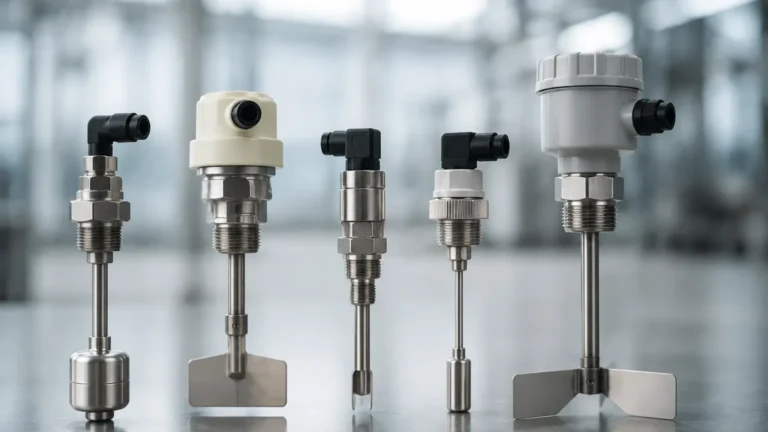
Float switches are the most traditional form of point-level detection. They operate on the principle of buoyancy. A float containing a magnet moves with the water level; when it reaches a reed switch inside the stationary stem, the magnetic field causes the switch to open or close. These are highly reliable for clean water applications and do not require external power to operate the switch itself.
Tuning Fork (Vibrating) Switches
The sensing element of a tuning fork switch vibrates at its natural resonant frequency (typically around 1200 Hz to 1400 Hz) using piezoelectric crystals. When the fork is submerged in water, the frequency shifts. The electronic circuit detects this change and converts it into a switching signal. These switches are excellent for preventing overfill in turbulent water because they are largely unaffected by flow, bubbles, or foam.
Conductivity Level Probes
Conductivity switches use the liquid itself as part of the electrical circuit. A low-voltage current is passed through a probe; when the water rises and touches the probe, the circuit is completed through the liquid to the tank wall (or a reference probe). This technology is cost-effective and ideal for conductive liquids like raw water or wastewater, though it is not suitable for deionized or ultra-pure water which lacks sufficient conductivity.
Ultrasonic Level Switches
For non-contact applications, ultrasonic switches emit high-frequency sound waves. The time it takes for the echo to return determines the distance to the water surface. While often used for continuous measurement, they can be configured as switches to trigger at specific distances. These are preferred when the water contains debris or corrosive elements that might damage contact-based sensors.
Comparison of Water Level Switching Technologies
To assist in the selection process, the following table compares the most common technologies used in industrial water management.
| Technology | Media Suitability | Max Pressure (Metric) | Max Temp (Metric) | Maintenance Level |
| :— | :— | :— | :— | :— |
| Float Switch | Clean Water | Up to 40 bar [580 psi] | 150°C [302°F] | Low |
| Tuning Fork | General Liquids/Foam | Up to 64 bar [928 psi] | 150°C [302°F] | Very Low |
| Conductivity | Conductive Liquids | Up to 25 bar [362 psi] | 100°C [212°F] | Moderate (Probe Cleaning) |
| Ultrasonic | Corrosive/Dirty Water | Atmospheric | 80°C [176°F] | Low |
| Optical | Clear Liquids | Up to 50 bar [725 psi] | 125°C [257°F] | Moderate (Lens Cleaning) |
Key Evaluation Criteria for Multi-Stage Systems
When designing a system that mirrors the complexity of banjo kazooie water level switches—where water must be held at specific, reliable intervals—engineers must evaluate several environmental factors.
Specific Gravity and Density
For buoyancy-based switches (floats), the specific gravity of the water is a primary factor. While pure water has a specific gravity of 1.0, additives like salt, glycol, or heavy sediment can alter this. If the float is not calibrated for the liquid's density, it may fail to rise or sink at the correct set-point.
Turbulence and Surface Agitation
In tanks with high-speed agitators or heavy inflow, the water surface may be unstable. Mechanical float switches may "chatter" (rapidly open and close) in these conditions. In such cases, tuning fork switches or switches with built-in time delays are recommended to ensure a stable signal.
Material Compatibility
While water is generally considered non-corrosive, industrial process water often contains chemicals for pH balancing or disinfection. 316L Stainless Steel is the standard for most industrial water applications, but for highly chlorinated water or saltwater, plastic materials like Polypropylene (PP) or Polyvinylidene Fluoride (PVDF) may be necessary to prevent pitting and corrosion.

Installation Considerations and Best Practices
Proper installation is as important as the technology itself. To ensure the longevity of the level switching system, follow these engineering guidelines:
1. Avoid Dead Zones: Ensure the switch is not installed directly under an inflow pipe. The force of the falling water can cause false readings or mechanical damage to the sensor.
2. Mounting Orientation: Some switches are designed for vertical top-mounting, while others are intended for horizontal side-mounting. Ensure the chosen orientation aligns with the switch's internal mechanism (e.g., a side-mounted float requires enough clearance for the hinge to move).
3. Wiring and Protection: Use shielded cables for electronic switches (ultrasonic or tuning fork) to prevent EMI (Electromagnetic Interference) from nearby pumps or motors. In outdoor installations, ensure the housing meets at least IP65 or IP67 standards for moisture protection.
4. Still Wells: In extremely turbulent tanks, installing the switch inside a "still well" (a vertical pipe that dampens surface movement) can significantly improve accuracy and prevent mechanical wear.
Limitations of Point-Level Switches
While point-level switches are highly effective for discrete control, they have inherent limitations. They cannot provide real-time data on the exact volume of water in a tank; they only indicate whether the water is above or below a specific point. If your application requires knowing the exact percentage of a tank's fill level at all times, a continuous level transmitter (such as radar or hydrostatic) should be used in conjunction with switches for redundant high/low alarms.
Furthermore, mechanical switches are subject to wear over millions of cycles. In mission-critical applications, it is standard practice to implement redundancy—using two different technologies (e.g., a float switch and a tuning fork) at the same high-level set-point to ensure the system fails safe.
Frequently Asked Questions (FAQ)
Q: Can I use a single switch to manage multiple water levels?
A: A standard point-level switch only monitors one level. However, multi-point float switches are available where a single stem contains multiple reed switches at different heights, allowing one device to monitor Low, Mid, and High levels.
Q: How do I handle water that has a lot of foam on the surface?
A: Foam can trick ultrasonic and optical sensors. Tuning fork switches are the best choice here, as they are designed to ignore foam and only trigger when the tines are submerged in the liquid phase.
Q: What is the difference between N.O. and N.C. in level switches?
A: N.O. (Normally Open) means the circuit is open when the switch is in its "shelf" state (usually dry). N.C. (Normally Closed) means the circuit is closed. Most industrial switches are "reversible," meaning you can flip the float or change a jumper to switch between these two modes depending on whether you want the pump to turn on or off when the level rises.
Q: Are these switches suitable for potable (drinking) water?
A: Yes, provided the materials are food-grade and have the necessary certifications (such as NSF/ANSI 61). Stainless steel 316 and certain food-grade plastics are typically used for these applications.
In conclusion, while the term "banjo kazooie water level switches" might originate from a digital landscape, the requirement for precise, sequential water level management is a fundamental reality in modern industry. By selecting the correct technology and adhering to rigorous installation standards, facilities can ensure their water systems operate with the highest levels of safety and efficiency.