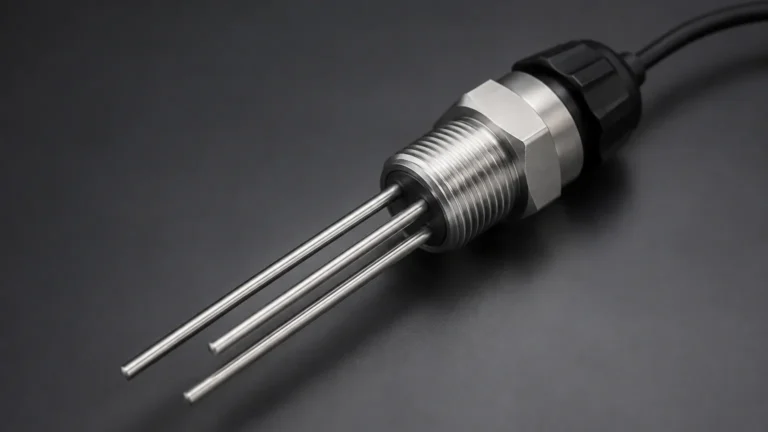
Ifm Level Switches
Ifm Level Switches
In industrial process control, point level detection serves as a critical safeguard for machinery and inventory management. Level switches are discrete sensors designed to detect the presence or absence of a medium at a specific height within a vessel, tank, or pipe. Unlike continuous level transmitters that provide a constant data stream of the volume, level switches act as triggers for automated actions, such as stopping a pump to prevent dry running or closing a valve to avoid an overflow. Among the various solutions available in the market, ifm level switches are frequently specified due to their integration of electronic sensing technologies and digital communication capabilities like IO-Link.
Understanding the technical nuances of these instruments is essential for engineers tasked with designing reliable automation systems. This guide examines the underlying measurement principles, selection criteria, and practical installation strategies for high-performance level switching.
Understanding Point Level Detection Principles
Before selecting a specific sensor, it is necessary to understand the physics governing different sensing technologies. Level switches operate on several distinct principles, each suited to specific media properties.
Impedance Spectroscopy (Frequency Sweep)
This is a primary technology used in advanced electronic level switches, such as the ifm LMT series. The sensor emits a high-frequency electromagnetic signal into the medium. By analyzing the change in the impedance (the total opposition to alternating current), the sensor can distinguish between the actual process medium and residual build-up on the sensor tip. This makes it highly effective for viscous or sticky substances like oils, sauces, or adhesives.
Capacitive Sensing
Capacitive switches measure the change in capacitance between the sensor electrode and the tank wall (or a reference electrode). When the medium covers the probe, the dielectric constant changes, altering the capacitance and triggering the switch. While versatile, standard capacitive sensors may struggle with conductive build-up, though modern versions often include compensation circuits.
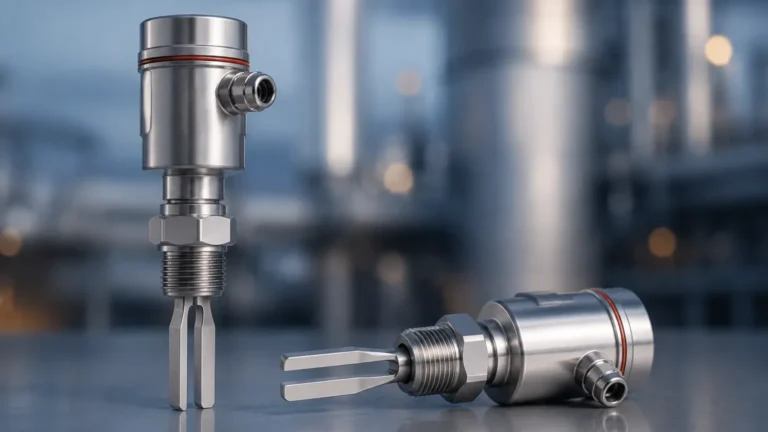
Vibratory (Tuning Fork) Principle
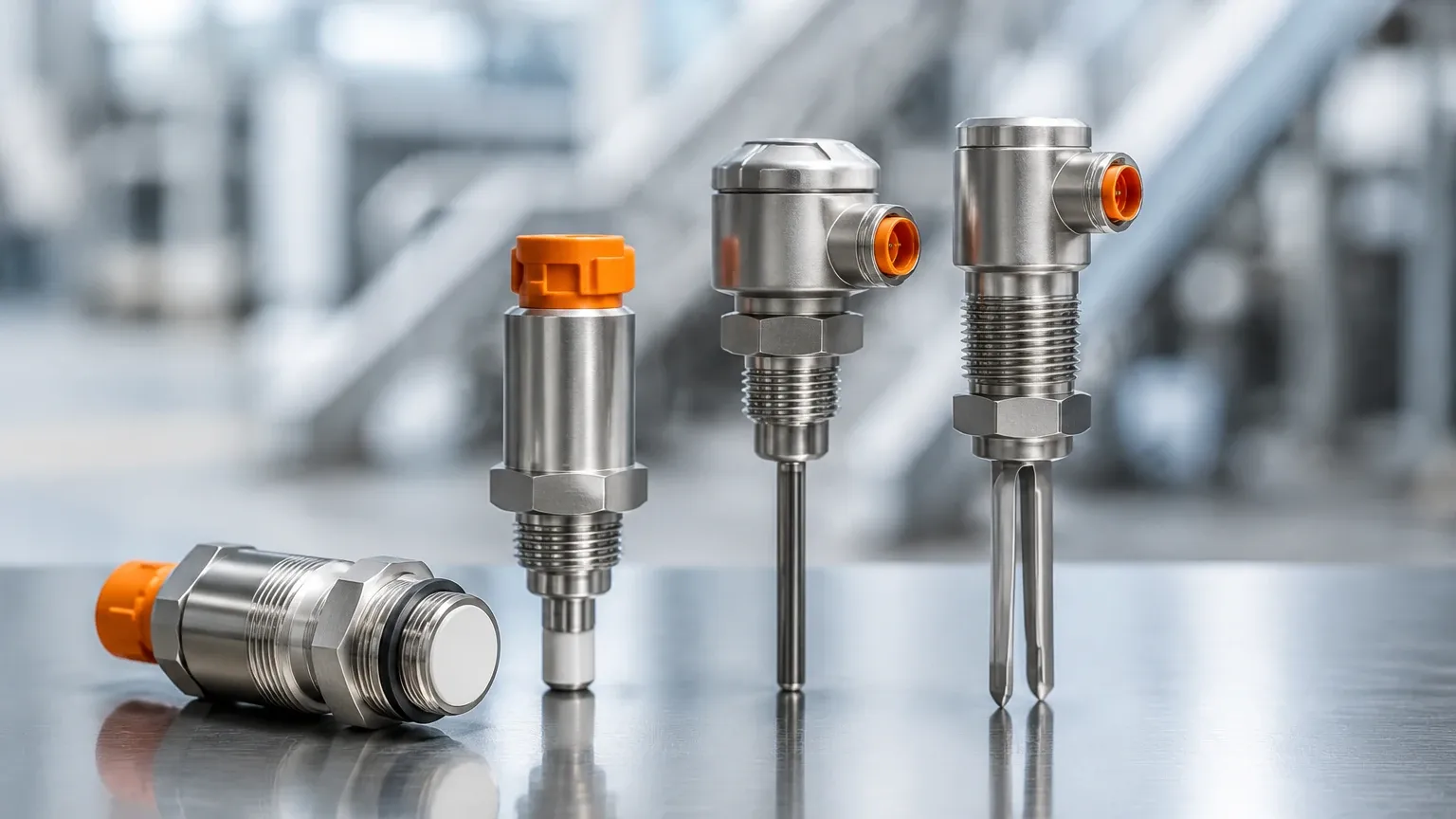
A sensing element in the shape of a tuning fork is piezoelectrically energized to vibrate at its mechanical resonance frequency in the air. When the fork is submerged in a liquid or solid, the frequency shifts or the amplitude is dampened. This change is detected by the electronics and converted into an output signal. This method is highly robust and independent of the medium's chemical properties.
Hydrostatic Point Detection
In some applications, pressure-based switches are used. When the liquid level reaches a certain height, the hydrostatic pressure exerted on a diaphragm at that depth reaches a set point, triggering the switch. This is common in deep wells or large open basins.
Technologies Used in ifm Level Switches
Ifm level switches primarily focus on electronic, non-mechanical sensing to reduce maintenance requirements and increase service life. Their product range is characterized by several key technological features:
1. Media Differentiation: Advanced sensors can be programmed to ignore foam or to specifically detect the interface between two different liquids (e.g., oil and water).
2. Hygienic Design: Many models are constructed with high-grade stainless steel (316L/1.4404) and PEEK (Polyether ether ketone) sensing tips. These materials are resistant to aggressive cleaning agents used in CIP (Clean-in-Place) and SIP (Sterilization-in-Place) processes.
3. IO-Link Integration: Most modern ifm sensors utilize IO-Link, a standardized point-to-point communication protocol. This allows for remote parameter setting, detailed diagnostics, and the transmission of process values alongside the discrete switching signal.
4. No Moving Parts: By eliminating floats or rotating paddles, these switches are immune to mechanical jamming, which is a common failure point in traditional level detection.
Selection Criteria for Industrial Applications
Choosing the correct Level Switches requires an evaluation of the physical and chemical environment. The following table provides a general framework for technology selection based on common industrial parameters.
Selection Matrix
| Application Requirement | Recommended Technology | Key Benefit |
| :— | :— | :— |
| Viscous/Sticky Media | Impedance Spectroscopy | Ignores build-up on the sensor tip |
| High-Foam Environments | Frequency Sweep / Tuning Fork | Can be tuned to detect liquid through foam |
| Bulk Solids/Grains | Vibratory (Tuning Fork) | Robust against mechanical impact |
| Non-Conductive Oils | Capacitive / Impedance | High sensitivity to low dielectric constants |
| Hygienic/Food Grade | PEEK-tipped Electronic | Flush mounting, no crevices for bacteria |
| Simple Water Tanks | Capacitive / Hydrostatic | Cost-effective and reliable |
Critical Evaluation Factors
* Dielectric Constant (εr): For capacitive and impedance-based switches, the medium must have a dielectric constant high enough to be detected. Water has a high εr (~80), while oils are low (~2).
* Operating Pressure: Ensure the sensor housing and process connection can withstand the maximum system pressure, often rated up to 40 bar or higher for industrial models.
* Temperature Range: Process temperatures in chemical or food industries can exceed 100°C. Sensors must be rated for these peaks, especially during sterilization cycles.
Installation and Mounting Best Practices
Proper installation is as critical as sensor selection. Incorrect mounting can lead to false triggers or premature sensor failure.
Orientation and Positioning
* Horizontal vs. Vertical: Most electronic level switches can be mounted in any orientation. However, for viscous media, a horizontal mount with a slight downward angle is often preferred to allow the medium to drain off the sensor tip.
* Dead Zones: Avoid installing switches in "dead zones" where the medium might become trapped, or near the inlet where turbulence and splashing can cause intermittent switching.
* Pipe Diameter: When installing in small-diameter pipes, ensure the sensor tip does not obstruct the flow or touch the opposite wall, which could cause interference.
Process Connections
Industrial level switches utilize various connection types, including G threads (e.g., G 1/2, G 1), NPT threads, and hygienic clamps (Triclamp). It is vital to use the correct sealing method. For hygienic applications, flush-mount welding adapters are used to ensure there are no recesses where product can stagnate.
Wiring and Configuration
Most switches offer PNP/NPN output options. With the advent of IO-Link, many sensors can be configured via software (such as ifm’s moneo or LR DEVICE). This allows the user to set the "switch point" and "reset point" (hysteresis) digitally, providing much greater precision than manual potentiometers.
Limitations and Operational Risks
While electronic ifm level switches are highly reliable, certain conditions can challenge their performance:
* Extreme Turbulence: In tanks with high-speed agitators, the physical force of the liquid can damage long probes or cause rapid "chattering" of the switch. In these cases, a damping delay should be programmed into the sensor output.
* Heavy Coating: Although impedance spectroscopy is designed to ignore build-up, an extremely thick, dry crust of material may eventually bridge the sensor to the tank wall, leading to a false positive. Regular inspection in such applications is recommended.
* Gas Bubbles: In some capacitive applications, large gas bubbles passing the sensor tip may be interpreted as a drop in level. Adjusting the sensitivity or using a vibratory fork can mitigate this.
* Material Compatibility: Always verify that the wetted materials (e.g., FKM, EPDM, PEEK) are chemically compatible with the process fluid to prevent seal degradation.
Frequently Asked Questions (FAQ)
Q: Can ifm level switches detect the interface between oil and water?
A: Yes. Certain models using impedance spectroscopy can be calibrated to trigger only when the sensor contacts a medium with a specific dielectric range, allowing them to distinguish between oil and water layers.
Q: Do these sensors require regular calibration?
A: Most electronic switches are factory-calibrated for standard media. However, for very specific or difficult media, a "teach-in" process may be required during commissioning. Once set, they typically do not drift and do not require routine recalibration like mechanical switches.
Q: Are there versions available for explosive atmospheres?
A: Yes, many level switches are available with ATEX or IECEx certifications for use in hazardous areas where flammable gases or dusts are present.
Q: How does IO-Link benefit level switching?
A: IO-Link allows the sensor to report its internal temperature, the quality of the signal, and the actual process value (dielectric change). This data can be used for predictive maintenance—for example, detecting when a sensor is starting to get coated before it actually fails.
Conclusion
Selecting the right level switch is a foundational step in ensuring process safety and efficiency. Ifm level switches offer a modern, solid-state alternative to traditional mechanical floats, providing enhanced durability and data integration through IO-Link. By understanding the specific requirements of the medium—such as viscosity, conductivity, and the potential for foam—engineers can implement a detection solution that minimizes downtime and maintenance costs. For a broader range of industrial measurement tools, including radar and ultrasonic options, professionals should evaluate the full spectrum of Level Switches to find the optimal match for their specific application environment.