Liquid Level Switches Pressure Sensors & Switches
Liquid Level Switches Pressure Sensors & Switches
In the landscape of industrial automation, the ability to accurately detect and manage the presence of liquids within tanks, vessels, and pipelines is fundamental to operational safety and efficiency. Engineers and plant managers frequently evaluate two primary technologies for these tasks: discrete level switches and hydrostatic pressure sensors. While both serve to monitor fluid levels, they operate on distinct physical principles and offer different advantages depending on the application environment.
This guide explores the technical nuances of liquid level switches pressure sensors & switches, providing a comprehensive reference for selecting the appropriate technology for water treatment, chemical processing, and oil and gas applications.
Understanding the Measurement Principles
Before selecting hardware, it is essential to understand how these devices interpret the physical state of a liquid. Level measurement is generally categorized into point level detection and continuous level measurement.
Point Level Detection (Level Switches)
Point level detection is binary; it determines whether a liquid has reached a specific height. When the liquid contacts the sensing element, the device triggers a switch (normally open or normally closed). Common technologies include:
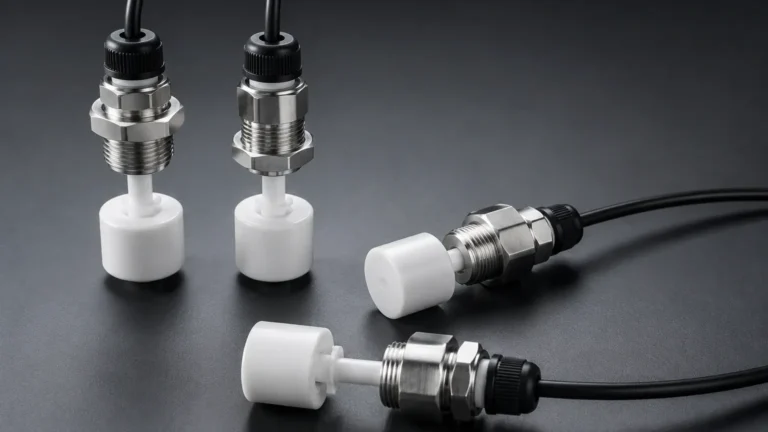
* Buoyancy (Float): Uses a float containing a magnet that moves with the liquid level to actuate a reed switch.
* Vibration (Tuning Fork): A fork vibrates at its resonant frequency in air. When submerged in liquid, the frequency shifts, triggering the output.
* Conductivity: Relies on the electrical conductivity of the liquid to close a circuit between two electrodes.
* Capacitance: Measures the change in capacitance between an electrode and the tank wall as liquid displaces air.
Hydrostatic Pressure Measurement
Pressure-based level measurement relies on the principle that the pressure at the bottom of a liquid column is directly proportional to the height of that column and the density of the fluid. The formula used is $P = \rho \cdot g \cdot h$, where $P$ is pressure, $\rho$ is fluid density, $g$ is gravity, and $h$ is the height of the liquid. By measuring the hydrostatic pressure, a sensor can provide a continuous level reading, which can then be used to trigger multiple virtual switch points via a controller or PLC.
Types of Liquid Level Switches
Industrial Level Switches are designed for ruggedness and reliability. They are often the first line of defense in overfill prevention or pump dry-run protection.
1. Magnetic Float Switches
Magnetic float switches are among the most common and cost-effective solutions. They consist of a hollow float that slides along a stem. As the float rises with the liquid, an internal magnet actuates a reed switch located inside the stem. These are ideal for clean liquids but can struggle with viscous fluids or media containing particulates that might jam the float.
2. Vibrating Level Switches (Tuning Forks)
Vibrating switches are highly versatile. Because they do not rely on buoyancy or electrical conductivity, they are unaffected by bubbles, foam, or changes in the liquid's dielectric constant. They are frequently used in the chemical industry for high-level alarms in turbulent tanks. Welk tuning fork switches are engineered to resist coating and buildup, ensuring long-term reliability in demanding environments.
3. Optoelectronic Switches
These switches use an infrared LED and a light receiver. In air, the light reflects within a prism at the sensor tip. When liquid covers the prism, the light is refracted into the liquid, and the receiver detects the drop in intensity. These are compact and excellent for leak detection in double-walled pipes or small vessels.
Hydrostatic Pressure Sensors as Level Switches
In many modern systems, a liquid level switches pressure sensors & switches configuration is used to provide both a continuous level display and discrete switching actions. A pressure transmitter installed at the bottom of a tank (either submerged or via a side-mounted flange) sends a 4-20mA or digital signal to a process controller.
Advantages of Pressure-Based Switching
* Adjustable Setpoints: Unlike a mechanical float switch, which is fixed at a specific height, the "switch points" for a pressure sensor can be programmed and adjusted remotely via software.
* No Moving Parts: Submersible pressure transducers have no external moving components, reducing the risk of mechanical failure in slurries or wastewater.
* Density Compensation: While pressure sensors are sensitive to density changes, modern digital systems can compensate for temperature-induced density fluctuations to maintain accuracy.
Selection Criteria for Liquid Level Switches and Pressure Sensors
Choosing between a discrete switch and a pressure-based sensor requires an analysis of the media, the vessel, and the required output. Use the following table as a general engineering reference:
| Feature | Float Level Switch | Tuning Fork Switch | Pressure Sensor (Hydrostatic) |
| :— | :— | :— | :— |
| Measurement Type | Point Level | Point Level | Continuous (with switch points) |
| Media Viscosity | Low | Low to Medium | Low to High |
| Presence of Foam | May cause false trips | Excellent resistance | Generally ignored (measures mass) |
| Installation | Top or Side mount | Side or Top mount | Bottom or Submerged |
| Moving Parts | Yes | No (Vibrating) | No |
| Cost | Low | Moderate | Moderate to High |
| Maintenance | High (cleaning floats) | Low | Low (periodic calibration) |
Key Considerations:
1. Media Compatibility: Ensure the wetted materials (316L Stainless Steel, PTFE, PP, or PVDF) are compatible with the process fluid, especially in corrosive chemical applications.
2. Process Temperature and Pressure: Mechanical switches have specific ratings for maximum pressure (e.g., 40 bar) and temperature (e.g., 150°C). Exceeding these can lead to seal failure or sensor drift.
3. Tank Geometry: In tall, narrow tanks, a submersible pressure sensor is often easier to install than a long-stemmed multi-point float switch.

Installation and Engineering Best Practices
Proper installation is critical to the longevity of any level instrument. Errors in placement can lead to "chattering" (rapid cycling of the switch) or false alarms.
Positioning and Turbulence
Avoid installing level switches or pressure sensors directly in the path of the tank's fill stream. The kinetic energy of the incoming liquid can cause mechanical damage or create localized pressure spikes that result in inaccurate readings. If turbulence is unavoidable, use a stilling well—a vertical pipe with vent holes—to dampen the liquid's movement around the sensor.
Electrical and Safety Considerations
* Contact Protection: For mechanical reed switches, always use a relay to handle high-current loads. Directly switching a heavy pump motor through a small reed switch will cause the contacts to weld shut.
* Intrinsic Safety: In hazardous areas (Oil & Gas), ensure the devices are ATEX or IECEx certified. Use intrinsic safety barriers to limit the energy available for ignition.
* Cable Venting: Submersible pressure sensors require a vented cable to allow the internal sensor to reference atmospheric pressure. Ensure the vent tube is protected from moisture and debris by using a desiccant filter.
Common Challenges and Limitations
While robust, neither technology is a "one-size-fits-all" solution. Understanding limitations prevents field failures.
* Buildup and Coating: In applications like wastewater treatment, fats, oils, and grease (FOG) can build up on tuning forks or floats. Periodic cleaning is required unless a non-contact technology like radar is used.
* Vented vs. Sealed Tanks: Hydrostatic pressure sensors measure the weight of the liquid plus the air pressure above it. In a sealed tank, you must use a differential pressure (DP) sensor to subtract the headspace pressure, or the level reading will be incorrect.
* Specific Gravity Fluctuations: If the process involves mixing different liquids (e.g., oil and water), the density changes. A pressure sensor calibrated for water will provide an incorrect level reading for oil unless the density is updated in the controller.
Frequently Asked Questions (FAQ)
Q: Can I use a pressure switch for level control in a pressurized tank?
A: Yes, but you must use a differential pressure switch. This device measures the difference between the bottom pressure and the headspace pressure to isolate the hydrostatic head of the liquid.
Q: Why is my tuning fork switch vibrating even when the tank is empty?
A: Tuning forks are designed to vibrate in air. The switch triggers when the vibration stops or changes frequency due to liquid immersion. If it triggers while empty, check for heavy material buildup or internal electronic failure.
Q: How often should I calibrate a hydrostatic level transmitter?
A: For most industrial applications, an annual calibration check is recommended. However, in high-precision chemical dosing, semi-annual checks may be necessary to account for sensor drift.
Q: Are level switches suitable for hygienic food and beverage applications?
A: Yes, provided they feature hygienic process connections (like Tri-Clamp) and are made from FDA-approved materials with high-surface-finish polish (Ra < 0.8 μm).
Conclusion
Selecting between liquid level switches pressure sensors & switches depends on whether your process requires simple high/low alarms or sophisticated, continuous monitoring. For basic overfill protection, a dedicated vibrating or float-based level switch offers the highest reliability with the simplest integration. For applications requiring variable setpoints and detailed inventory management, hydrostatic pressure sensors provide a flexible, solid-state alternative.
By carefully evaluating fluid density, tank pressure, and environmental conditions, engineers can implement a level measurement strategy that minimizes downtime and maximizes safety. For specific technical specifications and model selection, consulting with a specialized manufacturer like Welk ensures the instrument is perfectly matched to the industrial application.
Download Liquid Level Switches Pressure Sensors & Switches as a PDF