Level Switch Finetek
Level Switch Finetek
In industrial process control, the reliable detection of material levels is fundamental to operational safety and efficiency. Whether managing bulk solids in a silo or liquids in a chemical reactor, point level detection prevents overfills, protects pumps from dry running, and automates replenishment cycles. Among the established names in this field, the level switch Finetek range represents a significant portion of the global market for point level instrumentation.
This guide provides a technical overview of the measurement principles employed by these devices, compares different technologies, and offers practical engineering advice for selecting and installing Level Switches in diverse industrial environments.
Understanding Level Switch Measurement Principles
Before selecting a specific level switch Finetek model, it is essential to understand the physics behind the various sensing technologies. Level switches are "point level" sensors, meaning they do not provide a continuous 0-100% reading but instead trigger a discrete output (relay or transistor) when the material reaches a specific height.
1. Rotary Paddle Principle
Commonly used for bulk solids, the rotary paddle switch operates using a low-speed synchronous motor that rotates a plastic or stainless steel paddle. When the material reaches the paddle, it creates a mechanical resistance that stalls the motor. This stall triggers a microswitch to change state. Once the material level drops, a spring returns the motor to its original position, and rotation resumes.
2. Vibrating Probe (Tuning Fork) Principle
The vibrating level switch utilizes piezoelectric crystals to vibrate a fork or a single rod at its natural resonant frequency in the air. When the probe is covered by a liquid or solid, the frequency or amplitude of the vibration changes. The internal electronics detect this shift and convert it into a switching signal. This technology is highly resistant to changes in material density, temperature, and pressure.
3. RF-Capacitance Principle
Capacitance switches measure the electrical capacitance between a sensing electrode and the tank wall (or a reference electrode). Every material has a dielectric constant. When the material replaces the air around the probe, the capacitance increases. Modern RF (Radio Frequency) admittance switches, often found in the level switch Finetek catalog, use high-frequency signals to ignore material buildup on the probe, which is a common cause of false alarms in standard capacitance sensors.
4. Float and Displacement Principle
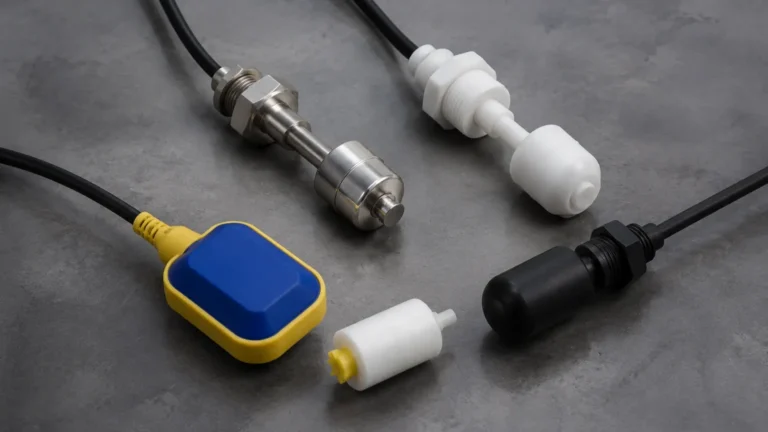
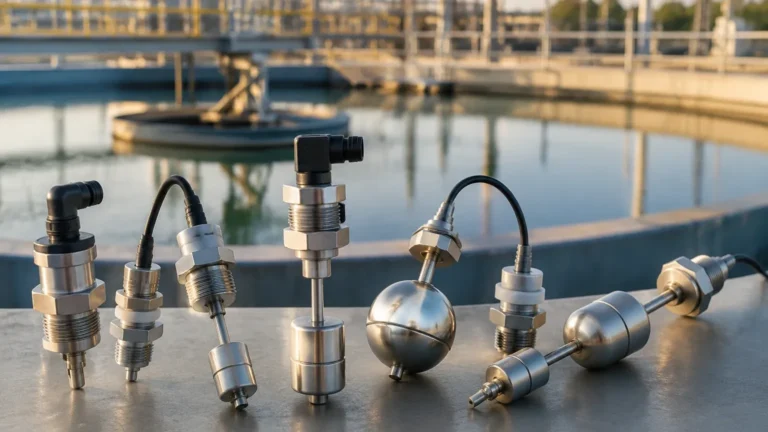
For liquid applications, buoyancy-based switches remain a staple. A magnetic float rises and falls with the liquid level along a stem. Inside the stem, reed switches are positioned at specific points. As the magnet in the float passes the reed switch, it closes or opens the circuit. Displacement switches work similarly but use a heavy weight (displacer) that becomes lighter when submerged, triggering a spring-loaded mechanism.
Key Types of Finetek Level Switches
Finetek produces a broad spectrum of sensors tailored to specific industrial needs. Understanding the series designations helps in identifying the right tool for the job.
* SE Series (Rotary Paddle): These are the workhorses of the plastics, food, and mining industries. They are available with various paddle shapes to accommodate materials ranging from lightweight powders to heavy ores.
* SC Series (Vibrating Probe): Available in tuning fork and single-rod designs. The tuning fork is ideal for liquids and fine-grained solids, while the single rod is preferred for larger granules where material might otherwise bridge between the tines of a fork.
* SA Series (RF-Capacitance): These are designed for complex applications where the material may be sticky or prone to coating the sensor. They are frequently used in chemical processing and wastewater treatment.
* FC/FD Series (Float Switches): These range from small plastic units for OEM equipment to heavy-duty stainless steel versions for high-temperature oil and water tanks.
Selection Criteria for Industrial Applications
Selecting the correct level switch Finetek requires a thorough analysis of the process conditions. Choosing the wrong technology often leads to premature failure or frequent false alarms.
Material Characteristics
* State: Is it a liquid, powder, or granule? Liquids usually require float or vibrating fork switches. Solids require rotary paddles or capacitance probes.
* Density: For vibrating switches, there is a minimum density requirement (measured in g/cm³ or kg/m³). For example, very light powders like fumed silica may not provide enough damping for a standard vibrating fork.
* Dielectric Constant: If using capacitance switches, the material must have a dielectric constant significantly different from air (which is 1.0).
* Corrosivity: Ensure the wetted parts (304 SS, 316 SS, or PTFE coating) are compatible with the process medium.
Process Environment
* Temperature: Standard switches often handle up to 80°C (176°F). High-temperature versions with extended cooling necks are required for processes reaching 200°C (392°F) or higher.
* Pressure: Tank pressure affects the seal integrity. Check the bar (PSI) rating of the mounting connection.
* Vibration: Heavy mechanical vibration in a silo can damage the internal electronics of some switches. In such cases, remote-mounted electronics may be necessary.
Technical Comparison and Selection Table
The following table provides a general comparison of the most common level switch technologies used in the industry.
| Technology | Suitable Medium | Key Advantage | Limitation | Typical Max Temp |
| :— | :— | :— | :— | :— |
| Rotary Paddle | Bulk Solids | Low cost, simple | Mechanical wear | 200°C (392°F) |
| Vibrating Fork | Liquids/Solids | No calibration needed | Susceptible to bridging | 150°C (302°F) |
| RF-Capacitance | Liquids/Slurries | Handles buildup | Requires calibration | 250°C+ (482°F+) |
| Magnetic Float | Clean Liquids | No power required | Moving parts can jam | 120°C (248°F) |
| Conductivity | Conductive Liquids | Very low cost | Only for conductive media | 100°C (212°F) |

Installation Best Practices and Maintenance
Correct installation is as important as selecting the right technology. Even the highest quality level switch Finetek will fail if positioned incorrectly.
Positioning and Orientation
1. Avoid the Fill Stream: Never install a level switch directly in the path of the incoming material. The force of the falling material can damage paddles or cause false triggers in vibrating probes. If the location is unavoidable, install a protective baffle or shield above the sensor.
2. Side vs. Top Mount: Rotary paddles and vibrating probes are often side-mounted. Ensure the probe is angled slightly downward (about 15 to 20 degrees) to prevent material from collecting on the mounting boss.
3. Nozzle Length: For RF-Capacitance switches, ensure the inactive section of the probe extends past the mounting nozzle and into the tank. If the active sensing element is inside a metal nozzle, it will detect the nozzle wall as a permanent "high" level.
Electrical Considerations
* Cable Glands: Always point cable glands downward to prevent moisture from entering the housing via the cable. Use a "drip loop" in the wiring.
* Grounding: For capacitance switches, a solid ground connection to the metal tank wall is mandatory. In non-metallic tanks, a ground rod or reference electrode must be used.
Maintenance Schedule
While many modern level switches are advertised as maintenance-free, a periodic inspection is recommended:
* Visual Check: Inspect for physical damage to paddles or probes.
* Buildup Removal: Even with "anti-coating" technology, extreme buildup should be cleaned periodically to ensure maximum sensitivity.
* Seal Integrity: Check the housing gaskets and cable entries for signs of moisture or chemical ingress.
Addressing Common Challenges and Limitations
No single technology is a universal solution. Engineers must be aware of the specific limitations associated with level switch Finetek applications.
1. Material Bridging: In vibrating fork sensors, sticky solids can bridge the gap between the two tines. Once a bridge is formed, the sensor will indicate a "full" state even after the tank is empty. A single-rod vibrating probe or a rotary paddle is usually a better choice for these materials.
2. Turbulence and Foam: In liquid tanks with high-speed agitators, float switches can bounce, causing "chatter" in the relay. In these environments, a vibrating fork with a built-in time delay or a capacitance switch with a damping filter is preferred. Foam can also be problematic; some switches detect the top of the foam, while others detect only the liquid. RF-admittance switches can often be tuned to ignore light foam.
3. Vacuum Applications: In vacuum-distillation or pneumatic conveying, the seal at the mounting point is critical. Ensure the switch is rated for vacuum service to prevent air leaks into the process.
Frequently Asked Questions (FAQs)
Q: Can a rotary paddle switch be used for liquids?
A: No. The resistance of most liquids is not sufficient to stall the motor of a rotary paddle switch. These are strictly for bulk solids.
Q: How do I calibrate a capacitance level switch?
A: Most level switch Finetek capacitance models feature a sensitivity potentiometer. Usually, you set the sensitivity with the tank empty and then verify the switch triggers when the material covers the probe. Some advanced models feature "Auto-Calibration" buttons.
Q: What is the difference between a PNP and NPN output?
A: These are types of transistor outputs used in DC circuits. PNP (Source) switches the positive side of the load, while NPN (Sink) switches the negative side. Ensure your PLC input card matches the switch output type.
Q: Can I use a standard level switch in an explosive atmosphere?
A: Only if it is specifically rated as "Explosion Proof" (Ex d) or "Intrinsically Safe" (Ex ia). Always check the ATEX, IECEx, or UL certifications on the product label before installing in hazardous areas.
Conclusion
Choosing the right level switch Finetek involves more than just matching a part number; it requires a deep understanding of the interaction between the sensor and the process material. By following the principles of measurement and the installation guidelines outlined above, engineers can ensure long-term reliability and minimize downtime. For those seeking high-performance alternatives or customized solutions for challenging industrial environments, Welk offers a comprehensive range of level measurement instruments designed to meet the rigorous demands of modern automation.
To explore more technical options and find the right fit for your specific application, you can Review product options and application support to ensure your facility operates with the highest level of precision and safety.