Level Switch Vibrating Fork Type
Level Switch Vibrating Fork Type
In the landscape of industrial process control, point level detection serves as a critical safeguard for overfill prevention, pump protection, and inventory management. Among the various technologies available, the level switch vibrating fork type—often referred to as a tuning fork switch—has emerged as a preferred solution due to its high reliability and minimal maintenance requirements. Unlike mechanical float switches that rely on moving parts prone to jamming, or ultrasonic sensors that can be affected by foam and vapor, vibrating fork sensors utilize stable electronic resonance to detect the presence or absence of a medium.
This guide provides a technical overview of the measurement principles, selection criteria, and installation best practices for vibrating fork level switches in both liquid and solid applications.
Measurement Principles of Vibrating Fork Technology
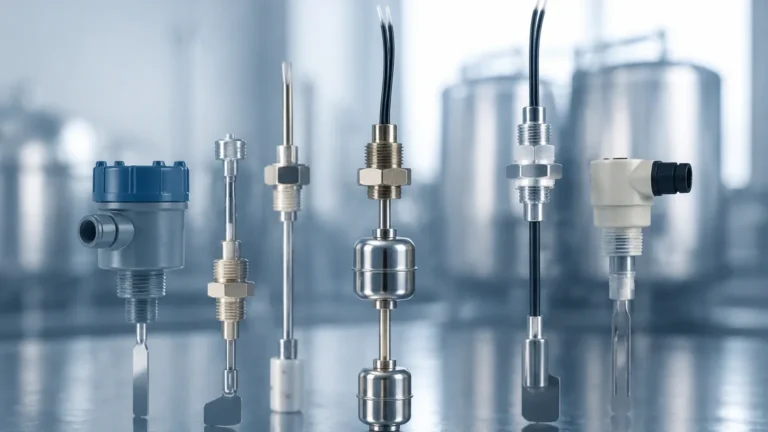
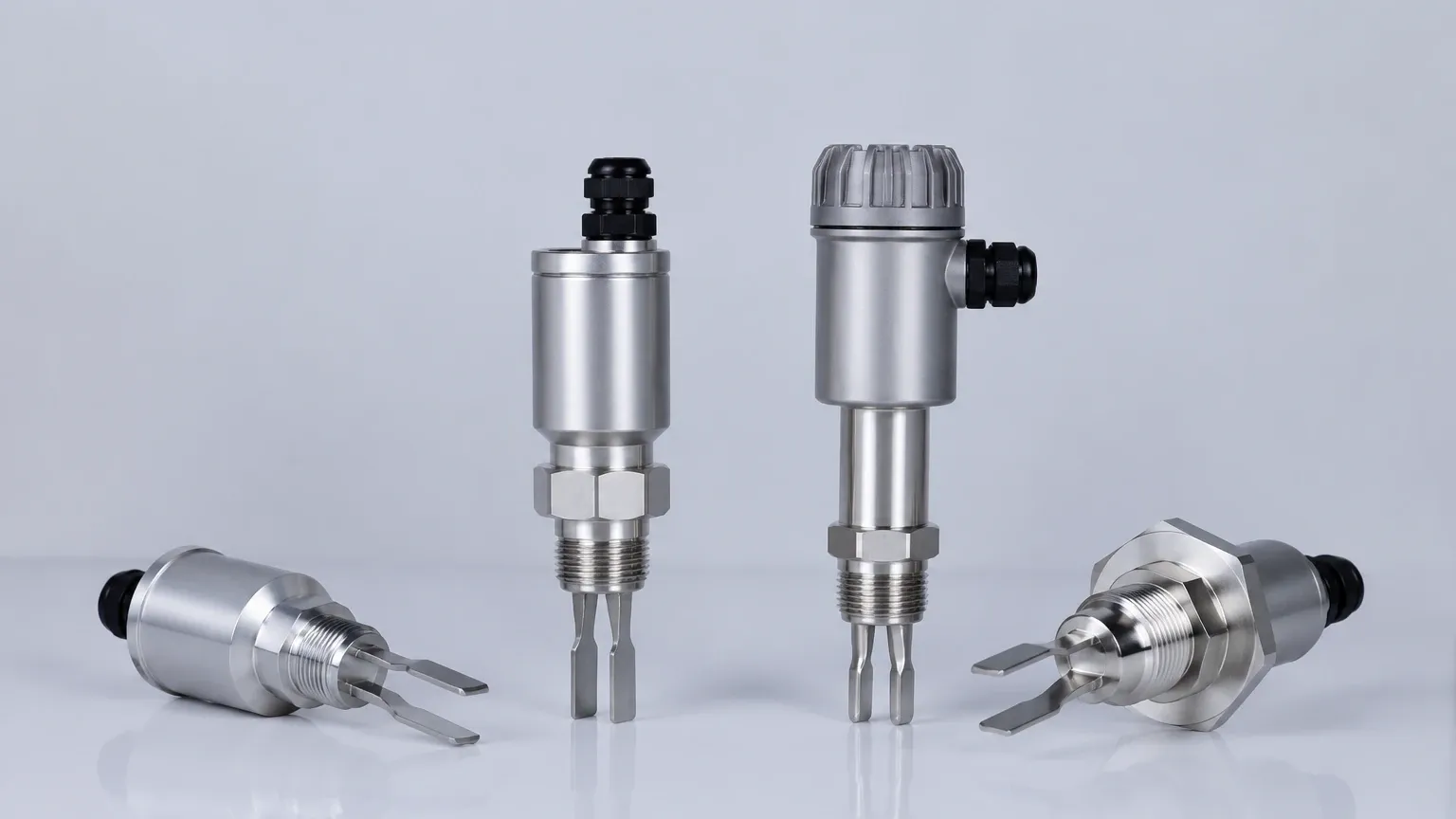
The fundamental operation of a level switch vibrating fork type is based on the principle of frequency shift. The instrument consists of a symmetric fork-shaped sensing element, typically made of stainless steel, which is driven into mechanical vibration by an internal set of piezoelectric crystals.
Resonance and Damping
In air or an empty vessel, the fork vibrates at its natural resonant frequency. For liquid applications, this frequency is typically around 1,200 Hz to 1,400 Hz. For solid applications, the frequency may be lower to accommodate the different physical properties of bulk materials.
The electronics within the housing continuously monitor this frequency. When the process medium (liquid or solid) rises and covers the fork tines, the mechanical vibration is dampened. This damping causes a significant shift in the resonant frequency or a decrease in the vibration amplitude. The internal circuitry detects this change and triggers a switching signal, such as a relay contact or a transistor output, to indicate that the level has reached the sensor's position.
Advantages of the Frequency Shift Method
Because the sensor relies on mechanical resonance rather than electrical conductivity or dielectric constants, it is largely immune to changes in the medium's properties. It can accurately detect levels regardless of the liquid's conductivity, turbulence, bubbles, foam, or pressure variations. This makes it a versatile component in the broader category of industrial Level Switches.
Technical Specifications and Selection Criteria
Selecting the correct level switch vibrating fork type requires a detailed understanding of the process environment. While these sensors are robust, their performance is dictated by the physical interaction between the fork and the medium.
1. Medium Density
The most critical factor is the density of the material. For liquid switches, the minimum density threshold is usually 0.5 g/cm³ (500 kg/m³), though high-sensitivity models can detect lighter hydrocarbons down to 0.4 g/cm³. For solids, the bulk density must be sufficient to dampen the vibration, typically requiring at least 0.01 g/cm³ for very light powders or up to 0.1 g/cm³ for standard granules.
2. Viscosity
In liquid applications, high viscosity can cause the medium to "stick" to the fork tines, creating a coating that prevents the fork from returning to its resonant frequency once the level drops. Most standard vibrating forks can handle viscosities up to 10,000 mPa·s. If the medium is highly viscous or prone to crystallization, specialized fork geometries or coatings may be required.
3. Temperature and Pressure
Standard industrial models are designed for temperatures ranging from -40°C to +150°C. For high-temperature applications, such as steam boiler monitoring or hot oil tanks, extended housings with cooling fins can allow operation up to +250°C. Pressure ratings typically extend up to 40 bar (4.0 MPa), though high-pressure versions for specialized chemical reactors can reach 100 bar.
4. Materials of Construction
The wetted parts must be chemically compatible with the process medium. While 316L stainless steel is the industry standard, corrosive environments may necessitate the use of Hastelloy C, or coatings such as PFA (Perfluoroalkoxy) and ECTFE to prevent chemical attack.
Selection Table for Vibrating Fork Switches
| Feature | Liquid Vibrating Fork | Solid (Granule) Vibrating Fork |
| :— | :— | :— |
| Typical Frequency | 1,200 Hz – 1,400 Hz | 85 Hz – 150 Hz |
| Min. Density | 0.5 g/cm³ (Standard) | 0.01 – 0.1 g/cm³ |
| Max. Viscosity | Up to 10,000 mPa·s | N/A (Flowability is key) |
| Common Use Case | Overfill protection, pump run-dry | High/Low alarm in silos, hoppers |
| Sensitivity | Adjustable via DIP switches | Adjustable for light/heavy solids |
Installation Considerations and Best Practices
Proper installation is paramount to ensuring the longevity and accuracy of a level switch vibrating fork type. Improper orientation can lead to false triggers or mechanical damage.
Orientation and Positioning
* Side Mounting: This is the most common installation for high-level or low-level alarms. The fork tines should be oriented so that the liquid can easily drain off them. For liquids, the tines should be vertical (standing on edge) rather than horizontal to prevent the medium from pooling between the forks.
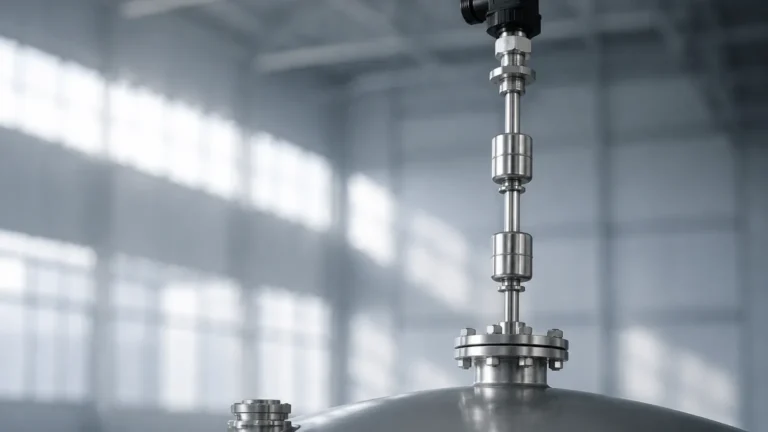
* Top Mounting: Used primarily for high-level alarms or overfill protection. The fork is attached to an extension pipe (up to 3,000 mm or more) to reach the desired switching point.
* Flow Considerations: If the sensor is installed in a pipe or a tank with high agitation, the tines must be aligned parallel to the flow direction to minimize mechanical stress and prevent the accumulation of debris.
Avoiding False Alarms
To prevent the sensor from being triggered by falling material or splashing, it should not be installed directly under the tank's filling inlet. If such a position is unavoidable, a protective baffle or shield should be installed above the fork to deflect the incoming material.
Wiring and Electronics
Modern vibrating fork switches offer various output options to integrate with PLC (Programmable Logic Controller) or DCS (Distributed Control System) environments:
* Relay Output (DPDT): Ideal for direct control of pumps or valves.
* Transistor (PNP/NPN): Used for high-speed switching in DC circuits.
* Two-Wire (8/16mA or NAMUR): Common in hazardous areas (Ex-proof) where intrinsic safety is required.
Limitations of Vibrating Fork Switches
While highly versatile, the level switch vibrating fork type is not universal. Engineers should be aware of the following limitations:
1. Heavy Coating and Bridging: In applications involving extremely sticky materials or large-grained solids, the material may "bridge" between the tines. If the bridge remains after the level drops, the sensor will continue to indicate a "covered" state.
2. Solid Particle Size: For solids, if the particle size is too large (e.g., large rocks or heavy ore), the physical impact can damage the tines. Generally, particle sizes should be less than 10 mm for standard forks.
3. Turbulence and Aeration: While largely unaffected by surface foam, extreme aeration (bubbles) that significantly reduces the density of the liquid below the sensor's threshold may cause the switch to fail to detect the liquid.
Comparison with Other Technologies
| Technology | Advantage over Vibrating Fork | Disadvantage vs. Vibrating Fork |
| :— | :— | :— |
| Float Switch | Lower initial cost. | Moving parts wear out; prone to jamming. |
| Capacitance | Can detect interface between two liquids. | Requires recalibration if dielectric constant changes. |
| Ultrasonic | Non-contact measurement. | Affected by foam, vapor, and heavy dust. |
| Radar (Point) | Non-contact; high precision. | Significantly higher cost for simple point detection. |
Frequently Asked Questions (FAQ)
Q: Does the vibrating fork require calibration?
A: No. One of the primary benefits of the level switch vibrating fork type is that it is a "plug-and-play" device. It does not require calibration for different media, provided the density is above the minimum threshold. Most units feature a sensitivity adjustment (usually a DIP switch) to toggle between standard and low-density modes.
Q: Can it be used in hygienic applications?
A: Yes. Many manufacturers, including Welk, offer hygienic versions with polished stainless steel surfaces (Ra < 0.8 µm) and Tri-Clamp connections. These are suitable for CIP (Clean-in-Place) and SIP (Sterilization-in-Place) processes in the food, beverage, and pharmaceutical industries.
Q: How do I test if the switch is functioning correctly?
A: Most high-quality vibrating fork switches include a functional test magnet or a test button on the electronics module. By applying the magnet to a specific spot on the housing, the user can simulate a covered state to verify that the electronics and output relays are functioning without needing to fill the tank.
Q: What happens if the fork tines are damaged?
A: If a tine is bent or broken, the resonant frequency will shift permanently. Most modern electronics will detect this as an "Error" state and trigger a fail-safe alarm, preventing a dangerous undetected failure in the process.
In summary, the level switch vibrating fork type represents a robust, low-maintenance solution for point level detection in a wide array of industrial sectors. By understanding the mechanical requirements of the medium and following standard installation practices, engineers can ensure reliable overfill and dry-run protection for their critical infrastructure.