Level Switch Working
Level Switch Working
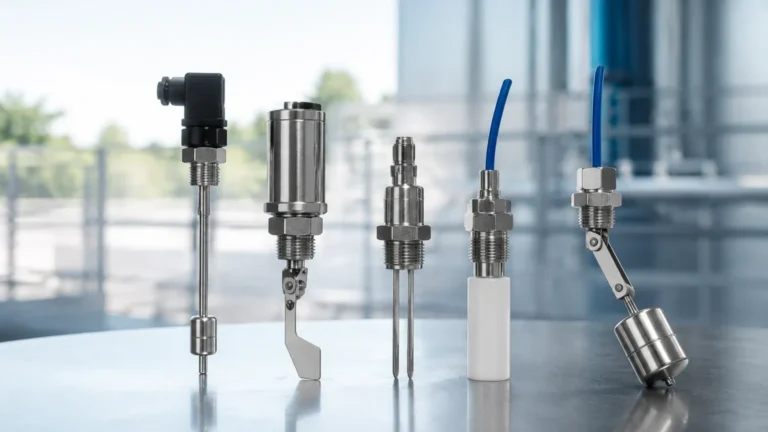
In industrial process control, the ability to detect the presence or absence of a substance at a specific height within a vessel is critical for safety, inventory management, and automation. While continuous level transmitters provide a constant data stream of the level, point-level detection is handled by devices known as level switches. Understanding the mechanics of level switch working is essential for engineers and technicians tasked with selecting the right technology for specific media, such as liquids, slurries, or bulk solids.
Level Switches function as binary sensors, providing an "on/off" signal (typically via a relay or transistor output) when the material reaches a predetermined set point. This article explores the diverse physical principles behind these devices, their selection criteria, and best practices for industrial installation.
Fundamental Principles of Level Switch Working
Level switches operate based on various physical interactions between the sensor and the process material. The choice of technology depends on the physical properties of the media, such as density, conductivity, dielectric constant, and viscosity.
1. Float Level Switches (Buoyancy Principle)
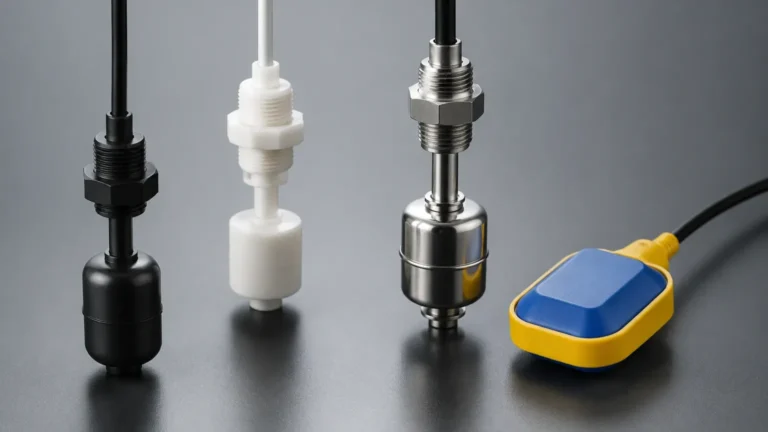
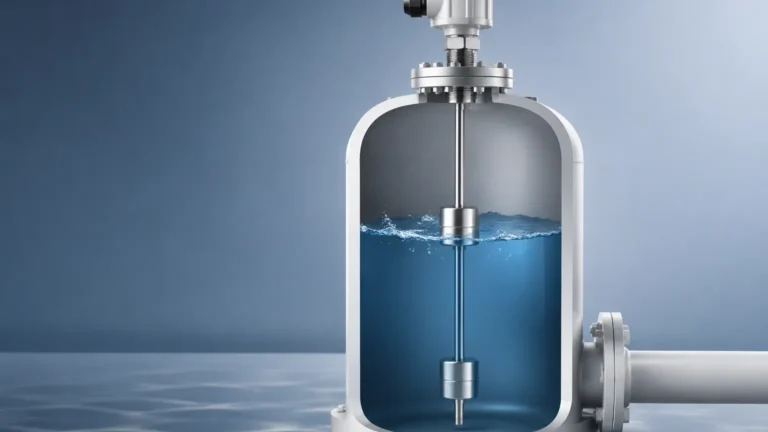
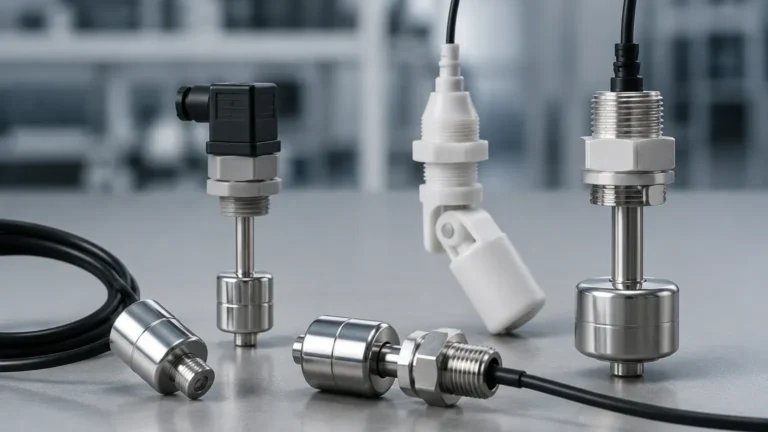
Float switches are among the most common and cost-effective technologies. They operate on Archimedes' principle of buoyancy. A float, containing a permanent magnet, moves up and down a stem as the liquid level changes.
* The Mechanism: Inside the stationary stem is a hermetically sealed reed switch. When the float’s magnet aligns with the reed switch, the magnetic field causes the reed contacts to close (or open), completing an electrical circuit.
* Applications: Best suited for clean, non-coating liquids like water, oils, and chemicals. They are widely used in sump pumps and storage tanks.
2. Vibrating Tuning Fork Switches (Frequency Shift)
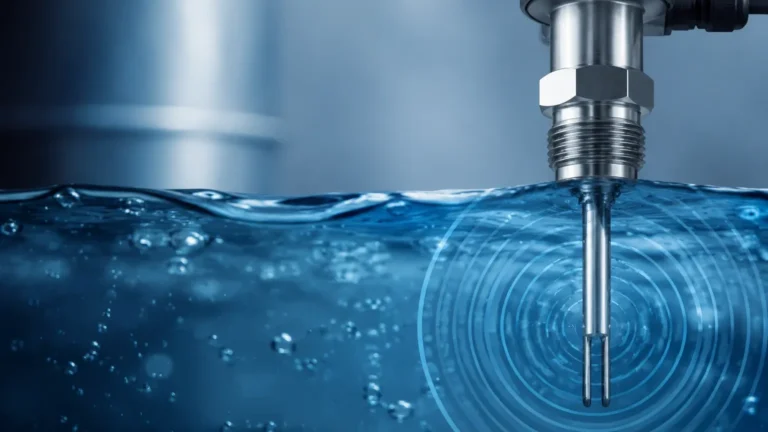
Often referred to as vibrating level switches, these devices utilize a fork-shaped sensing element that is piezoelectrically energized to vibrate at its natural resonance frequency in the air.
* The Mechanism: When the fork is submerged in a liquid or covered by a solid, the density of the surrounding medium causes the vibration frequency to drop. The electronics detect this frequency shift and trigger the switch output.
* Applications: Highly versatile, these switches are unaffected by flow, turbulence, bubbles, or foam. They are excellent for overfill protection and run-dry protection in pipes.
3. Capacitance Level Switches (Dielectric Principle)
Capacitive sensors treat the probe and the tank wall (or a second reference probe) as two plates of a capacitor, with the process material acting as the dielectric medium.
* The Mechanism: The device measures the capacitance between the probe and the ground. Since most materials have a higher dielectric constant ($ε_r$) than air, the capacitance increases when the material covers the probe.
* Applications: Ideal for powders, granules, and liquids. Modern capacitive switches often include "active shield" technology to ignore material buildup or coating on the probe.
4. Conductive Level Switches (Electrical Resistance)
This technology is restricted to conductive liquids. It uses the liquid itself as part of the electrical circuit.
* The Mechanism: Two or more electrodes are suspended in the tank. When a conductive liquid bridges the gap between the electrodes (or between an electrode and a metal tank wall), a low-voltage AC current flows, signaling the switch to trigger.
* Applications: Simple water tanks, wastewater treatment, and acidic/alkaline solutions. They are not suitable for oils or distilled water.
5. Rotating Paddle Switches (Mechanical Resistance)
Specifically designed for bulk solids, these switches use a low-speed motor to rotate a paddle.
* The Mechanism: When the material reaches the paddle, it creates mechanical resistance (torque), which stalls the motor. A microswitch is then activated to signal the level. Once the material level drops, a spring returns the motor to its starting position, and rotation resumes.
* Applications: Silos containing grain, sand, plastic pellets, or cement.
6. Optical Level Switches (Refraction)
Optical switches use an infrared LED and a light receiver housed within a prism-shaped tip.
* The Mechanism: In air, the infrared light reflects off the internal surface of the prism back to the receiver. When liquid covers the prism, the light is refracted into the liquid, and the receiver detects a loss of signal.
* Applications: Compact and ideal for leak detection or small tanks where space is limited.
Technical Comparison and Selection Table
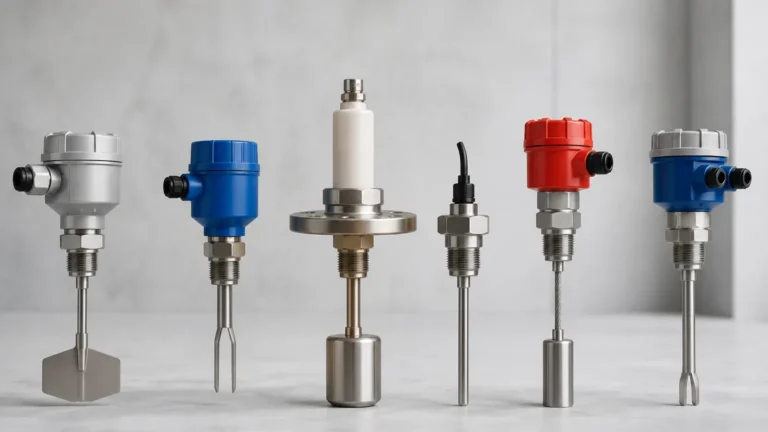
Choosing the correct level switch requires balancing performance requirements against the physical characteristics of the application. The following table provides a comparison of common technologies.
| Technology | Suitable Media | Viscosity Tolerance | Pressure/Temp Range | Common Limitations |
| :— | :— | :— | :— | :— |
| Float | Clean Liquids | Low | Moderate | Moving parts can jam; sensitive to debris |
| Tuning Fork | Liquids/Solids | Moderate to High | High | Can be affected by very high viscosity |
| Capacitive | Liquids/Powders | High (with shield) | High | Requires calibration for different media |
| Conductive | Conductive Liquids | Low | Moderate | Only works with conductive fluids |
| Rotating Paddle | Bulk Solids | N/A | Moderate | Mechanical wear; not for liquids |
| Optical | Clean Liquids | Low | Low to Moderate | Sensitive to coating and ambient light |
Engineering Considerations for Installation
Successful level switch working depends heavily on correct installation. Failure to account for the vessel's internal environment can lead to false positives or mechanical failure.
Mounting Orientation
* Horizontal Mounting: Common for side-entry switches like tuning forks or floats. Ensure the switch is positioned so that material does not collect on the sensing element.
* Vertical Mounting: Ideal for top-down detection. For float switches, ensure the stem is perfectly vertical to prevent the float from binding.
Avoiding Turbulence and Inflow
If a switch is installed directly beneath an inflow pipe, the force of the falling material or the resulting turbulence can cause premature switching or mechanical damage. In such cases, a baffle plate or a stilling well should be used to protect the sensor.
Managing Material Buoyancy and Density
For float switches, the density of the liquid must be higher than the density of the float. If the liquid's specific gravity is too low, the float will not rise. Standard floats are usually designed for liquids with a specific gravity of 0.8 or higher. For lower density fluids, specialized high-buoyancy floats are required.
Electrical Safety and Hazardous Areas
In industries involving flammable gases or dust (e.g., oil and gas, chemical processing), level switches must be rated for hazardous locations (ATEX, IECEx, or UL/CSA). This often involves using intrinsically safe (IS) circuits or explosion-proof housings to prevent the device from becoming an ignition source.

Limitations and Common Risks
While level switches are robust, they are not universal solutions. Engineers must be aware of the following risks:
1. Coating and Buildup: In applications involving sticky resins or slurries, material can build up on the sensor. A vibrating fork may eventually stop vibrating, or a capacitive probe may "see" the coating as the actual level.
2. Agitation and Foam: Mechanical switches (floats) and some optical switches struggle in heavy foam. The foam may be dense enough to trigger a tuning fork but not dense enough to move a float, leading to inconsistent results.
3. Electromagnetic Interference (EMI): Electronic switches, particularly capacitive types, can be sensitive to EMI from nearby high-voltage motors or variable frequency drives (VFDs). Proper shielding and grounding are mandatory.
4. Mechanical Fatigue: Rotating paddles and float switches involve moving parts. Over time, bearings can wear out, or pivots can corrode, leading to failure in the "closed" or "open" position.
Frequently Asked Questions (FAQs)
Q: Can a level switch be used for continuous measurement?
No. A level switch only detects if the material has reached a specific point. For continuous tracking (0-100%), a radar, ultrasonic, or hydrostatic level transmitter is required.
Q: How do I test if a level switch is working?
Most modern electronic switches have a "test" button or a magnetic test point that simulates a high-level condition. For float switches, manual movement of the float or checking continuity with a multimeter while submerged is standard practice.
Q: What is the difference between NPN and PNP outputs in level switches?
These refer to the type of transistor output. PNP switches provide a positive voltage signal when activated (sourcing), while NPN switches connect the load to the negative/ground (sinking). The choice depends on the PLC or controller input requirements.
Q: Are tuning fork switches affected by bubbles?
Generally, no. Tuning forks are designed to detect a significant change in density. Small bubbles usually do not provide enough density change to trigger a false state, making them superior to ultrasonic point sensors in aerated liquids.
Conclusion
Reliable level switch working is the foundation of automated process safety. By understanding the physical principles—whether it be the buoyancy of a float, the resonance of a tuning fork, or the capacitance of a probe—engineers can select the most durable and accurate solution for their specific environment. When selecting a device, always confirm the chemical compatibility of the wetted parts, the temperature/pressure ratings of the process, and the electrical output requirements of your control system. For high-performance industrial applications, choosing a manufacturer like Welk ensures access to advanced technologies like active-shield capacitance and high-frequency tuning forks designed for the most demanding environments.