Level Switches Types
Level Switches Types
In industrial process control, point level detection serves as a critical safeguard for inventory management and equipment protection. Unlike continuous level transmitters that provide a constant stream of data, level switches are designed to detect when a substance reaches a specific height, triggering an output signal to start or stop a process, or to sound an alarm. Selecting the correct instrument requires a deep understanding of the various level switches types and the physical principles that govern their operation.
Industrial environments present diverse challenges—ranging from corrosive chemicals and high-pressure steam to abrasive bulk solids. Consequently, no single technology is universal. This guide examines the primary technologies used in modern Level Switches, providing engineering insights into their selection and application.
1. Float Level Switches
Measurement Principle
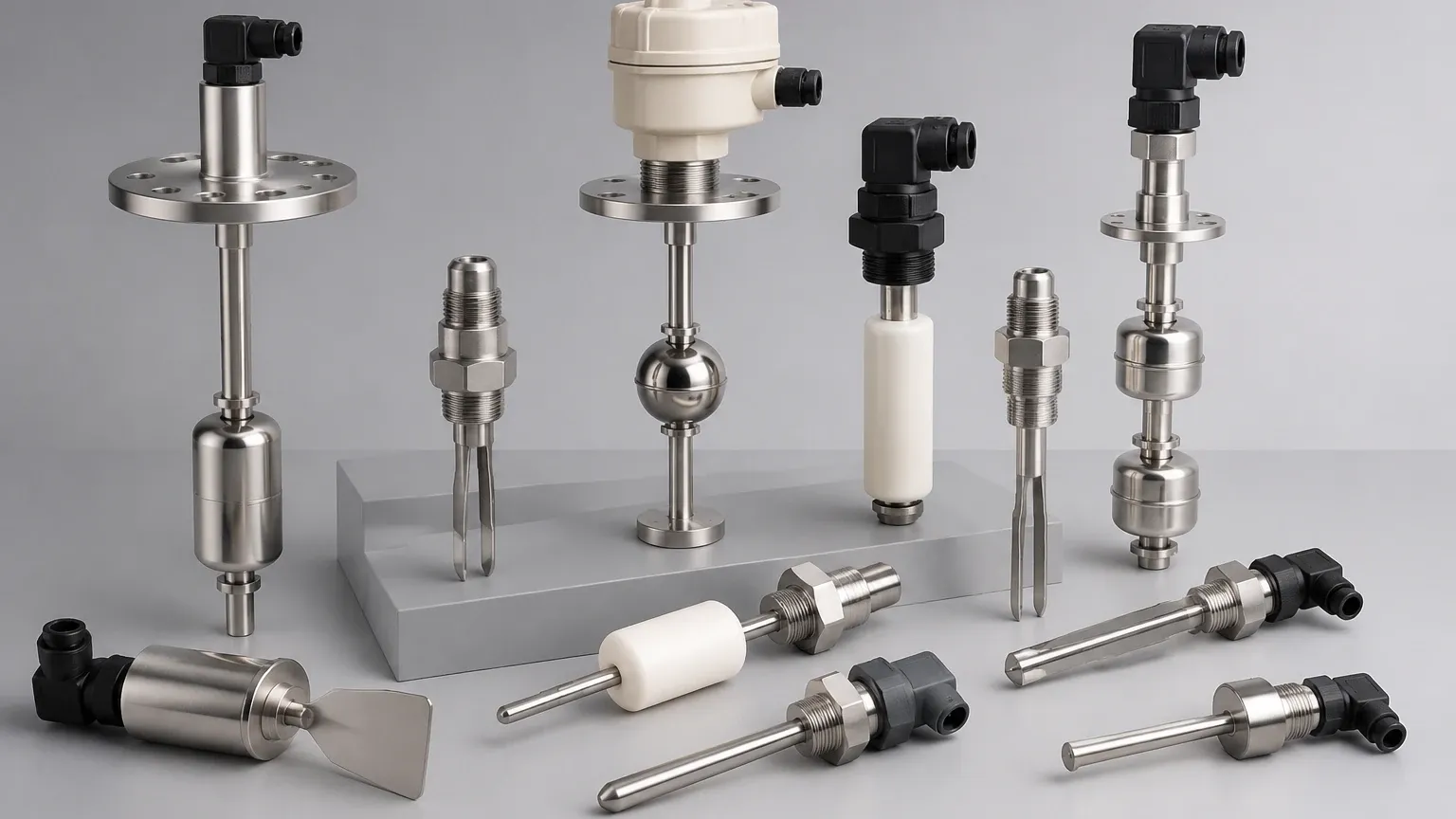
Float level switches operate based on the principle of buoyancy (Archimedes' Principle). A float, usually constructed from stainless steel or plastic, is designed with a lower density than the process liquid. As the liquid level rises, the float moves upward. In a typical magnetic float switch, the float contains a permanent magnet. When the float reaches a predetermined point, the magnetic field actuates a hermetically sealed reed switch located within the stationary stem.
Applications and Advantages
* Media: Clean liquids, water, oils, and non-coating chemicals.
* Pros: Simple, cost-effective, and requires no external power to actuate the reed switch.
* Cons: Susceptible to fouling in viscous or scaling liquids; moving parts can wear over time.
Technical Limitations
Float switches are generally unsuitable for liquids containing high concentrations of solids or high-viscosity fluids that might "stick" the float to the stem. They are also sensitive to turbulence unless a stilling well is installed.
2. Tuning Fork (Vibrating) Level Switches
Measurement Principle
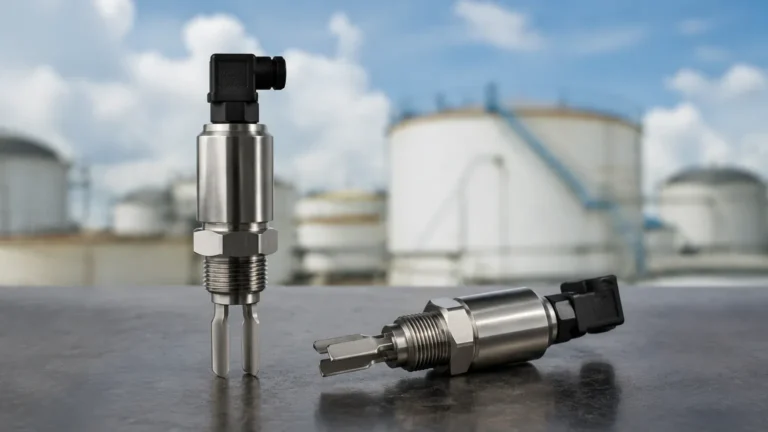
Tuning fork switches utilize piezoelectric crystals to vibrate a pair of metal tines at their natural resonant frequency. When the tines are immersed in a medium (liquid or solid), the frequency of vibration shifts or the amplitude is dampened. An internal electronic circuit detects this change and converts it into a switching signal.
Applications and Advantages
* Media: Liquids, powders, and fine-grained solids.
* Pros: Highly resistant to turbulence, foam, and bubbles. They are virtually maintenance-free due to the lack of moving parts.
* Cons: Performance can be affected by significant material buildup between the tines.
Key Considerations
For liquid applications, tuning forks are often used for overfill protection. For solids, they are ideal for low-density powders. When selecting among level switches types, the tuning fork is often favored for its reliability in varying fluid densities.
3. Capacitance Level Switches
Measurement Principle
Capacitance switches treat the sensor probe and the tank wall as two plates of a capacitor. The process material acts as the dielectric. The formula for capacitance ($C = ε A / d$) dictates that as the material covers the probe, the dielectric constant ($ε$) changes, increasing the measured capacitance. The electronics detect this increase relative to a calibrated setpoint.
Applications and Advantages
* Media: Both conductive and non-conductive liquids, slurries, and bulk solids.
* Pros: Can withstand high temperatures (up to 250°C or more) and high pressures. Modern units often include "active shield" technology to ignore material buildup on the probe.
* Cons: Requires calibration for different materials; sensitive to changes in the dielectric constant of the media.
4. Rotary Paddle Level Switches
Measurement Principle
Specifically designed for bulk solids, the rotary paddle switch uses a low-speed electric motor that rotates a paddle. When the solid material rises to the level of the paddle, it creates mechanical resistance. Once the torque threshold is exceeded, the motor rotates a dry contact switch and stops itself. When the material level drops, a spring returns the motor to its original position, and rotation resumes.
Applications and Advantages
* Media: Grains, sand, plastic pellets, cement, and wood chips.
* Pros: Robust, easy to install, and highly visible operation. Best suited for heavy bulk materials.
* Cons: Mechanical wear of the motor and paddle assembly; not suitable for liquids.
5. Conductivity Level Switches
Measurement Principle
Conductivity switches are used exclusively for conductive liquids. They consist of multiple electrodes (probes) of varying lengths. When the liquid touches a probe, a low-voltage electrical circuit is completed between the probe and the tank wall (or a reference probe). This flow of current triggers the switch.
Applications and Advantages
* Media: Water, acids, alkalis, and conductive slurries.
* Pros: Extremely low cost, no moving parts, and can manage multiple points (high/low) with a single entry point.
* Cons: Cannot be used with non-conductive fluids like oils or distilled water; probes may corrode or scale over time.
6. Ultrasonic Level Switches
Measurement Principle
These switches utilize ultrasonic transducers. In a gap-style ultrasonic switch, two transducers are separated by a small space. One emits an ultrasonic signal, and the other receives it. When the gap is filled with air, the signal is weak; when the gap is filled with liquid, the signal transmits efficiently, triggering the output.
Applications and Advantages
* Media: Most liquids, especially those that are chemically aggressive.
* Pros: Non-contact options are available; highly accurate with no moving parts.
* Cons: Can be affected by heavy foam or high-pressure vapors that attenuate the sound waves.
Technical Selection Table
| Technology | Media Type | Max Temp (Typical) | Pressure Range | Primary Advantage |
| :— | :— | :— | :— | :— |
| Float | Clean Liquids | 120°C | Up to 40 bar | Low cost, no power required |
| Tuning Fork | Liquids/Solids | 150°C | Up to 64 bar | Immune to foam/bubbles |
| Capacitance | Liquids/Solids | 250°C+ | High Pressure | Handles extreme environments |
| Rotary Paddle| Bulk Solids | 80°C (Std) | Atmospheric | Robust for heavy solids |
| Conductivity | Conductive Liq | 100°C | Up to 10 bar | Simple multi-point control |
| Ultrasonic | Liquids | 90°C | Up to 10 bar | Reliable for aggressive media |
Engineering Installation Considerations
Proper installation is as vital as selecting the right technology among the various level switches types. Engineers should adhere to the following guidelines:
1. Orientation: Most switches can be mounted horizontally or vertically. However, float switches are often restricted to vertical mounting unless specifically designed for side-entry. Tuning forks should be oriented so that the tines are vertical (for liquids) or angled (for solids) to prevent material accumulation.
2. Turbulence and Agitation: In tanks with agitators, switches should be installed away from the blades. For float switches, a stilling well (a perforated pipe) may be necessary to prevent mechanical damage or false tripping.
3. Nozzle Length: Ensure the active sensing element (the tines, the paddle, or the probe) extends sufficiently into the vessel. If the nozzle is too long, material may trap inside, causing a "dead zone" where the switch stays triggered even after the level drops.
4. Electrical Protection: In hazardous areas, use intrinsically safe or explosion-proof housings. Always ensure the IP (Ingress Protection) rating (e.g., IP65 or IP67) matches the washdown requirements of the facility.
Limitations and Common Risks
While level switches are generally robust, certain conditions can lead to failure:
* Coating and Buoyancy: In float switches, if the media is sticky (like molasses or crude oil), the float may stick to the stem. In this case, a non-contact or vibrating technology is preferred.
* Dielectric Fluctuations: For capacitance switches, if the moisture content of a solid or the composition of a liquid changes significantly, the switch may require recalibration.
* Specific Gravity: Float switches are designed for a specific minimum SG (Specific Gravity). If the fluid density drops below the float's design limit (e.g., if a tank is switched from water to a light solvent), the float will not rise.
* Vibration: Excessive external vibration from pumps or heavy machinery can cause tuning fork switches to trip falsely if the vibration frequency matches the fork's resonant frequency.
Frequently Asked Questions (FAQ)
Q: Can I use a liquid tuning fork switch for dry powders?
A: Generally, no. Tuning forks for solids are designed with larger tines and different vibration frequencies to handle the higher density and potential for material wedging associated with powders and grains.
Q: What is the difference between NPN/PNP and Relay outputs?
A: Relay outputs are mechanical contacts suitable for switching higher loads or AC circuits. NPN/PNP are solid-state transistor outputs used for high-speed switching and direct connection to PLCs (Programmable Logic Controllers).
Q: How do I handle level switching in a pressurized tank?
A: You must select a switch rated for the vessel's Maximum Allowable Working Pressure (MAWP). Capacitance and tuning fork switches are typically available in high-pressure variants (up to 64 bar or higher), whereas standard plastic float switches are not.
Q: Is it possible to detect the interface between two liquids (e.g., oil and water)?
A: Yes, certain level switches types like capacitance or specialized float switches (weighted for a specific SG) can detect the interface between a conductive and non-conductive liquid or two liquids of different densities.
For more detailed specifications and to compare specific models for your application, you can Review product options and application support to ensure the selected instrument meets your operational requirements.