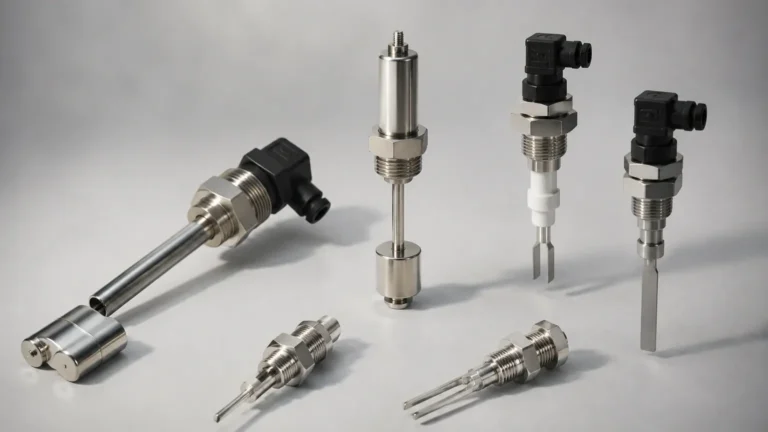
Levels Switch
Levels Switch
In industrial process control, point level detection serves as a critical safeguard for inventory management, pump protection, and overfill prevention. A levels switch is a device designed to detect the presence or absence of a substance—whether liquid, slurry, or granular solid—at a specific height within a vessel or pipe. Unlike continuous level transmitters that provide a constant stream of data across a range, a levels switch provides a discrete output, typically a relay or transistor signal, when the material reaches a predetermined threshold.
Selecting the appropriate technology for a levels switch requires a deep understanding of the physical properties of the media, the environmental conditions of the process, and the specific functional requirements of the control system. This guide examines the fundamental measurement principles, selection criteria, and installation best practices for modern industrial level switches.
Fundamental Measurement Principles
Before selecting a specific instrument, it is essential to understand how different technologies interact with the process media. Each principle offers distinct advantages depending on the physical characteristics of the material being measured.
Float-Based Level Switches
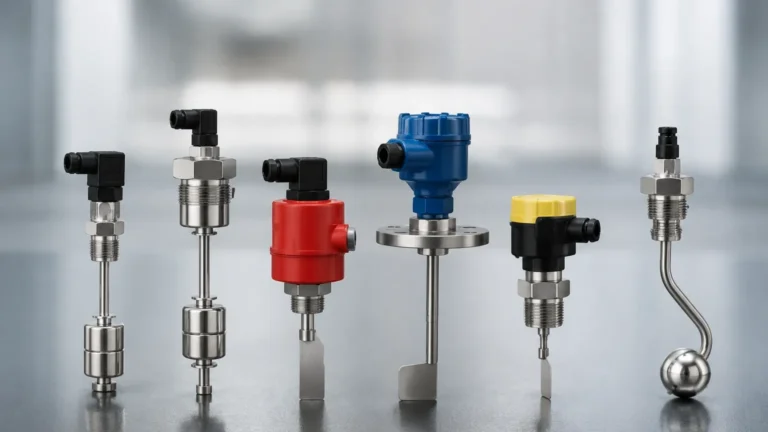
Float switches operate on the principle of buoyancy. A float containing an internal magnet moves vertically along a stem or pivots on a hinge as the liquid level rises or falls. When the float reaches a specific position, the magnetic field actuates a hermetically sealed reed switch located within the stem. This technology is purely mechanical and often does not require external power for the sensing element itself, making it a robust choice for simple high or low-alarm applications.
Vibrating Point Level Switches (Tuning Forks)
Often referred to as tuning fork switches, these devices utilize a sensing element that is vibrated at its resonant frequency by a piezoelectric crystal. When the fork is immersed in the medium, the frequency of vibration changes. The internal electronics detect this frequency shift and trigger the output. These Level Switches are highly versatile because they are largely unaffected by the flow, turbulence, bubbles, or foam often found in industrial tanks.
Conductive Level Switches
Conductive probes are used exclusively with conductive liquids, such as water, acids, or caustic solutions. The system uses a low-voltage, current-limited signal between two electrodes (or one electrode and the tank wall). When the liquid touches the probe, the electrical circuit is completed, signaling the levels switch to change state. This method is cost-effective and contains no moving parts, though it is unsuitable for non-conductive oils or hydrocarbons.
Capacitance Level Switches
Capacitance switches measure the change in electrical capacitance between a sensing electrode and the vessel wall (or a reference probe). As the media displaces air near the probe, the dielectric constant changes, causing a shift in capacitance. This technology is effective for both liquids and solids, including powders and granules. Advanced capacitance switches include "active shield" technology to ignore material buildup on the probe, which is a common cause of false triggers in sticky media.
Ultrasonic and Optical Switches
Ultrasonic switches use high-frequency sound waves to detect the presence of media. In a "gap" style ultrasonic switch, the signal is transmitted across a small space; when liquid fills that space, the signal strength increases, triggering the switch. Optical switches use an infrared LED and a receiver inside a prism. When liquid covers the prism, the light is refracted into the liquid rather than reflected back to the receiver, signaling a level change.
Technical Selection Criteria
Choosing the right levels switch involves more than just selecting a technology. Engineers must evaluate the process environment against the instrument's specifications. The following table provides a comparison of common technologies based on typical application requirements.
Technology Comparison Matrix
| Technology | Media Type | Viscosity Tolerance | Pressure Range (Typical) | Key Advantage |
| :— | :— | :— | :— | :— |
| Float | Clean Liquids | Low | Up to 40 Bar (580 PSI) | Simple, no power needed |
| Tuning Fork | Liquids/Solids | Medium | Up to 64 Bar (928 PSI) | Immune to foam/bubbles |
| Conductive | Conductive Liquids | High | Up to 25 Bar (362 PSI) | Low cost, multi-point |
| Capacitance | Liquids/Solids | High (with shield) | Up to 100 Bar (1450 PSI) | Versatile, no moving parts |
| Optical | Clean Liquids | Low | Up to 50 Bar (725 PSI) | Compact size |
Media Properties
* Density/Specific Gravity: Float switches require the media to be denser than the float itself (typically >0.5 g/cm³). For vibrating switches, the density must be sufficient to dampen the vibration (typically >0.7 g/cm³ for standard models).
* Viscosity: Highly viscous or "sticky" materials can cause mechanical floats to hang up or coat tuning forks, leading to false readings. In these cases, capacitance switches with buildup compensation are preferred.
* Chemical Compatibility: The wetted materials (e.g., 316L Stainless Steel, PTFE, PP, or Hastelloy) must be resistant to the process media to prevent corrosion and premature failure.
Process Conditions
* Temperature: Standard switches often handle up to 80°C (176°F), but high-temperature versions with cooling fins or ceramic insulators can reach 250°C (482°F) or higher.
* Pressure: The housing and process connection must be rated for the maximum possible vessel pressure, including surges.
* Turbulence and Foam: If the tank has an agitator or high-velocity fill lines, a switch that is immune to surface turbulence, such as a vibrating fork or a float inside a stilling well, should be used.
Installation and Engineering Considerations
Proper installation is as critical as instrument selection. A poorly placed levels switch may suffer from premature wear or provide unreliable data.
Mounting Orientation
Most level switches can be mounted either horizontally (from the side of the tank) or vertically (from the top).
* Horizontal Mounting: Ideal for high or low-level alarms where the exact trip point is fixed at the height of the nozzle. For vibrating forks, the tines should be oriented so that material can easily drain off them.
* Vertical Mounting: Used when the switch must reach deep into the tank or when side-wall access is unavailable. Extension rods or cables are used to position the sensing element at the desired depth.
Avoiding False Triggers
To prevent interference, switches should not be installed directly in the path of a fill stream. If the tank contains an agitator, the switch must be positioned to avoid mechanical impact from the blades and the forces of the moving fluid. In applications with heavy foam, ultrasonic and optical switches may struggle, whereas vibrating forks or conductive probes are generally more reliable.
Electrical Output and Wiring
Modern level switches offer various output options to interface with PLC or DCS systems:
* Relay (SPDT/DPDT): Provides a dry contact for switching high-current loads or providing simple logic signals.
* Transistor (PNP/NPN): Ideal for high-speed switching and direct connection to PLC digital inputs.
* Two-Wire (NAMUR): Used in intrinsically safe applications for hazardous areas.

Limitations and Common Risks
While level switches are generally reliable, certain conditions can compromise their performance:
1. Material Buildup: In solids applications or with sticky liquids, material can accumulate on the sensor. If the buildup becomes significant, it may mimic the presence of the media (a "false high" alarm).
2. Mechanical Wear: Float switches have moving parts that can wear out over time, especially in abrasive slurries or environments with high vibration.
3. Dielectric Changes: Capacitance switches are sensitive to changes in the dielectric constant of the media. If a tank is used for different products with varying electrical properties, the switch may require recalibration.
4. Turbulence: Extreme turbulence can cause mechanical floats to bounce, leading to "chattering" of the relay. This can be mitigated through the use of time-delay electronics or stilling wells.
Frequently Asked Questions (FAQs)
Q: Can a levels switch be used for continuous level monitoring?
A: No. A levels switch only detects if the material has reached a specific point. For continuous monitoring (e.g., 0-100% full), a radar, ultrasonic, or hydrostatic level transmitter is required.
Q: What is the difference between a "normally open" and "normally closed" switch?
A: This refers to the state of the electrical contact when the switch is not activated. For safety reasons, many high-level alarms are configured as "normally closed" (fail-safe), so that if a wire breaks, the system triggers an alarm.
Q: How do I handle applications with significant foam?
A: Vibrating tuning forks are generally the best choice for foam-covered liquids, as they can be tuned to ignore the low-density foam and only trigger when the liquid itself contacts the tines.
Q: Is calibration required for all level switches?
A: Most float and vibrating switches are factory-calibrated and do not require field adjustment. Capacitance switches usually require a simple calibration step to "teach" the sensor the difference between an empty and full state.
Conclusion
The reliability of an industrial process often hinges on the performance of its point level detection system. By understanding the physical principles of the levels switch and carefully matching the instrument to the specific media and process conditions, engineers can ensure long-term operational safety and efficiency. Whether protecting a pump from running dry or preventing an environmental spill, the correct application of level switching technology is a cornerstone of modern industrial automation. For those evaluating specific hardware for their next project, it is advisable to Review product options and application support to ensure all technical parameters are met.