Tank Level Switches
Tank Level Switches
In industrial process control, the ability to detect specific liquid or solid levels within a vessel is critical for operational safety and efficiency. Tank level switches serve as the primary line of defense against overfill conditions, which can lead to environmental hazards and equipment damage, and dry-run conditions, which can destroy pumps and disrupt downstream processes. Unlike continuous level transmitters that provide a constant data stream of the volume or height, a tank level switch is a point-level detection device designed to trigger an electrical signal when a substance reaches a predetermined height.
Selecting the appropriate technology for tank level switches requires a deep understanding of the physical properties of the media, the environmental conditions of the storage vessel, and the specific integration requirements of the automation system. This guide examines the underlying measurement principles, selection criteria, and installation best practices for modern industrial level switches.
Measurement Principles of Tank Level Switches
Before selecting a device, it is essential to understand how different sensing technologies interact with the process media. Each principle offers distinct advantages depending on the viscosity, conductivity, and state of the material being measured.
Float Level Switches
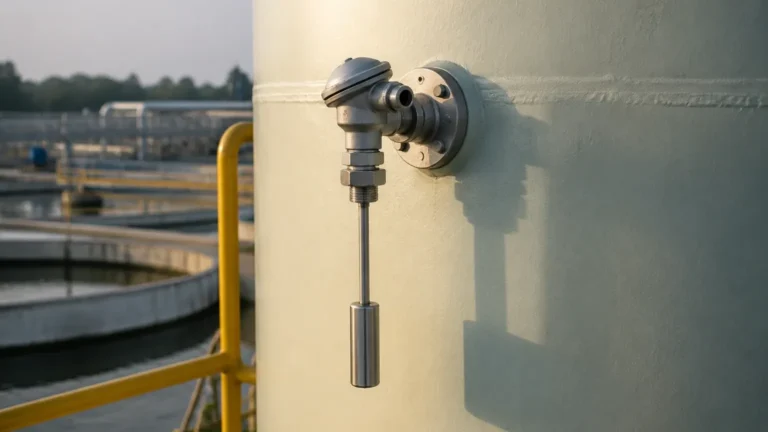
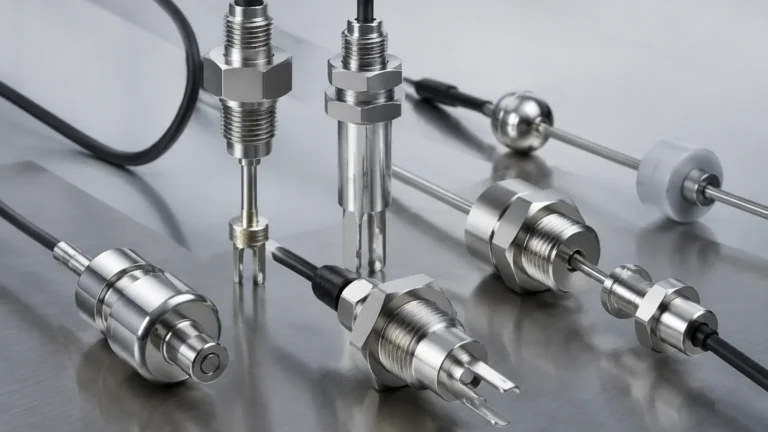
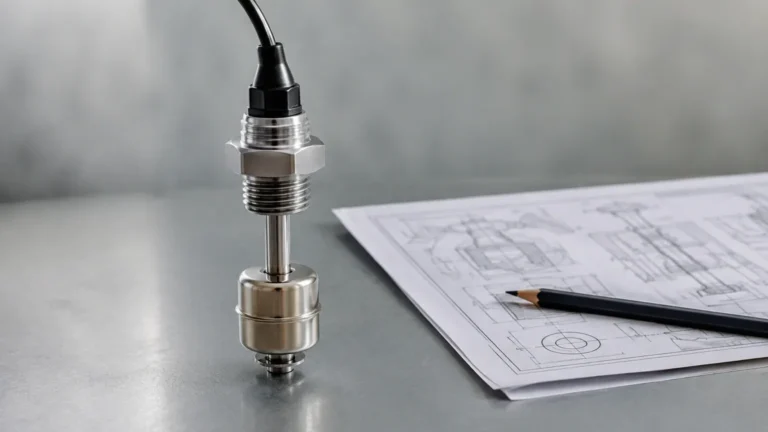
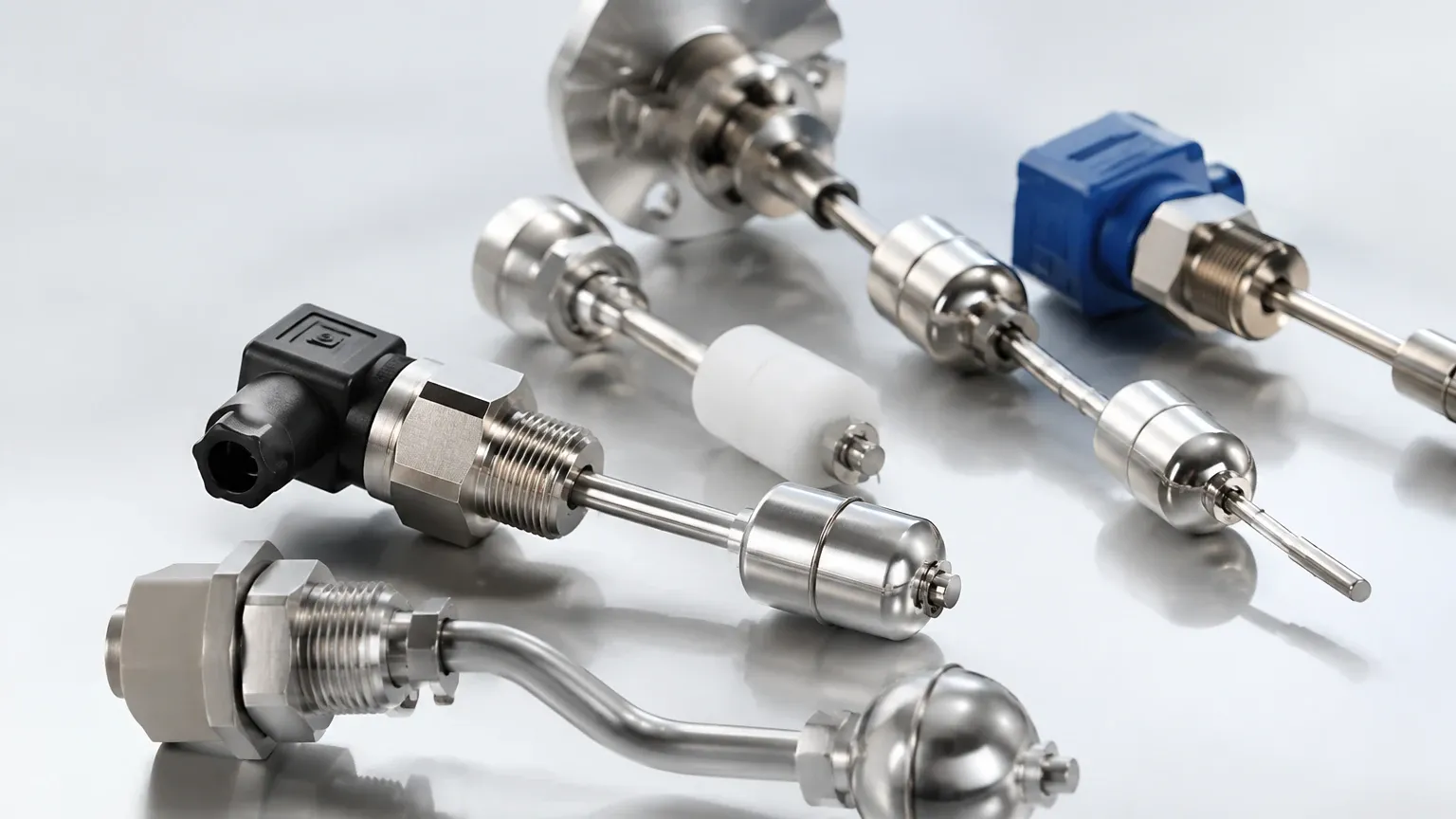
Float-based systems operate on the principle of buoyancy. A float containing a permanent magnet moves with the liquid level. When the float reaches a specific point, the magnetic field actuates a hermetically sealed reed switch located within the stationary stem.
- Advantages: Simple, requires no external power to operate the switch itself, and is highly cost-effective.
- Limitations: Susceptible to mechanical sticking if the fluid is viscous or contains debris. They are generally unsuitable for high-pressure environments exceeding 50 bar (approx. 725 psi).
Vibrating Point Level Switches (Tuning Fork)
These switches utilize piezoelectric crystals to vibrate a fork-shaped element at its natural resonant frequency. When the fork is immersed in a liquid or solid, the frequency changes or the vibration is dampened. This shift is detected by the internal electronics and converted into an output signal.
- Advantages: Highly reliable, unaffected by bubbles, foam, or vibration in the tank. They are excellent for most clean liquids and granular solids.
- Limitations: Heavy coating or build-up between the forks can cause false triggers.
Capacitive Level Switches
Capacitive sensors treat the probe and the tank wall (or a second probe) as two plates of a capacitor. As the material fills the space between them, the dielectric constant changes, increasing the overall capacitance. Once a specific threshold is reached, the switch triggers.
- Advantages: No moving parts, making them ideal for corrosive chemicals and high-temperature applications.
- Limitations: Requires calibration based on the specific dielectric constant of the media. Changes in moisture content in solids can affect accuracy.
Conductive Level Switches
This technology is used exclusively for conductive liquids. A low-voltage AC current is passed between two electrodes (or an electrode and the tank wall). When the liquid touches the probe, the electrical circuit is completed.
- Advantages: Extremely simple and robust for water-based applications.
- Limitations: Cannot be used with oils, hydrocarbons, or pure distilled water which lack conductivity.
Key Evaluation Criteria for Selection
When specifying Level Switches for industrial tanks, engineers must evaluate several variables to ensure long-term reliability. A mismatch between the sensor technology and the application often leads to frequent maintenance or catastrophic failure.
1. Media Characteristics: Consider the density (Specific Gravity), viscosity, and chemical compatibility. For instance, a float switch requires a media density higher than the float itself to function. For aggressive acids, PTFE or PVDF coatings are mandatory.
2. Process Conditions: Operating temperatures can range from cryogenic levels to over 250°C. Similarly, pressure ratings must be verified. High-pressure tanks often require magnetic level gauges with integrated switches rather than direct-insertion float switches.
3. Tank Geometry and Agitation: If the tank features heavy agitation or turbulence, a mechanical float switch may suffer from premature wear. In these cases, a vibrating tuning fork or a capacitive probe with a delayed response setting is preferred.
4. Output Requirements: Determine if the system requires a dry contact relay, a PNP/NPN transistor output, or a two-wire loop-powered configuration. For hazardous areas, ATEX or IECEx certified intrinsically safe switches are required.
Practical Selection Table
The following table provides a quick reference for matching common industrial media with the most suitable tank level switches.
| Application Media | Recommended Technology | Primary Benefit | Potential Limitation |
| :— | :— | :— | :— |
| Potable Water | Float or Conductive | Low cost, simple | Mineral scaling over time |
| Corrosive Chemicals | Capacitive (PTFE coated) | High chemical resistance | Requires dielectric calibration |
| Lubricating Oils | Vibrating Fork | Unaffected by viscosity | Not for high-solids sludge |
| Grain / Powders | Vibrating Rod / Fork | Robust against dust | Physical impact damage |
| Wastewater / Sewage | Ultrasonic Point Switch | Non-contact, no clogging | Sensitive to heavy foam |
| High-Pressure Steam | Magnetic Level Switch | Isolated from process | High initial cost |
Installation and Integration Considerations
The performance of tank level switches is often dictated by their placement. Improper installation can lead to "chattering" (rapid cycling of the switch) or failure to detect the level entirely.
Positioning and Orientation
- Top Mounting: Ideal for high-level alarms. Ensure the probe length is sufficient to reach the desired trip point. For long probes in agitated tanks, use a stillwell (a pipe surrounding the probe) to prevent mechanical stress.
- Side Mounting: Common for low-level or mid-level detection. Ensure the switch is installed at a slight downward angle (if specified by the manufacturer) to allow liquid to drain off the sensing element, preventing false positives due to residual film.
Avoiding Interference
Switches should be installed away from the tank's inlet flow. Falling material hitting a tuning fork or float can cause physical damage or intermittent signals. If the inlet cannot be moved, a baffle plate should be installed to protect the sensor.
Wiring and Safety
In B2B industrial environments, wiring integrity is paramount. Use shielded cables to prevent electromagnetic interference (EMI) from large motors or VFDs from triggering the switch. Always implement a "Fail-Safe" configuration:
- High Level Alarm: The switch should be normally closed (NC) so that a power failure or wire break mimics a high-level state, stopping the fill process.
- Low Level Alarm: The switch should be normally open (NO) or configured so that a loss of signal triggers a pump stop.
Common Risks and Limitations
While tank level switches are generally robust, they are not immune to failure. Understanding these risks allows for better preventative maintenance planning.
- Build-up and Coating: In applications involving resins, paints, or wastewater, material can accumulate on the sensor. Capacitive switches with "active shield" technology can ignore some build-up, but mechanical floats will eventually seize.
- Turbulence and Foam: Foam is a common challenge in chemical processing. Most ultrasonic and optical switches will struggle with foam, either triggering too early or failing to see through it. Vibrating forks are generally the most "foam-immune" option.
- Hysteresis Issues: Hysteresis is the difference between the point where the switch turns on and where it turns off. If the hysteresis is too small and the liquid surface is wavy, the switch will cycle rapidly. Choosing a switch with adjustable delay or built-in hysteresis is vital for agitated tanks.
Frequently Asked Questions (FAQ)
Q: Can a single tank level switch provide both high and low alarms?
A: While most point-level switches provide a single setpoint, some specialized float switches feature multiple reed switches within a single stem, allowing for high, low, and even intermediate level detection from a single tank entry point.
Q: How do I choose between a non-contact and a contact switch?
A: Contact switches (like floats and forks) are generally more affordable and easier to troubleshoot. Non-contact switches (like ultrasonic or radar point levels) are preferred when the media is extremely corrosive, prone to coating, or when the tank must remain hermetically sealed without any internal obstructions.
Q: What maintenance is required for these devices?
A: For mechanical switches, a semi-annual physical inspection for scaling or corrosion is recommended. For electronic switches (tuning forks, capacitive), a functional "proof test"—manually raising the level or using a test button—should be performed to ensure the output relay is still functioning correctly.
Q: Are tank level switches compatible with PLC and SCADA systems?
A: Yes. Most modern switches offer standard industrial outputs such as 4-20mA (for some smart switches), PNP/NPN, or SPDT relays that integrate directly into Programmable Logic Controllers (PLCs) for automated process control.
Conclusion
Selecting the right tank level switches is a balance between understanding the physics of the application and the mechanical constraints of the vessel. By prioritizing measurement principles and considering factors like media density and turbulence, engineers can implement a level control strategy that minimizes downtime and maximizes safety. For organizations seeking to optimize their liquid management, consulting with a professional manufacturer like Welk ensures that the chosen technology aligns with the specific rigors of their industrial environment.