Choosing a Calibration Lab for Flow Meters
Choosing a Calibration Lab for Flow Meters
In industrial automation and process control, the accuracy of measurement instrumentation is the foundation of operational efficiency, safety, and regulatory compliance. While level measurement instruments—such as radar level meters and ultrasonic sensors—are critical for inventory management, flow meters are equally vital for monitoring the movement of fluids through a system. Over time, all sensors experience drift due to mechanical wear, electronic degradation, or environmental stress. Consequently, periodic calibration is necessary to ensure that the meter’s output aligns with a known standard.
Selecting the right facility for this service is a complex technical decision. This guide explores the principles of flow calibration and provides a framework for choosing a calibration lab for flow meters that meets the rigorous demands of modern industry.
The Principles of Flow Meter Calibration
Before evaluating a laboratory, it is essential to understand how flow calibration is performed. Unlike level measurement, which often relies on a linear distance reference, flow calibration involves dynamic variables, including velocity, pressure, and temperature. Calibration is the process of comparing the readings of a "Unit Under Test" (UUT) against a reference standard with a higher degree of accuracy.
Gravimetric Calibration (Static Weighing)
This is considered the most accurate method for liquid flow calibration. The fluid passing through the meter is collected in a vessel on a high-precision scale over a timed interval. The mass of the fluid is measured, and its volume is calculated based on its density at the operating temperature. This method provides a primary standard reference.
Volumetric Calibration
Similar to the gravimetric method, this involves measuring the volume of fluid collected in a calibrated prover or volumetric tank. It is often used for high-flow applications where weighing large masses of fluid is impractical.
Master Meter Calibration
In this secondary method, the UUT is placed in series with a "master meter"—a flow meter that has been calibrated to an extremely high level of precision and is traceable to national standards (such as NIST in the United States or PTB in Germany). This is a common method for field calibrations and for labs that require high throughput.
Key Technical Criteria for Evaluating a Calibration Facility
When choosing a calibration lab for flow meters, technical competence must be the primary filter. A lab's ability to provide a certificate does not necessarily mean the data is valid for your specific application.
1. ISO/IEC 17025 Accreditation
The most critical credential for any calibration laboratory is ISO/IEC 17025 accreditation. This standard specifies the general requirements for the competence of testing and calibration laboratories. An accredited lab has undergone rigorous third-party audits to verify its management system and, more importantly, its technical proficiency. Always request the lab’s "Scope of Accreditation," which lists the specific flow ranges and uncertainties they are authorized to calibrate.
2. Calibration and Measurement Capability (CMC)
The CMC represents the smallest uncertainty a lab can achieve under ideal conditions. It is usually expressed as a percentage of the flow rate or a fixed value (e.g., ±0.05% of reading). Your chosen lab should have a CMC at least four times better than the accuracy of the meter being calibrated. This is known as the Test Uncertainty Ratio (TUR). If your flow meter has a 1% accuracy, the lab should ideally offer an uncertainty of 0.25% or better.
3. Traceability
Traceability ensures that the calibration results can be linked back to national or international standards through an unbroken chain of comparisons. Without documented traceability, the calibration data is legally and technically indefensible in many regulated industries, such as chemical processing or oil and gas.
Practical Steps for Choosing a Calibration Lab for Flow Meters
The process of choosing a calibration lab for flow meters requires a deep dive into the lab's operational capabilities versus your specific process requirements. Not all labs are equipped to handle every type of flow meter or fluid.
Step 1: Verify Fluid Compatibility
Most calibration labs use water as the test medium for liquid flow meters and air for gas flow meters. However, if your meter is used for high-viscosity oils, corrosive chemicals, or non-conductive fluids, a water-based calibration may not be sufficient. The Reynolds number—a dimensionless value representing the ratio of inertial forces to viscous forces—must be considered. If the lab cannot match the Reynolds number of your actual process, the calibration may be inaccurate when the meter is returned to service.
Step 2: Assess Flow Range and Pipe Size
Ensure the lab can accommodate the full operating range of your instrument. A lab that specializes in small-bore tubing (e.g., 6 mm to 25 mm) may not have the pump capacity or pipe headers required for a 300 mm (12-inch) magnetic flow meter. For large-scale industrial applications, verify that the lab has the physical infrastructure to handle the weight and dimensions of your hardware.
Step 3: Evaluate Turnaround Time and Logistics
In many process plants, downtime is the most significant cost. Inquire about the lab's standard turnaround time and whether they offer expedited services. Additionally, consider the logistics of shipping sensitive instruments. Some high-precision meters, much like advanced radar level sensors, can be damaged by excessive vibration or improper handling during transit.
Understanding the Relationship Between Level and Flow
In many industrial environments, level and flow measurement are intrinsically linked. For example, in water treatment and irrigation, open-channel flow is often measured by monitoring the level of water as it passes through a weir or flume. In these cases, the accuracy of the flow calculation depends entirely on the precision of the level sensor, such as an ultrasonic level transmitter.
When managing a facility's instrumentation, it is beneficial to source equipment from a Main Page that understands these interdependencies. A professional manufacturer of level measurement instruments, like Welk, provides the hardware (radar, ultrasonic, and hydrostatic transmitters) that often serves as the primary data source for flow calculations in tanks and open channels.
Common Risks and Limitations in External Calibration
Even when using a high-quality lab, certain risks can compromise the effectiveness of the calibration:
* Installation Effects: A flow meter calibrated in a lab with long, straight pipe runs may perform differently when installed in a plant near elbows, valves, or pumps that create turbulence. Some labs can simulate specific piping configurations, but this is a specialized service.
* Communication Gaps: Failure to provide the lab with the correct configuration data (e.g., K-factor, pulse output scaling, or communication protocols like HART or Modbus) can lead to errors in the final report.
* Environmental Factors: If the lab's ambient temperature and pressure differ significantly from your process conditions, and the lab does not apply compensation factors, the results may be skewed.
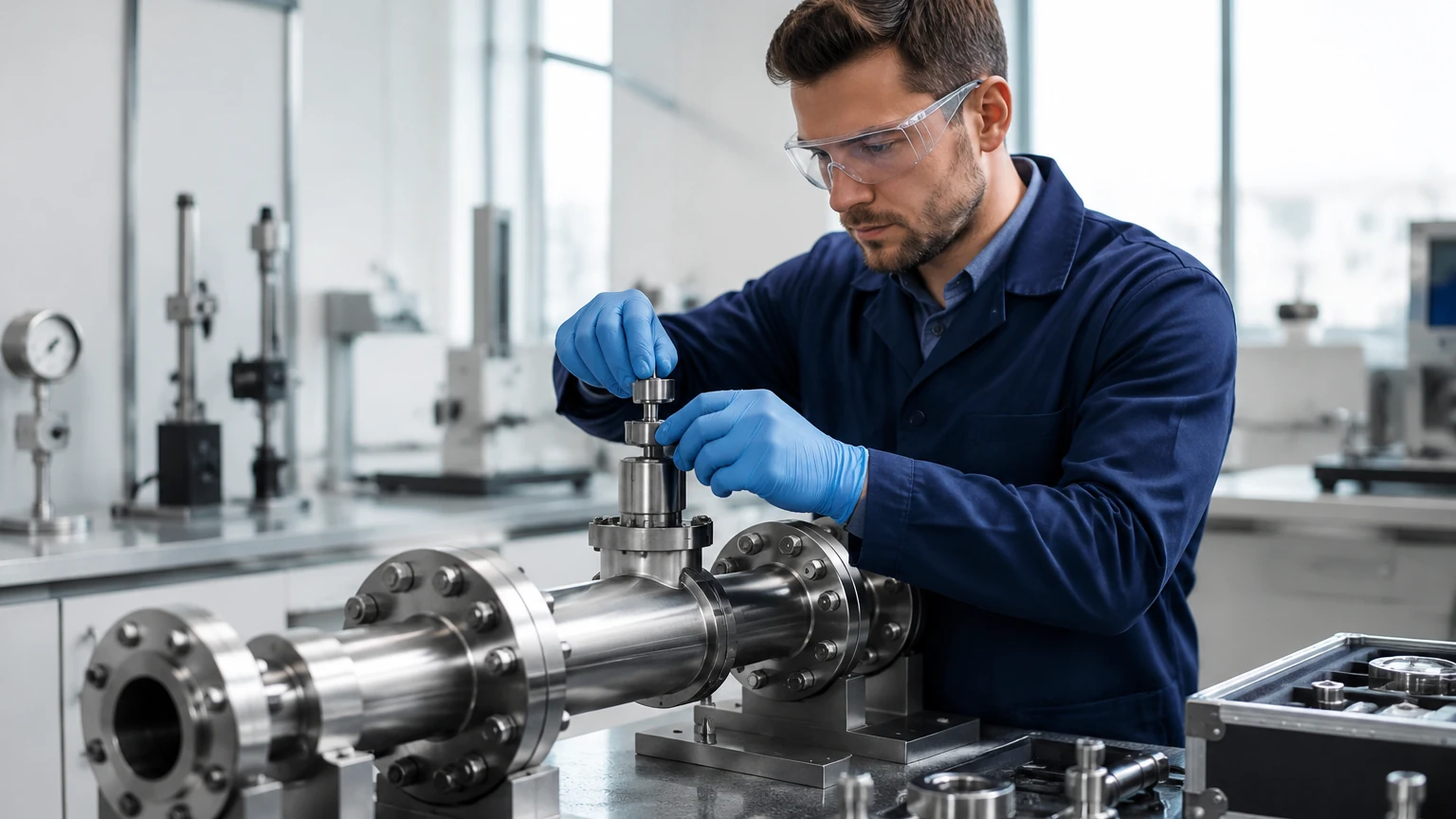
Selection Table: Calibration Lab Evaluation Matrix
Use the following table to compare potential calibration providers during your selection process.
| Criteria | Requirement | Importance | Lab A | Lab B |
| :— | :— | :— | :— | :— |
| Accreditation | ISO/IEC 17025 | Mandatory | | |
| Uncertainty (CMC) | 4x better than UUT | High | | |
| Fluid Media | Water, Oil, or Gas | High | | |
| Max Flow Rate | > Max Process Flow | High | | |
| Pipe Diameter | Match UUT Size | Medium | | |
| Traceability | NIST/PTB/National | Mandatory | | |
| Turnaround | < 10 Business Days | Medium | | |
Installation and Maintenance Considerations
Once a flow meter returns from a calibration lab, its re-installation is as critical as the calibration itself. Ensure that gaskets do not protrude into the flow stream and that the meter is oriented correctly according to the manufacturer's specifications.
For level-based flow measurement (such as in flumes), the positioning of the level sensor is paramount. An ultrasonic sensor must be mounted perpendicular to the liquid surface and at the correct distance specified by the weir or flume design. Regular maintenance of these sensors, including cleaning the transducer face and checking for firmware updates, ensures that the calibrated accuracy is maintained throughout the instrument's lifecycle.
Frequently Asked Questions (FAQs)
Q: How often should I calibrate my flow meters?
A: The frequency depends on the criticality of the process, the stability of the instrument, and regulatory requirements. Most industrial facilities follow an annual calibration cycle, but high-precision applications may require semi-annual checks.
Q: Can I perform "in-situ" calibration instead of sending the meter to a lab?
A: In-situ calibration (using a portable master meter or clamp-on ultrasonic meter) is useful for verifying performance without removing the instrument. However, it typically has higher uncertainty than a controlled lab environment and may not meet certain regulatory standards.
Q: What is the difference between a "Calibration Report" and a "Certificate of Conformance"?
A: A Calibration Report provides the actual data points, measured values, and calculated uncertainty. A Certificate of Conformance simply states that the device meets the manufacturer's original specifications without providing the supporting data. For critical processes, always insist on a full Calibration Report.
Q: Does the lab need to be in the same country as my facility?
A: Not necessarily, provided the lab is accredited by a body that is a signatory to the ILAC MRA (International Laboratory Accreditation Cooperation Mutual Recognition Arrangement). This ensures that the accreditation is recognized globally.
Conclusion
Choosing a calibration lab for flow meters is a strategic decision that impacts the long-term reliability of your process data. By prioritizing ISO/IEC 17025 accreditation, verifying fluid and range compatibility, and understanding the uncertainty requirements of your specific application, you can ensure that your instrumentation provides the accuracy needed for optimized operations. For those managing complex systems where level and flow intersect, partnering with experienced manufacturers for your hardware needs is the first step toward a robust measurement strategy. For more information on high-precision level and flow solutions, you can review product options and application support on our Main Page.
Download Choosing a Calibration Lab for Flow Meters as a PDF