Cip Optimization
Cip Optimization
In the modern industrial landscape, particularly within the food and beverage, pharmaceutical, and chemical sectors, Clean-In-Place (CIP) systems are the backbone of hygiene and operational efficiency. Cip optimization is no longer merely a goal for sustainability; it is a technical necessity to reduce operational costs, minimize downtime, and ensure the highest standards of product safety. At the heart of any optimized CIP process lies precise instrumentation, specifically level measurement, which dictates the management of water, detergents, and recovery cycles.
Optimizing these systems requires a deep understanding of how fluid dynamics, chemical concentrations, and temperature interact within a closed-loop system. By integrating advanced level sensing technology, engineers can achieve a granular level of control that prevents the wastage of expensive cleaning agents and reduces the environmental footprint of the facility.
The Role of Level Measurement in CIP Optimization
CIP systems typically consist of several tanks containing fresh water, recovered rinse water, caustic soda, and acid. The efficiency of the entire cleaning cycle depends on the accurate monitoring of these vessels. If a level sensor fails to provide real-time, accurate data, the system may suffer from pump cavitation due to low levels or environmental hazards caused by overfills.
Beyond simple volume tracking, cip optimization involves the precise timing of transitions between cleaning phases. For instance, knowing the exact moment a tank is empty allows for the immediate initiation of the next rinse cycle, shaving seconds or minutes off each phase. Over hundreds of cycles per year, these increments translate into significant savings in water and energy. Furthermore, accurate level monitoring in chemical dosing tanks ensures that the concentration of cleaning agents remains within the specified range, preventing both inadequate cleaning and excessive chemical use.
Measurement Principles for Hygienic Level Sensing
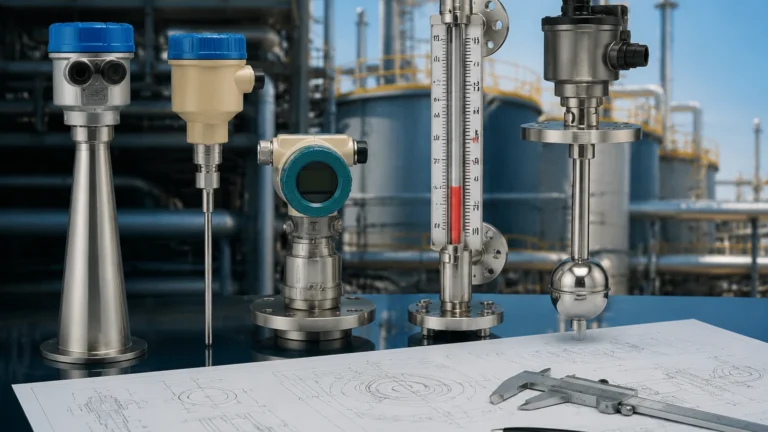
Before selecting instrumentation for CIP applications, it is essential to understand the physical principles that govern level measurement. In sanitary environments, the choice of technology is often dictated by the need for non-contact sensing or flush-mounted diaphragms that prevent bacterial growth.
Radar Level Measurement (ToF)
Radar level meters operate on the Time-of-Flight (ToF) principle. The sensor emits a high-frequency electromagnetic wave (typically in the 26 GHz or 80 GHz range). This wave travels through the air, reflects off the surface of the liquid, and returns to the sensor. The distance is calculated based on the time taken for the signal to travel. In CIP optimization, 80 GHz radar is often preferred because its narrow beam angle avoids internal tank obstructions like spray balls and agitators.
Ultrasonic Level Sensing
Similar to radar, ultrasonic sensors use ToF but rely on sound waves. A transducer emits an ultrasonic pulse that bounces off the liquid surface. While cost-effective, ultrasonic sensors can be sensitive to the heavy steam and temperature fluctuations common during hot caustic or hot water cycles in CIP processes. Therefore, they are best suited for ambient temperature storage tanks within the CIP skid.
Hydrostatic Level Pressure
Hydrostatic transmitters measure the pressure exerted by the liquid column (P = ρgh, where P is pressure, ρ is density, g is gravity, and h is height). In sanitary applications, these must feature flush-mounted diaphragms to eliminate "dead spaces" where media could collect and rot. They are highly reliable for vented tanks but require compensation if the tank is pressurized.
Point Level Detection
Level switches, such as tuning forks or capacitive probes, provide discrete signals at specific heights. These are critical for high-level alarms (overfill protection) and low-level pump protection. In an optimized CIP system, these switches act as a redundant safety layer alongside continuous level transmitters.
Technical Selection Criteria for CIP Tank Monitoring
Selecting the right instrument requires balancing technical performance with the harsh realities of the cleaning process. The following table provides a comparison of common technologies used in cip optimization.
| Technology | Accuracy | Suitability for Steam | Chemical Resistance | Maintenance Needs |
| :— | :— | :— | :— | :— |
| 80 GHz Radar | ±1 mm | Excellent | High (PTFE/PFA) | Very Low |
| Hydrostatic | ±0.1% Span | Moderate | High (Stainless/Hastelloy) | Moderate |
| Ultrasonic | ±0.25% Range | Low | Moderate | Low |
| Guided Wave Radar | ±2 mm | Excellent | High | Moderate (Probe cleaning) |
| Capacitance Switch | N/A (Point) | Good | High | Low |
When evaluating these options, engineers must consider the "Sinner’s Circle"—the four factors of cleaning: Time, Temperature, Chemical Action, and Mechanical Action. Level instrumentation directly influences the "Mechanical Action" by ensuring that pumps have sufficient head pressure to feed spray balls at the required velocity.
Installation Guidelines for Sanitary Level Instruments
For cip optimization to be successful, the physical installation of the sensor must adhere to hygienic design principles, such as those outlined by EHEDG or 3-A standards. A poorly installed sensor can become a site for biofilm accumulation, defeating the purpose of the CIP system.
1. Nozzle Length: For radar sensors, the nozzle should be as short as possible to prevent signal interference. If a long nozzle is unavoidable, a sensor with a higher frequency (80 GHz) should be used to ensure the beam clears the nozzle edge.
2. Surface Finish: All wetted parts should have a surface roughness (Ra) of less than 0.8 μm. This prevents chemicals and organic matter from adhering to the sensor face.
3. Orientation: Sensors should be mounted away from the tank inlet to avoid measuring the turbulent flow of incoming liquid. If an agitator is present, the sensor must be positioned to avoid the blades.
4. Drainability: The mounting position must allow for complete drainage. Any pocket where liquid can sit after a cycle is a potential contamination risk.

Addressing Limitations: Foam, Steam, and Chemical Resistance
CIP processes are notoriously difficult environments for sensors. Optimization efforts often stall when instrumentation fails to handle the following challenges:
* Heavy Foam: Caustic cleaning cycles often generate foam. Standard ultrasonic sensors may lose their signal in these conditions. Radar sensors, particularly those using advanced signal processing algorithms, can usually "see through" light foam to the liquid surface. For extremely thick foam, hydrostatic pressure sensors are the most reliable option as they measure the mass of the liquid, ignoring the foam layer.
* Steam and Condensation: Hot rinse cycles (up to 90°C) create steam. Condensation can form on the sensor face, causing "ringing" or signal loss in ultrasonic devices. Modern radar sensors utilize PTFE-encapsulated antennas that shed droplets, ensuring continuous measurement even during steam-out procedures.
* Chemical Aggression: CIP involves strong bases (NaOH) and acids (HNO3). All wetted materials must be compatible. 316L stainless steel is the standard, but for highly concentrated acids, Hastelloy C or full PTFE coatings may be required.
Maintenance and Calibration for Long-Term Performance
To maintain the gains achieved through cip optimization, a rigorous maintenance schedule is required. While non-contact radar requires very little upkeep, hydrostatic sensors should be checked periodically for diaphragm fatigue or scaling. Scaling—the buildup of mineral deposits—can affect the accuracy of pressure-based measurements.
Calibration should be performed at least annually using a reference standard. In many pharmaceutical applications, this calibration must be traceable to national standards to meet regulatory compliance. If a sensor drifts, the entire CIP logic may become inefficient, leading to the use of more water than necessary or failing to meet the required "hold times" for disinfection.
FAQ: Optimizing CIP Through Better Instrumentation
Q: How does 80 GHz radar improve CIP efficiency over older 26 GHz models?
A: The 80 GHz frequency allows for a much smaller antenna and a narrower beam. This means the sensor can be installed in smaller tanks and can more easily avoid reflecting off internal pipes, agitators, or spray balls, providing a cleaner signal and more reliable data for the control system.
Q: Can I use one type of sensor for all tanks in a CIP skid?
A: While standardization is good for spare parts management, it is not always optimal. A radar sensor is excellent for the main process tanks, but a simple hydrostatic transmitter might be more cost-effective for the large, vented water recovery tanks where steam is not an issue.
Q: How do I handle level measurement in tanks that are vacuum-rated?
A: Vacuum conditions can affect the boiling point of liquids and the performance of certain seals. For these applications, a high-quality hydrostatic pressure transmitter with a specialized vacuum-resistant diaphragm or a non-contact radar sensor is recommended.
Q: What is the impact of temperature on level accuracy?
A: Temperature changes affect the density of the liquid. If you are using hydrostatic pressure sensors, the PLC must compensate for density changes to maintain accuracy. Radar and ultrasonic sensors are generally unaffected by density but can be influenced by changes in the gas phase composition above the liquid.
Conclusion
Cip optimization is a multifaceted challenge that requires a synergy between process engineering and advanced instrumentation. By selecting the correct level measurement technology—whether it be high-frequency radar, hygienic hydrostatic transmitters, or robust level switches—manufacturers can significantly reduce waste and improve throughput.
For those looking to upgrade their existing systems or design new skids, it is vital to consult with experts who understand the nuances of sanitary measurement. To explore a wide range of industrial measurement solutions and technical support, visit the Main Page of Welk, a professional manufacturer of industrial level measurement instruments. Through precise control and reliable data, true optimization becomes an achievable standard rather than a moving target.