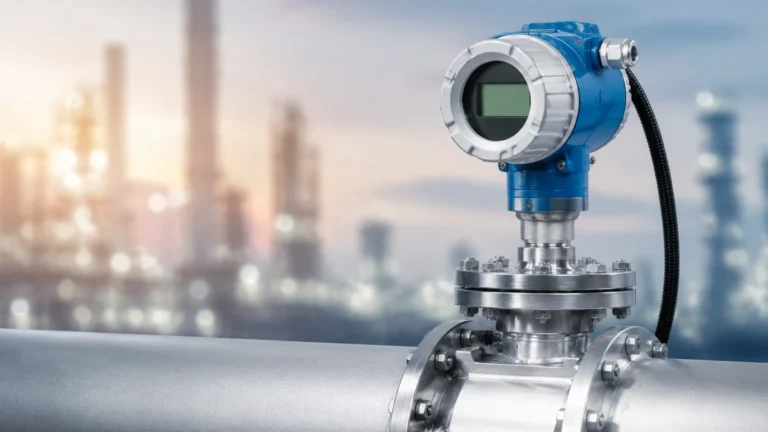
Cryogenic Flow Meter
Cryogenic Flow Meter
Cryogenic flow measurement represents one of the most demanding challenges in industrial process control. Cryogenic fluids, typically defined as liquids at temperatures below -150°C (-238°F), include liquefied natural gas (LNG), liquid nitrogen (LIN), liquid oxygen (LOX), liquid argon (LAR), and liquid hydrogen (LH2). Measuring the flow of these substances requires specialized instrumentation capable of maintaining accuracy while subjected to extreme thermal gradients, potential phase changes, and the unique physical properties of super-cooled fluids.
In B2B industrial environments, from air separation plants to LNG bunkering stations, selecting the correct cryogenic flow meter is critical for safety, efficiency, and custody transfer accuracy. This guide provides a technical overview of the measurement principles, selection criteria, and installation requirements for cryogenic flow meters.
Measurement Principles for Cryogenic Fluids
Before selecting a meter, it is essential to understand the physical principles used to derive flow rates in cryogenic conditions. Each technology interacts differently with the fluid’s density, viscosity, and temperature.
Coriolis Mass Flow Meters
Coriolis meters are widely regarded as the gold standard for cryogenic applications, particularly for custody transfer. The principle relies on the Coriolis effect: as fluid moves through an oscillating tube, it induces a phase shift in the vibration. This shift is directly proportional to the mass flow rate.
In cryogenic service, Coriolis meters are valued because they measure mass directly, independent of changes in fluid density or temperature. This is crucial for fluids like LNG, where the composition and density can fluctuate. Modern Coriolis meters for cryogenics are designed with specialized alloys to prevent brittle fracture at temperatures as low as -200°C.
Turbine Flow Meters
Turbine meters utilize a rotor mounted on bearings within the flow stream. As the cryogenic liquid passes through, it causes the rotor to spin at a speed proportional to the fluid's velocity. A pickup coil outside the pressure boundary detects the rotation of the rotor blades.
For cryogenics, the primary challenge is bearing design. Traditional lubricants freeze instantly, so cryogenic turbine meters use self-lubricating ball bearings or sleeve bearings made from materials like PTFE or specialized ceramics. While highly accurate in single-phase liquid flow, they are susceptible to damage if "overspeeding" occurs due to gas slugs or flashing.
Differential Pressure (DP) Meters
Differential pressure measurement, often using orifice plates or Venturi tubes, is a time-tested method. It relies on Bernoulli’s principle, where a constriction in the pipe creates a pressure drop. The square root of this pressure drop is proportional to the flow rate.
In cryogenic applications, the DP transmitter itself is usually located at a distance from the pipe, connected by impulse lines. These lines allow the liquid to vaporize and reach ambient temperature before hitting the sensor. This protects the electronics but requires careful design to prevent "gas pockets" from causing measurement errors.
Ultrasonic Flow Meters (Transit-Time)
Ultrasonic meters use acoustic transducers to send sound pulses across the flow. The difference in time between pulses traveling with the flow and those traveling against it is used to calculate velocity. For cryogenics, non-intrusive (clamp-on) or wetted-transducer designs are used.
The challenge here is the change in the speed of sound within the cryogenic liquid as temperature varies. Advanced signal processing is required to compensate for these changes. However, the lack of moving parts makes them attractive for low-maintenance applications.
Key Evaluation Criteria for Selection
When evaluating a cryogenic flow meter for a specific project, engineers must look beyond the basic flow range. The following factors are decisive in ensuring long-term reliability:
1. Material Compatibility: Standard carbon steel becomes brittle and can fail catastrophically at cryogenic temperatures. Most cryogenic meters utilize 316/316L stainless steel, Hastelloy, or Monel. All seals and gaskets must be made of cryogenic-grade materials like Kel-F or reinforced PTFE.
2. Accuracy and Repeatability: For custody transfer (buying and selling of gas), high accuracy (typically ±0.1% to ±0.5%) is required. For process control, ±1.0% may be sufficient.
3. Turndown Ratio: This refers to the range over which the meter can measure accurately. Cryogenic processes often have high variability during startup and cooldown, requiring a meter that can handle both low and high flow rates.
4. Pressure Drop: High pressure drops can cause cryogenic liquids to "flash" (boil into gas), which disrupts measurement and can damage equipment. Venturi tubes and Coriolis meters generally offer lower pressure drops compared to orifice plates.
Technical Comparison Table
| Technology | Typical Accuracy | Primary Advantage | Main Limitation |
| :— | :— | :— | :— |
| Coriolis | ±0.1% to ±0.2% | Direct mass measurement | High initial cost; size limits |
| Turbine | ±0.25% to ±0.5% | Excellent repeatability | Moving parts; bearing wear |
| Differential Pressure | ±1.0% to ±2.0% | Simple, well-understood | Limited turndown; high pressure drop |
| Ultrasonic | ±0.5% to ±1.0% | No moving parts; low maintenance | Sensitive to bubbles/two-phase flow |
| Vortex | ±1.0% | Robust; no moving parts | Requires high Reynolds number |
Common Risks and Mitigation in Cryogenic Flow
Operating at -160°C or lower introduces risks that are not present in standard industrial flow measurement. Understanding these is vital for project safety.
Two-Phase Flow and Flashing
Cryogenic liquids are often stored near their boiling point. Any heat gain or pressure drop can cause the liquid to partially vaporize, creating a two-phase (liquid and gas) mixture. Most flow meters are calibrated for single-phase flow. If gas bubbles enter a turbine meter, the rotor may spin at excessive speeds, leading to mechanical failure. In Coriolis meters, two-phase flow can dampen the tube vibration, leading to a "stalling" of the measurement. Proper system sub-cooling and back-pressure maintenance are necessary to prevent this.
Thermal Shock
When a room-temperature meter is suddenly exposed to cryogenic fluid, the rapid contraction of materials can cause stress fractures or seal failures. Systems must be "pre-cooled" slowly using gas before liquid flow is introduced. The meter's design must account for these thermal expansion and contraction cycles.
Icing and Moisture
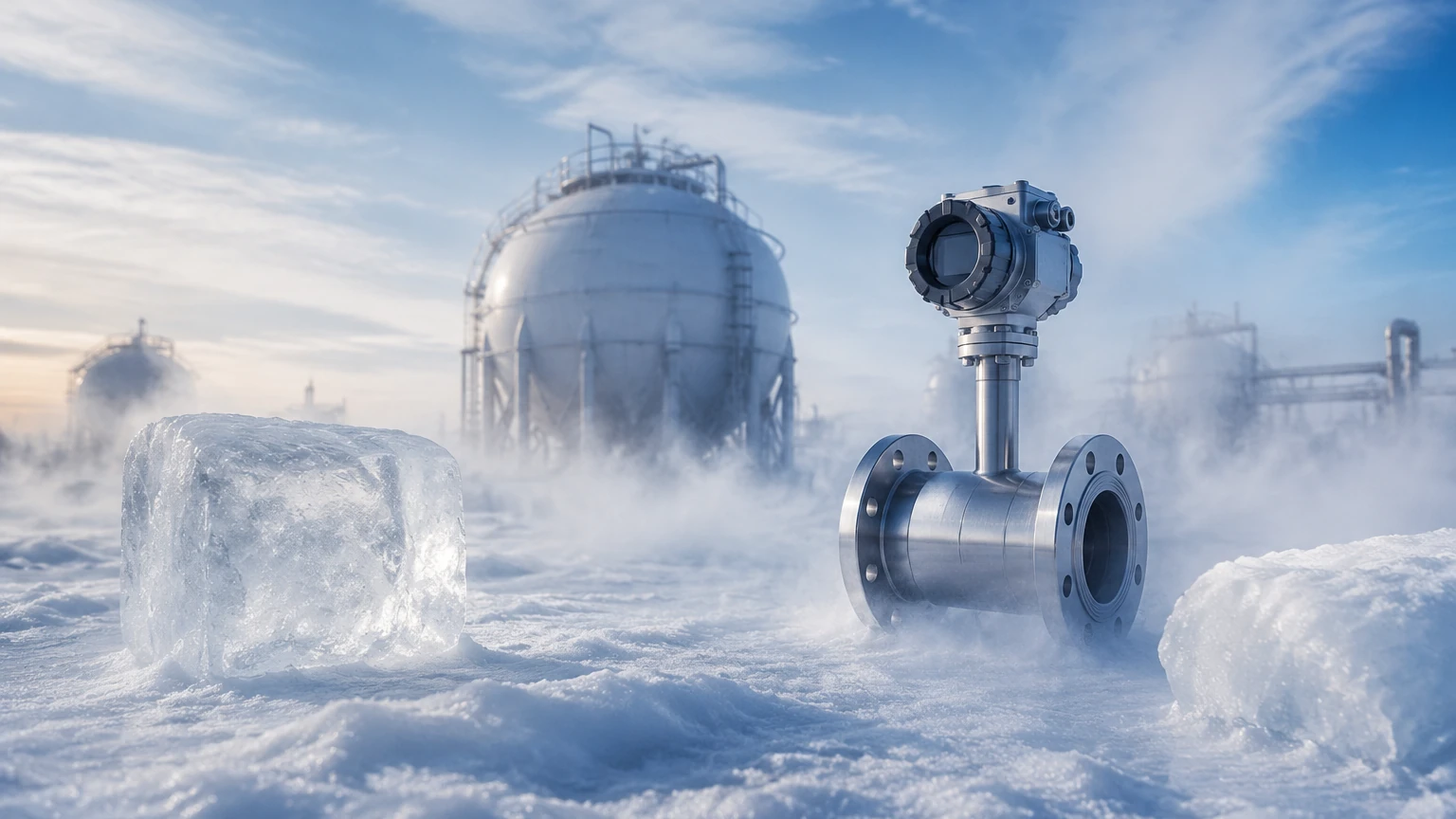
Any moisture in the air will immediately freeze upon contact with uninsulated cryogenic components. Ice buildup can seize moving parts or obscure sensors. Cryogenic flow meters often require vacuum-jacketed insulation or specialized "cold boxes" to keep the measurement section isolated from ambient humidity.
Installation Considerations
Proper installation is as important as the meter technology itself. Engineers should follow these best practices:
* Straight Run Requirements: Most velocity-based meters (Turbine, DP, Ultrasonic) require a specific length of straight pipe upstream (typically 10-20 diameters) and downstream (5 diameters) to ensure a stable flow profile.
* Orientation: For cryogenic liquids, horizontal installation is often preferred to prevent gas pockets from being trapped in the meter body. If installed vertically, the flow should generally be upward.
* Insulation: Use vacuum-jacketed piping or high-quality foam glass insulation. Inadequate insulation leads to boil-off gas (BOG), which introduces measurement errors.
* Grounding and Electronics: Cryogenic meters used in LNG or LH2 applications must be certified for hazardous areas (ATEX/IECEx). Electronics should be mounted remotely or protected by thermal stand-offs to prevent the cold from damaging the circuit boards.
Maintenance and Calibration
Cryogenic meters cannot be easily calibrated using water at ambient temperatures, as the physical properties differ significantly. Calibration should ideally be performed using the actual cryogenic fluid or through a transfer standard at a specialized cryogenic flow lab. Regular inspection of bearings (for turbine meters) and checking for zero-drift (for Coriolis meters) are essential maintenance tasks.
For engineers and procurement professionals looking to integrate these technologies into their systems, it is helpful to consult with manufacturers who specialize in the full spectrum of level and flow instrumentation. You can Review product options and application support at the Welk Main Page to find solutions tailored to specific industrial automation needs.
Frequently Asked Questions (FAQ)
Q: Why is mass flow preferred over volumetric flow for cryogenics?
A: Cryogenic liquids are highly compressible compared to water, and their density changes significantly with small temperature fluctuations. Mass flow provides a more consistent measurement of the actual energy content or quantity of the substance, which is essential for billing.
Q: Can I use a standard stainless steel flow meter for liquid nitrogen?
A: No. While 316 stainless steel is common, the meter must be specifically rated for cryogenic service. This includes specialized cleaning (to remove oils that could react with oxygen), cryogenic-grade seals, and testing for thermal contraction.
Q: What is the impact of boil-off gas on measurement?
A: Boil-off gas (BOG) creates a two-phase flow. This usually results in a significant over-reading in volumetric meters and a loss of signal or "slug flow" errors in mass meters. Maintaining sufficient head pressure is the best way to minimize BOG at the meter.
Q: How often should a cryogenic flow meter be calibrated?
A: For custody transfer, annual calibration is standard. For process monitoring, the interval may be extended to 2-3 years, depending on the stability of the technology and the criticality of the process.
By understanding the physics of cryogenic fluids and the limitations of various sensor technologies, engineering teams can implement flow measurement solutions that are both accurate and durable in the harshest industrial environments.